Whiskey
It’s in the Vedas!

My parents were incoherent by 9:30 PM. Every single night.
This wasn’t a character flaw. This was protocol. Delhi in the 1970s operated on a strict schedule: cocktails at 7, slightly drunk by 8, quite drunk by 9, approaching comatose by 10, and then—only then—dinner would be served.
Seven nights a week. Minimum.
Billy Joel understood: “The businessman slowly gets stoned.” Well, in Delhi, it wasn’t slow. It was scheduled, systematic, and somehow essential to building my mother’s law practice and my father’s business. Though I cannot independently confirm this. I was too busy being a child whose parents were out six or seven nights a week, or hosting their own parties where everyone followed the same pattern.
The drink of choice? Whiskey. Always whiskey. Specifically, Scotch. Because India—in its magnificently contradictory way—is simultaneously the world’s largest consumer of Scotch whiskey and a country where multiple states have banned alcohol entirely.
Welcome to India’s alcohol paradox, where everything is illegal, legal, sacred, profane, in the Vedas, and in the black market—all at the same time.
The Numbers That Make No Sense (But Do)
Let’s start with the absurdity: India consumes 192 million bottles of Scotch annually, more than France (177 million) or America (132 million). We are the world’s Scotch champions.
But here’s where it gets Indian: Scotch represents only 2% of India’s total whiskey consumption. The other 98%—roughly 9.8 billion bottles—is domestic Indian whiskey. Do the math: India drinks approximately 1.5 billion liters of whiskey per year, which is 50% of all whiskey consumed globally. We drink three times more whiskey than the United States.
Yet by value, we rank only 5th globally in Scotch spending. Why? Because we’re buying cheaper blended Scotch, not premium single malts. We love whiskey, but we’re price-conscious about it. Very Indian: world-dominating market share, but let’s not be extravagant.
And then there’s this delicious contradiction: India ranks 103rd globally in per capita alcohol consumption. Only 10% of Indian adultsdrink alcohol at all. Among males: 18.8%. Among females: 1.3%.
So how can we be both the world’s largest whiskey market and ranked 103rd per capita? Simple: those who do drink consume an average of 28.7 liters of pure alcohol per person per year—the highest in the WHO South East Asia region. More than Australians. More than Germans. More than Americans.
India has 1.4 billion people. Most don’t drink. Those who do drink heroically. The result: massive total consumption, low per capita average, and a public health crisis among actual drinkers. Also: my parents, incoherent by 9:30 PM, building professional networks.
Indian Made Foreign Liquor: The Most Indian Thing Ever
But wait. Before we go further, we need to address the elephant in the room. Or rather, the molasses in the bottle.
68% of India’s alcohol market—worth $60 billion—is something called “IMFL”: Indian Made Foreign Liquor.
Let that phrase marinate for a moment. Indian Made Foreign Liquor. It’s Indian. But it’s foreign. Made here, but styled after there. Local production, aspirational branding.
Only in India could we invent a category this gloriously contradictory.
Here’s the reality: real whiskey—Scotch, bourbon, Irish—is made from grain (barley, corn, rye, wheat). Indian “whiskey” is made from molasses, a sugarcane byproduct. It’s distilled to 96% ABV neutral spirit, reduced to 42.8% with demineralized water, then flavored with caramel and sometimes tiny amounts of actual imported Scotch for taste.
The European Union refuses to recognize it as whiskey. The Scotch Whisky Association calls Indian labeling laws “pure protectionism.” Indian distillers call EU rules “British imperialism” and “colonialism continuing by other means.”
Everyone’s right. That’s the beauty of it.
Why molasses? Because it’s dramatically cheaper than grain, sweeter to the Indian palate (we love sweet things), and India produces massive amounts of sugarcane. Plus, import duties on real Scotch were 150% until recently, making IMFL hyper-competitive on price.
The result? McDowell’s No.1—a molasses-based Indian whiskey nobody outside India has heard of—is the world’s bestselling whiskey brand. 32.2 million cases annually. It outsells Johnnie Walker. It outsells Jack Daniel’s. It outsells everything. A spirit the EU won’t even call “whiskey” is the planet’s #1 whiskey.
The top five Indian whiskey brands—McDowell’s, Royal Stag, Officer’s Choice, Imperial Blue, and 8PM—sell more combined than all of Scotland’s distilleries put together. These bottles cost Rs 1,100 ($13) for 750ml. They have Scottish-sounding names. They’re decorated with tartan patterns and bagpipe imagery. Peter Scot. Bagpiper. Royal Challenge.
None of them have ever been to Scotland. Most aren’t made from grain. But they’re “foreign liquor”—foreign in aspiration, Indian in production, and somehow, magnificently, the world’s dominant whiskey category.
At my parents’ parties in the ‘70s, the hierarchy was clear: start the evening with real Scotch (if you could afford it or had embassy connections). As the night wore on and taste buds surrendered, switch to IMFL. By 10 PM, nobody could tell the difference anyway. The bottles looked Scottish enough. That was sufficient.
The polite complaint about bad whiskey: “I think your bootlegger cheated you.” The impolite complaint: “What is this crap? Indian?”
But here’s the twist: India is now producing actual grain-based single malts that are winning international awards. Amrut, Paul John, Rampur, Indri. In 2024, Indian single malts outsold Scotch single malts in India for the first time. Indri’s Diwali Collector’s Edition was named “Best Whisky in the World” in 2023.
Why? India’s tropical climate accelerates aging: 1 year in Bangalore = 3 years in Scotland. The “angel’s share” (evaporation) is 10-15% annually versus Scotland’s 1-2%, concentrating flavors faster. These whiskies are legitimately good.
So India simultaneously produces: - The world’s bestselling “whiskey” that isn’t legally whiskey - Award-winning whiskey that beats Scottish whiskey - The most Scotch consumption while drinking mostly non-Scotch - Premium Indian single malts and molasses-based mass-market spirits
Both things are true. That’s India.
The Morarji Desai Interlude: Piss-Drinking Prohibition
You cannot understand Indian alcohol culture without understanding Morarji Desai, Prime Minister from 1977-1979, who managed to be both a prohibitionist and an international laughingstock.
Desai believed fervently in prohibition. He also believed fervently in drinking his own urine for health reasons—”5 to 8 ounces every morning,” as he cheerfully explained to Dan Rather on 60 Minutes in 1978. Barbara Walters was so repulsed that ABC initially refused to air her interview with him. The joke about President Jimmy Carter’s 1979 visit wrote itself: the peanut farmer had come to visit the “pee-nut.”
This was India’s moral authority on alcohol.
Under Desai and the general socialist-moralist climate of the 1970s, various states banned alcohol. The Constitution’s Article 47 had made prohibition a national goal (thanks, Gandhi), though it wasn’t enforceable. But moralists like Desai took it seriously.
The problem? Indians love alcohol. We’ve loved it for millennia. The Rig Veda dedicates an entire book—114 hymns—to Soma, an intoxicating ritual drink: “We have drunk soma, become immortal, attained the light, reached the gods.” The Mahabharata and Ramayana feature constant drinking. Ancient India had multiple fermented beverages: Sura (for warriors), Kilala (beer-like), Masara (rice beer).
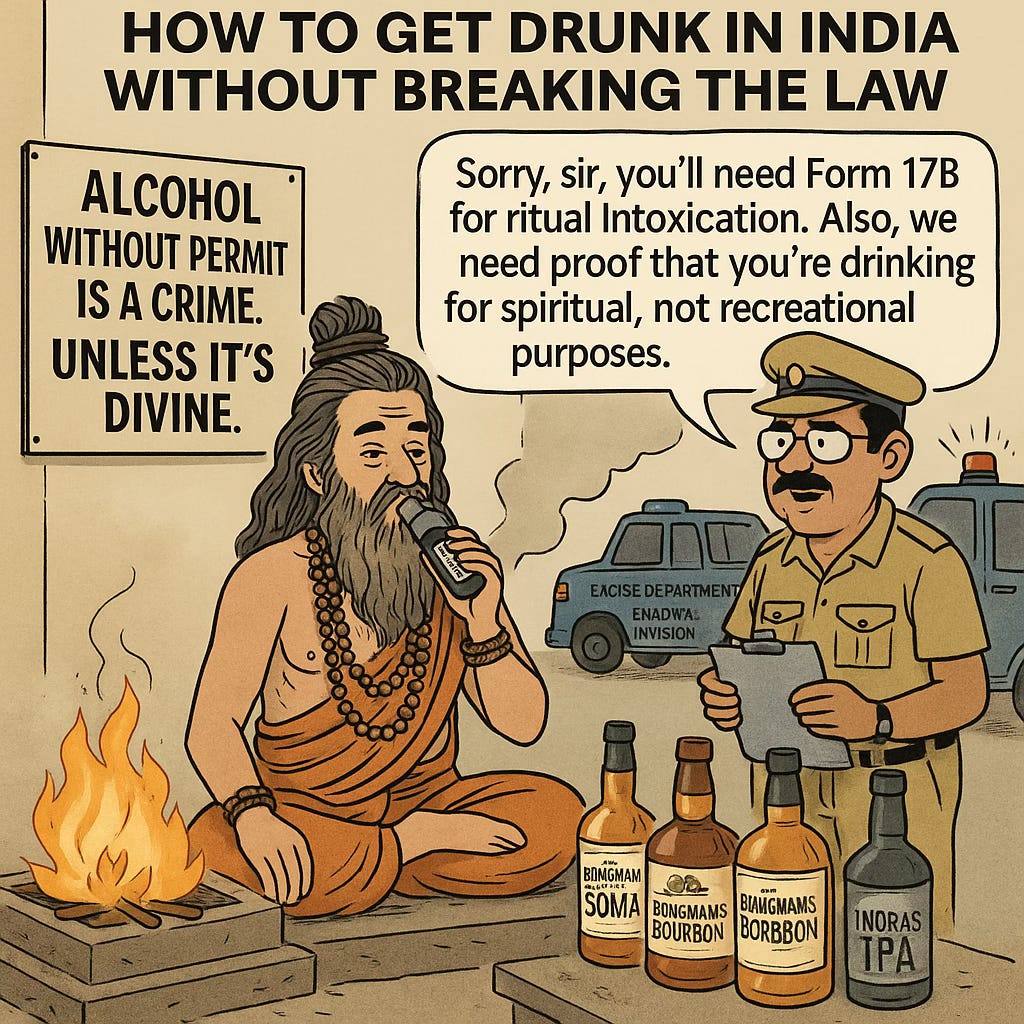
So when prohibition came to various Indian states, a magnificent workaround emerged: medical certificates for “Sura.”
Since Sura was in the Vedas—and Vedic texts were sacrosanct—it couldn’t be banned. If you had a medical certificate saying you needed Sura for health reasons, you could legally obtain alcohol. Doctors issued these certificates right, left, and center. Everyone who wanted to drink got one. The system worked perfectly: prohibition was maintained for moral appearances, drinking continued as always, doctors made money, and everyone could claim they were following both the law and ancient Hindu scripture.
Only in India.
Delhi’s Seven-Night-a-Week Professional Development Program
Back to my childhood: my parents were out constantly. So was everyone else in their social circle. Cocktail parties were how business got done, how legal clients were cultivated, how connections were maintained.
The hierarchy was strict. Red Label was the minimum. If you served less, you were insulting your guests. Step up: Dewar’s, Haig. Real snobbery: single malts (though these were rare in the ‘70s).
The evening’s progression was equally systematic: parties started with pure Scotch (or what was claimed to be Scotch). By evening’s end, it was purely Indian whiskey (IMFL, molasses-based, but nobody’s admitting that). In between, something in between—bottles were diluted, mixed, adulterated. Nobody noticed. By 9 PM, taste buds had surrendered.
Bootlegging in the ‘70s was a refined art. Since imports were restricted and duties were prohibitive, bootleggers would: - Fill empty Scotch bottles with Indian whiskey or adulterants - Sell “embassy Scotch” (bottles supposedly from embassy sales, often fake) - Create an entire parallel economy of questionable provenance
The polite complaint about bad whiskey: “I think your bootlegger cheated you.” The impolite complaint: “What is this crap? Indian?”
And the ultimate irony: all this while people discussed socialism at snotty clubs, government members proclaimed the evils of alcohol (while drinking), and my parents—along with everyone else—built careers through systematic nightly inebriation.
Dinner was never before 10-11 PM. You needed time to tank up. Everyone had 5-6 drinks per evening, minimum. This was not considered excessive. This was networking.
I cannot independently confirm this helped my mother’s law practice or my father’s business. But they were out six or seven nights a week, or hosting parties. And everyone was incoherent by 9:30. So presumably something was working.
The State-by-State Madness: 28 Countries, One Currency
Here’s where India truly shines in contradiction: we’re one country, with one currency, with constitutional guarantees of free interstate commerce. But alcohol? Alcohol operates as if India were 28 separate countries with hostile trade policies.
Take a bottle of whiskey. Any bottle. Start in Goa, where it costs Rs 100. Drive it to Karnataka—same bottle, now Rs 513. You’ve just watched your whiskey appreciate 413% by crossing an invisible line on a map. The bottle didn’t change. The whiskey didn’t improve. You just crossed a state border in a unified federal democracy, and suddenly you’re holding a luxury good.
This isn’t a bug. This is the system. State excise taxes range from 49% in Goa to 83% in Karnataka. Each state treats alcohol like a sovereign nation treats imports—which is how you know you’re in a functioning democracy. The same constitutional document that guarantees free movement of goods somehow doesn’t apply to the one category that generates 15-25% of state revenues.
The result? India has the world’s most sophisticated domestic smuggling operation. Trucks with duplicate permits. Extended-time permits that turn a 147km journey into an 8-hour window for multiple trips. Bribed excise officers at distilleries. In September 2022, smugglers attacked an IAS officer who tried to intercept a convoy. The main accused got bail in two months.
Madhya Pradesh loses Rs 1,000 crore annually to Gujarat smuggling. Not international smuggling. Domestic smuggling. Between Indian states. In the world’s largest democracy.
And then there are the dry states: Gujarat (since 1960), Bihar (since 2016), Nagaland, Mizoram. Total prohibition. Except not really.
Gujarat: The Prohibition Comedy
Gujarat has been officially dry since 1960—Mahatma Gandhi’s home state must remain pure. Yet Gujarat has a Rs 30,000 crore illegal liquor market. Everyone knows this. The police know this. Politicians know this.
How does it work? Permits. If you’re a tourist, you can get a permit showing an out-of-state ID, travel tickets, and hotel certificate. Limit: 1 bottle per week. Reality: easily circumvented. If you’re upper-middle-class Gujarati, you probably have a “medical permit” for health reasons. Or your bootlegger delivers to your door. Or you drive to Daman (union territory, no prohibition) and stock up.
The crowning absurdity: in 2023, Gujarat permitted alcohol in GIFT City (Gujarat International Finance Tec-City) for the “global business ecosystem.” Economic interests trumped Gandhian values the moment serious money was involved.
Meanwhile, Deputy CM Nitin Patel’s son Jaimin was stopped at Ahmedabad Airport in 2017, boarding a flight to Greece in a “heavily drunken state,” unable to walk straight. His father’s response: “He returned home because he was not well.”
And Atal Bihari Vajpayee was once scolded by PM Morarji Desai for drinking at the Japanese embassy: “You went to the Japanese embassy and drank alcohol.” This from a man who drank his own urine on television.
Bihar: Where Prohibition Kills
Bihar banned alcohol in 2016. Chief Minister Nitish Kumar promised women voters he’d end alcohol-fueled domestic violence. Noble goal. Catastrophic execution.
Since then, 500+ people have died from spurious liquor. Let me be clear about what this means: these aren’t statistics. These are poor people who died because they couldn’t afford the bootlegger’s premium Scotch. These are laborers who drank industrial methanol because that’s what they could access. These are deaths that wouldn’t have happened if alcohol were legal and regulated.
The rich? They’re fine. Their bootleggers deliver premium brands to their doorsteps. Rs 1,200 for a bottle that costs Rs 500 in a legal state. Expensive, but nobody’s dying.
The poor? They’re drinking poison. Literally. Country liquor at Rs 20 per packet, cut with god-knows-what, and it kills them.
Bihar loses Rs 4,000-5,000 crore annually in revenue. The state has jailed over 14,000 people—entire families arrested if one member drinks, homeowners arrested if tenants drink, entire villages fined. Those caught face 10 years in prison.
For what? Bootlegging thrives. Smugglers use ambulances, school bags, camels, vegetable baskets, hollowed-out cooking gas cylinders. Neighboring states—West Bengal, Jharkhand—have seen their excise revenues jump 44% and 75% respectively, directly profiting from Bihar’s ban.
And in 2017, Bihar Police claimed that rats drank over 900,000 liters of seized alcohol stored in police stations. Nine lakh liters. Drunk by rats.
The obvious reality: corrupt officers sold it. But the excuse—blaming rodents for consuming enough liquor to fill an Olympic swimming pool—is so audacious it demands respect. This is what prohibition does: it turns law enforcement into comedy and poor people into corpses.
One man, Motu Lal, sold his property worth Rs 75 lakh to afford liquor after prohibition made it expensive. His mother lamented that financial stability disappeared after the ban. But at least Motu Lal could afford to be an alcoholic. The 500+ dead couldn’t.
Prohibition doesn’t stop drinking. It just decides who dies.
The British Left Us a Peg System
The “peg” system—standard Indian drink measurement—is British colonial legacy. A small (chota) peg is 30ml. A large (bara) peg is 60ml.
But the crown jewel: the Patiala Peg is 120ml—named after Maharaja Bhupinder Singh of Patiala. It equals the height between your index finger and pinky held parallel against a bottle. Still the standard across India and Pakistan. One Patiala Peg equals 3.5 British shots.
My parents’ generation drank Patiala Pegs. By 9:30 PM. Every night.
The British also left us clubs—social fortresses with the longest bars in Asia (Madras Club), strict hierarchies, and traditions of whiskey-drinking. Initially, these clubs excluded Indians. After independence, Indians took them over and maintained the same drinking traditions, just with different faces.
The Economic Reality Check
Here’s the Milton Friedman part: alcohol generates over Rs 90,000 crore annually for Indian states. Karnataka and UP each earn 300-400 billion rupees. Puducherry derives 34% of its tax revenue from alcohol. Most major states: 15-25%.
This massive revenue dependence explains why prohibition fails economically: - Bihar: Rs 40,000 crore lost over 7 years
- Gujarat: Rs 10,000-16,000 crore foregone annually - Andhra Pradesh (1995-97): Nearly bankrupted—deficit reached one-third of annual budget
States cannot afford prohibition. The lost revenue is staggering. Meanwhile, enforcement costs money, black markets flourish, people die from toxic hooch, and neighboring states profit from smuggling.
It’s economically insane. Which is why it persists—because politics, morality, and Gandhi’s legacy matter more than mere economics.
And yet: the UK-India trade deal of May 2025 just reduced Scotch tariffs from 150% to 75% immediately, dropping to 40% by Year 10. A Rs 5,000 bottle could fall to Rs 3,500-4,000 now. Now economics matters. When there’s money to be made from liberalization, suddenly prohibition takes a back seat.
The Verdict
India is a country where: - Ancient texts celebrate divine intoxicants, but modern nationalism promotes prohibition - The world’s largest whiskey consumer ranks 103rd per capita
- Only 10% of adults drink, but they drink more than almost anyone else on Earth - A molasses-based “whiskey” called “Indian Made Foreign Liquor” is the world’s bestselling whiskey brand - The European Union won’t call it whiskey, but 32 million cases sell annually - A bottle quintuples in price by crossing state lines in a unified democracy - Police claim rats drank 900,000 liters - Politicians arrive drunk at airports in dry states while poor people die from methanol - States ban alcohol while depending on it for 15-25% of revenue - Doctors prescribe alcohol for “health purposes” citing the Vedas - Prohibition kills 500+ people but the rich get bootlegger delivery service - Smugglers use camels and ambulances - My parents were incoherent by 9:30 PM for professional development
The British introduced a “condemnation of alcohol abuse in official discourse and a continuous refusal to impose prohibition.” India perfected this contradiction and elevated it to an art form.
Welcome to India’s $64 billion alcohol market in a country where it’s constitutionally discouraged. A global whiskey superpower where most whiskey isn’t legally “whiskey” by European standards. A land of prohibition where everything is available—if you can afford it. A culture of abstinence where the drinkers drink harder than anywhere else—and the poor die trying.
But here’s the thing Billy Joel really understood: “The businessman slowly gets stoned.”
Except in India, it’s the bureaucrat who slowly gets stoned. On smuggled Scotch that crossed three state lines and quintupled in price. Served in a Patiala peg measured by a Maharaja’s fingers. While discussing the five-year plan for implementing socialism. At a club that once excluded Indians but now excludes everyone who can’t afford the membership fee.
By 9:30 PM, the details of central planning become beautifully hazy. The contradictions between prohibition and revenue dependency resolve themselves. The question of why a bottle costs Rs 100 in Goa and Rs 513 in Karnataka stops mattering. By 10:30 PM, the fact that 500 Bihar villagers died from methanol while Deputy CMs’ sons get drunk at airports seems perfectly reasonable. By 11 PM, dinner is served, and somehow everything makes sense.
My parents built their careers this way. So did everyone else. Six, seven nights a week. Discussing the evils of capitalism while calculating compound interest. Condemning Western influence while drinking Johnny Walker. Praising prohibition while calling the bootlegger. Planning India’s sober, socialist future while slowly, systematically, getting stoned.
“It’s in the Vedas!” And in the black market. And in the state budget. And in the constitutional directive. And in the boot of your car crossing state lines. And in a category called “Indian Made Foreign Liquor” that perfectly captures our genius for having everything both ways. And in that club at 9:30 PM, where the bureaucrat slowly gets stoned while planning India’s alcohol-free tomorrow. And in the 500 corpses that prohibition created while the politician’s son boards a plane drunk. And somehow, impossibly, magnificently, absurdly—it all makes sense.
Served in a Patiala peg, with a medical prescription, smuggled by camel, discussed over dinner at 11 PM.
That’s the most Indian thing of all.
Next: From Hockey Hell to Cricket Heaven
[Previous posts: 1. The Paradox of India | 2. The Diaspora Paradox | 3. The Wedding Wars | 4. From Goddess Lakshmi to Ration Cards | 5. WhatsApp Uncles vs Wisdom Aunties | 6. From Lakshmi to Unicorns | 7. The Great Indian Cafeteria Wars | 8. The Mother Tongue Wars| 9. Gods In The Machine | 10. The Gender Paradox | 11. The Future of the Past | 12. Macaulay’s Children] | 13.1. Language (Part 1) | 13.2. Language (Part 2) | 14. Property]
If you enjoyed this exploration of India’s magnificent contradictions, you’ll appreciate my book, The Science of Free Will, which examines how understanding deterministic physics helps us see past comforting illusions to reality—much like understanding India requires accepting that everything contradictory can be simultaneously true. Available at https://amzn.to/4aMQJD1.
I love this article and in general the fascinating insights into Indian culture. I can’t help being pedantic though - Whiskey is never Scotch. Whisky with an e is the Irish stuff - Scotch is Whisky
Beautifully written! As I have always lived between these statements from my close friends - “I told you so” and colleagues “drink freely as long as we don’t show”