The Wedding Wars
How Indian Marriages Negotiate 5,000 Years of Tradition in One Weekend

This is the third in a series exploring India's unique approach to human diversity. We've examined how India manages its kaleidoscope of cultures and how this travels (or doesn't) with the diaspora. Now we dive into the ultimate arena where tradition and modernity collide: the Big Fat Indian Wedding.
When I told my mother I was marrying my girlfriend, an Italian Jew, she called all my friends in the US asking them to break us up.
When that failed, she faxed my future father-in-law threatening to disinherit me and never speak to me again. When that failed, she tried to get my PhD advisor to "tell us to break up." (Luckily, he was relaxed enough to laugh about it with me, though it was embarrassing and deeply unpleasant.) Then she invited my girlfriend to India to "meet the family," where my girlfriend paid a significant fraction of her yearly income as a starting engineer to fly over.
The pièce de résistance? My mother threw a party to "introduce her to everyone" — and spent the entire time complaining about her to all the guests. About 100 of those guests came to talk to me afterward, apologizing profusely, saying Indians aren't like this and I should explain so she doesn't think all Indians are nuts.
At my wedding, I had exactly zero relatives present. We didn't speak for three years.
Now here's the part that makes this story worth telling: My mother was about as non-traditional an Indian wife as you could find in 1964. She'd qualified as a barrister in the UK and returned to practice law in India when it was essentially unheard of for women to become lawyers. Like her own mother before her — who was among the first Indian women with an MA degree and the first female president of the Lahore Student Union — she came from a line of women who shattered barriers. Every single person in my family was, in Indian terms anyway, "entirely cosmopolitan" and "English speaking" — yes, English, really, that is my entire family's native tongue.
But here's where it gets truly absurd: my family was itself a monument to intercommunity marriage and barrier-breaking. My maternal grandparents? A Kashmiri Pandit married to a Punjabi landowner. My father's family? UP landowners — entirely different region, different culture. And while my maternal grandmother was an Indian freedom fighter (in fact, a pretty famous one), my maternal grandfather worked for the British Empire — simultaneously! My paternal great-grandfather received a CIE (Companion of the Order of the Indian Empire) from the British as a member of the Indian Audit and Accounts Service.
My maternal grandmother? Manmohini Zutshi Sahgal was among the first women in India with an MA degree. She took "the unusual step of joining the Government College for Men in Lahore," became the first female president of the Lahore Student Union in 1929, organized protests, and was sentenced to rigorous imprisonment three times for her freedom fighting. This was a woman who broke every gender barrier imaginable in the 1920s — and her daughter, my mother, was (as she put it) worried about "what will the servants think?"
So here was a family that had crossed every possible boundary — regional, cultural, even political (freedom fighters married to imperial servants!) — and had already welcomed spouses from Belgium, France, Italy, Germany, Hungary, Spain, and the UK. Yet suddenly they drew the line at... an Italian Jew? But wait — they already had Italians in the family! And Jews! The Hungarian was Jewish! So it wasn't the Italian part, it wasn't the Jewish part, it wasn't even the Italian-Jewish combination. The only variable left? The fact that I chose her myself. Or simply that this particular boundary-crossing wasn't family-approved.
Like rock stars who sang 'fuck the system' until they became the system, living in gated communities and sending cease-and-desist letters to cover bands, my boundary-breaking family had apparently decided they were now the boundary police.
Welcome to the Indian Wedding Wars, where even the most cosmopolitan families can transform into tradition's fiercest guardians, and where 5,000 years of civilization gets negotiated, contested, and performed in a single weekend. Where we celebrate diversity — until it wants to marry our son/daughter.
The Un-Arranged Arrangement
Here's the first paradox: India is simultaneously modernizing its marriage practices at breakneck speed while clinging desperately to traditions that may never have been as universal as imagined. Dating apps are exploding — Bumble, Hinge, and indigenous apps like Aisle and TrulyMadly. Yet matrimonial sites that sort by caste, complexion, and salary remain more popular. Shaadi.com processes over 35 million profiles. Parents create profiles. Children swipe.
The data tells a schizophrenic story. Love marriages have increased from 5% in the 1960s to about 10-15% in urban areas today — still shockingly low by global standards. Nationally, the figure hovers around 3-8%. But "arranged marriages" now often mean "arranged introductions" followed by months of WhatsApp courtship. The old system where bride and groom met on the wedding day? That's mostly dead except in the most conservative pockets.
Yet the infrastructure of tradition remains ironclad. The median age of marriage for women is still just 22.1 years. Intercaste marriages, despite all of India's supposed pluralism, hover around 5%. And 95-98% of Indians still marry within their religion — so much for "unity in diversity" when it comes to the bedroom.
I heard about one couple who met on Tinder, dated for two years, then had their parents 'introduce' them through a pandit. The pandit charged extra for keeping a straight face.
The Great Vegetarian Negotiation
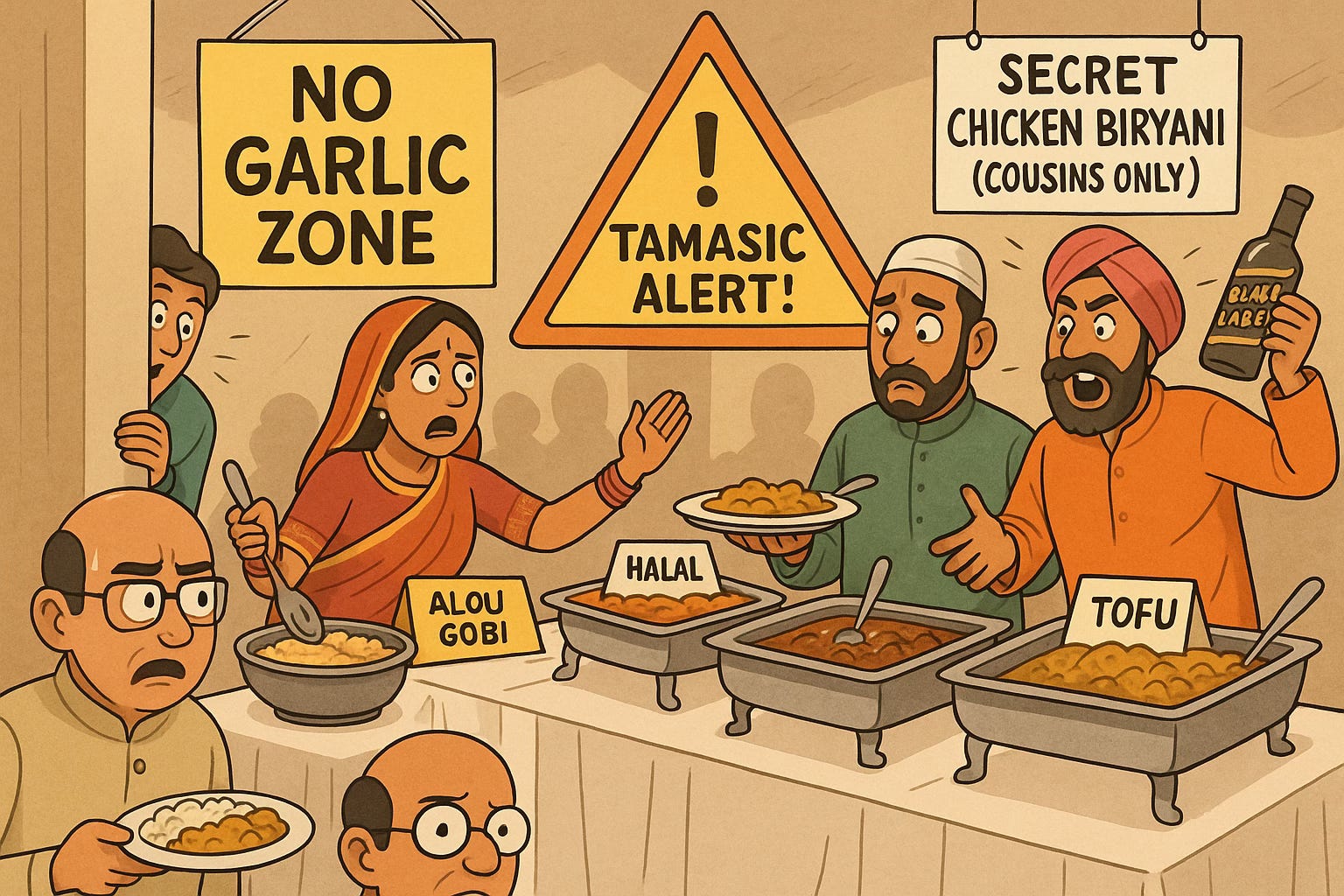
Food becomes the first battlefield in any cross-community Indian wedding. It's not just about vegetarian versus non-vegetarian — that's kindergarten-level conflict. The real wars are fought over:
Onion and garlic: Jains won't eat them (they're "root vegetables" that kill the plant). Many Brahmins avoid them (they're "tamasic" — passion-inducing). But try making a decent biryani without onions.
The alcohol question: Kerala Christians expect flowing wine. Gujaratis and many north Indians consider it shameful. Punjabis will be insulted if you don't serve Black Label. Muslims need everything halal. Buddhists are fine with alcohol but draw the line at meat.
Regional variations: South Indians need rasam and sambar. North Indians want paneer in everything. Bengalis demand fish (yes, many Bengali Brahmins consider fish "vegetarian" because it's "fruit of the water"). Gujaratis need dhokla. Punjabis require butter chicken. Try serving idli at a Punjabi wedding or chole bhature at a Tamil one — watch the aunties revolt.
I heard about a Gujarati-Tamil wedding where they needed seven different catering stations: pure veg Gujarati, pure veg Tamil, Jain, regular vegetarian with onion-garlic, non-veg Tamil, "light" non-veg for fence-sitters, and a secret chicken biryani station hidden behind the parking lot for rebellious cousins.
The couple spent more on food negotiations than on the venue.
At a Bengali-Marwari wedding, they served 'vegetarian fish' — basically potato cutlets shaped like fish. The Bengalis were horrified, the Marwaris suspicious, and the caterer philosophical: 'Sir, what to do? Customer is god.'
The Language Wars: Whose Sanskrit Is It Anyway?
Modern Indian weddings are polyglot performances where language becomes proxy for power. A typical north-south wedding might feature:
Sanskrit mantras (that neither family fully understands)
Hindi explanations (that the southern family resents)
Tamil/Telugu/Malayalam ceremonies (that the northern family ignores)
English commentary (for the NRIs and confused younger generation)
Regional songs (that one side performs while the other side checks Instagram)
I heard about a Punjabi-Bengali wedding where the pandit switched between Sanskrit, Hindi, Punjabi, and Bengali so rapidly that the couple just started saying "yes" to everything. They may have accidentally agreed to donate their firstborn to a temple — nobody's quite sure.
The language wars intensify around the vows. Hindu weddings have the saat phere (seven circles around the fire), but what those seven vows actually say varies wildly by region, caste, and the pandit's mood. One couple discovered post-wedding that the wife had promised to "bear ten sons" in the Sanskrit version while the English translation they'd requested said "support each other as equal partners." They're still married. The wife now introduces herself as "defaulting on my contractual obligations," but since no one has called to collect, they're probably fine!
The Dowry That Dare Not Speak Its Name
Dowry has been illegal in India since 1961. It's also universal.
The National Crime Records Bureau reports about 7,000 dowry deaths annually — women killed or driven to suicide over dowry demands. The real number is certainly higher. Yet dowries haven't disappeared; they've evolved.
Now it's "gifts." A car for the groom (but it's a gift!). Gold for the bride (tradition!). A flat in Mumbai (just helping the young couple!). Cash in Singapore dollars (easier for the honeymoon!). I heard about a Marwari family who "gifted" the groom's family a petrol pump. You know, the kind of thing you pick up at the mall. "Honey, I'm going to get milk." "Can you grab a petroleum retail outlet while you're out?"
The ironies multiply. Educated families often have the highest dowries — an IIT-IIM groom commands premium prices, like a tech IPO. Women CEOs still pay dowry. Female doctors marry male doctors and transfer lakhs in gold. The same families who send daughters to Harvard engage in baroque negotiations over how many tolas of gold constitute "respect."
I heard about a family that listed their daughter's achievements — Harvard MBA, McKinsey consultant, published author — then asked if the boy's side could "adjust" the dowry since she was 28. Apparently, female accomplishments depreciate faster than a new car.
Even in my mother's spectacular meltdown over my marriage, property and money lurked beneath the hysteria. She threatened disinheritance before she threatened emotional cutoff. The economics of marriage and the emotions of family are impossible to untangle.
Endogamy as Power Preservation
My mother kept saying "What will happen to our status?" At the time, I thought she was being ridiculous — a UK-educated barrister worried about societal opinion? But decades later, I discovered research that made her hysteria make some kind of sense.
When she fought against my marrying outside the community, she was unconsciously defending a system that had preserved her family's status for generations. Gregory Clark's research in The Son Also Rises revealed something stunning: Indian elites have used marriage as a technology for freezing social hierarchies for over a thousand years.
Using surname analysis to track social mobility across generations, Clark found that groups practicing high endogamy will be completely persistent in their status, high or low — essentially freezing social hierarchies in place. The mechanism is brutally effective. By ensuring that high-status families only marry other high-status families, elites prevent what statisticians call "regression to the mean" — the natural tendency for exceptional traits to moderate over generations.
This isn't just ancient history. Modern India's marriage market remains deeply endogamous. Despite all the dating apps and love marriage rhetoric, intercaste marriages hover around 5%. The matrimonial sites that dominate the market — processing millions of profiles — sort by caste as a primary filter. It's algorithmic endogamy, preserving privilege through search parameters.
The implications are staggering. Clark's research suggests that 50 to 70 percent of the variation in general social status within any generation is predictable at conception in highly endogamous societies. Your marriage choices don't just affect your happiness — they lock in your descendants' social position for centuries.
This puts my mother's hysteria in a different light. Every intercaste or interfaith marriage is a crack in the dam holding back social mobility.
Except, of course, her own family had been smashing those dams for generations. Kashmiri Pandits marrying Punjabi landowners, freedom fighters marrying imperial servants, crossing every regional and cultural boundary within India. They'd benefited from selective endogamy — breaking rules when it suited them, invoking them when it didn't. My marriage threatened not tradition but the family's monopoly on rule-breaking.
Among her arsenal of arguments was one that struck me as particularly absurd: "What will the servants think?" But in the logic of endogamy, it made perfect sense. The servants weren't just employees — they were witnesses to class boundaries. Their gossip networks could validate or undermine social status. If even the servants questioned your choices, had you really maintained your position?
The irony is that many of India's most successful families achieved their success by breaking bread and doing business across all religious and cultural lines. They maintained caste boundaries in marriage while crossing them in every other sphere of life. It's a sort of "selective endogamy": open borders for capital and talent, closed borders for genes.
The Guest List as United Nations General Assembly
Indian wedding guest lists are geopolitical documents. Every invitation is a statement of alliance, hierarchy, and carefully calibrated obligation. The average Indian wedding hosts 300-500 guests. The big ones hit 1,000+. But it's not about feeding people — it's about feeding relationships.
The taxonomy is precise: - Must invites: Close family, which in India means unto third cousins - Obligation invites: Boss, boss's boss, anyone who invited you to their kid's wedding - Strategic invites: People you need favors from, local politicians, that uncle who knows someone in the visa office - Defensive invites: People who'll create drama if not invited - Revenge invites: People you're inviting because they didn't invite you, just to show them.
One Bangalore techie showed me his wedding Excel sheet: 1,200 rows, 15 columns, color-coded by priority, with formulas calculating gift expectations versus catering cost. His wedding had project managers and Gantt charts. They still forgot to invite someone important and faced a family feud that lasted two years.
Instagram Weddings vs. WhatsApp Uncles
The modern Indian wedding exists simultaneously on multiple technological planes. The couple wants minimalist elegance — think Sabyasachi lehengas and curated Pinterest boards. The parents want maximum display — think golden thrones and endangered flower species.
Instagram has militarized weddings into competitive theater. Pre-wedding shoots in Santorini. Proposals at the Eiffel Tower. Sangeet performances that require three months of choreography. Hashtags that sound like startup names: #SidKiDulhaniya #PriyankiNick #VirushkaForever.
Meanwhile, WhatsApp uncles circulate ominous warnings about "western influence" and forward 1970s wedding photos as "inspiration." They want the bride in 10 kilos of gold and the groom on a horse. The same uncles who use FaceApp to see their "future selves" demand that weddings follow "ancient tradition."
The documentation is endless. Professional photographers, drone videographers, social media managers live-tweeting the ceremonies. One Mumbai wedding had 47 photographers — more than most international summits. The couple spent their own reception posing for staged candids. By the end, they'd perfected the "surprised by our own happiness" look.
Yet the most crucial moments still happen off-camera: The negotiations over wedding dates based on astrological charts. The families spent three hours arguing whether 7:23 AM or 7:31 AM was more auspicious for the ceremony. The pandit finally declared 7:27 AM as a compromise. Planetary alignments, apparently, are negotiable.
The Business of Tradition
The Indian wedding industry is worth $50-70 billion annually at its core — with some estimates reaching $130 billion when including all ancillary services. That's roughly the GDP of Ukraine. The average middle-class wedding costs 20-30 lakhs ($25,000-40,000), often wiping out family savings. Families take loans, liquidate investments, mortgage homes. All for a three-day performance of prosperity.
The economics are staggering: - Venue costs that spike 400% for "wedding season" - Mehendi artists who charge more than management consultants - Pandits with rate cards based on celebrity clientele - Designers who create $50,000 lehengas worn for four hours - Caterers who charge by the mythology (Krishna themes cost extra)
But here's what's rarely discussed: weddings are also wealth redistribution mechanisms. That $130 billion doesn't vanish — it flows to tent wallahs, flower vendors, sweet makers, tailors, musicians, drivers, cleaners. One big Delhi wedding employs 500+ people for a week. It's trickle-down economics, sanskaar style.
The Diaspora Double Standard
The supreme irony? Diaspora weddings are often MORE traditional than those in India. I heard about a Silicon Valley wedding where the NRI families flew in 17 pandits from different parts of India to ensure every ritual was 'authentic.' The bride's cousin in Delhi had a court marriage followed by a party. The California bride had a four-day extravaganza with ceremonies even her grandmother didn't recognize.
'We have to preserve our culture,' the California mother explained, while her relatives in India were choosing DJs over dhol players. Distance makes the heart grow fonder — and the rituals grow longer.
My Mother's Ghost at Every Wedding
Years later, after my father's death from cancer finally prompted a reconciliation, my mother sort of apologized. She was sorry earlier but "couldn't say anything." Then came the kicker: it was actually my father — who had said barely anything during the whole drama — who "disapproved," so she had to "fight his battles."
I didn't believe a word of it. My father was a fighter pilot who flew on and off aircraft carriers. He won a gallantry award in 1966 for landing a burning airplane on the deck of an aircraft carrier — which allowed them to figure out why so many pilots were dying. He was the first naval pilot to win the Air Force's Majumdar Trophy (which now sits on my bookshelf — no doubt they fought hard not to award it to a Navy man). This was a man who wasn't afraid of anyone or anything. Well, except dentists — even as a little kid, I had to hold his hand while his teeth were being cleaned. But afraid of his son marrying an Italian Jew? Please.
Even in reconciliation, she couldn't admit the obvious: that our cosmopolitan, world-traveled, UK-educated family had limits. Those limits lived in the wedding space, where somehow every Indian family becomes a guardian of traditions they don't even follow in daily life.
The supreme irony? She was defending "traditions" her own family had spent generations breaking. The Kashmiri-Punjabi alliance, the freedom fighter-imperial servant marriage, the regional boundary crossing — all fine. But apparently, after generations of smashing social conventions within India, the family had decided to draw the line at actual foreigners.
Except they hadn't even drawn that line! The family already included spouses from Belgium, France, Italy, Germany, Hungary, Spain, and the UK. So it wasn't foreigners that were the problem. It was... this particular foreigner? Or perhaps it was that I was unilaterally doing the choosing rather than submitting it to a committee of family members with broad terms of reference for their approval? It was like watching revolutionaries suddenly discover they were conservatives, but only at their children's weddings, and only selectively, and only when they weren't in charge of the revolution. In Robert Heinlein's The Moon Is A Harsh Mistress (if memory serves) Professor Bernardo de la Paz says that he is a rational anarchist: against the government unless he is the government!
This is the downside of India's "strong" culture — strength can become suffocation when it comes to marriage. The same diversity India celebrates becomes a threat when it might enter the bedroom. The pluralism that allows different communities to coexist peacefully breaks down when those communities might merge bloodlines.
The Revolution Will Be Catered
Yet change is coming, one wedding at a time. Interfaith marriages, while still rare, are increasing. The Special Marriage Act, which allows civil marriages outside religious law, saw a 30% increase in registrations last decade. Young Indians are pushing boundaries — same-sex couples are having commitment ceremonies despite homosexuality being only recently decriminalized. Inter-caste marriages are slowly becoming normalized in cities.
The pandemic accelerated changes that might have taken decades. Zoom weddings with 50 guests instead of 500. Court marriages followed by small receptions. Couples discovering they could actually enjoy their own wedding instead of performing it for hundreds of strangers.
But the old wars continue in new forms. Dating apps now have caste filters. Matrimonial sites let you search by skin tone. The same families that pride themselves on their NRI children also panic about those children marrying "foreigners." Every Indian wedding remains a negotiation between the couple that India is becoming and the country it insists it has always been.
Recently, I heard about an Indian daughter's wedding to a Korean-American she met at Stanford. The negotiations were evidently spectacular: kimchi at the sangeet, K-pop after the pheras, two ceremonies (Hindu and Presbyterian), three receptions (Indian, Korean, American), and a contracts lawyer to manage the guest list.
Apparently, the Korean grandmother and Indian grandmother discovered they both considered the other's food 'too spicy' and bonded over bland yogurt rice. The aunties WhatsApped furiously about the couple living together before marriage. The uncles compared real estate prices in Seoul versus Mumbai.
Watching such beautiful messes unfold, I think about my mother. She'd fought my intercultural marriage with everything she had, then spent her last years proudly showing off photos of her mixed grandchildren. 'Look how tall they are!' she'd tell anyone who'd listen, taking full credit for genes that were half Italian. She conveniently forgot her three-year silence, the faxed threats, the party where she'd badmouthed her future daughter-in-law to a hundred guests, and the decades of pointless recrimination that followed.
That's the thing about Indian weddings — they're not just about two people getting married. They're about 5,000 years of tradition colliding with modern love, family honor wrestling with individual choice, and everyone pretending they know what's best while secretly making it up as they go along.
My own marriage — to that Italian Jew my mother tried to sabotage — is now 33 years and counting. Turns out crossing boundaries doesn't doom you to failure, despite what the aunties whispered.
The Indian wedding, in all its exhausting, expensive, extraordinary glory, is where India stops being a theory and becomes a family. And families, as mine taught me, are messy, hypocritical, loving, cruel, and ultimately human.
We celebrate diversity until it wants to marry our son or daughter. Then, slowly, reluctantly, we expand our definition of 'our.'
Just don't forget to invite the right people. And for God's sake, make sure there's a Jain counter and a secret stash of biryani in the back of the parking lot.
If you enjoyed this exploration of you will enjoy my book, The Science of Free Will, which takes a similarly deep dive into unexpected connections—examining how deterministic physics shapes phenomena across every domain. Discover why bees get PTSD and cockroaches have free will (but your smartphone doesn't… yet!), why traffic jams materialize from perfectly rational driving, and why the smartest AI systems will be the least explainable.
I explore why consciousness must be physical (making it more extraordinary, not less), how understanding quantum fields helps explain why Nobel economists misunderstand taxation, what MacOS and the human brain have in common, and why patent law gets basic science catastrophically wrong. Plus learn why markets resist prediction despite following economic "laws," why information can never truly be lost, and why evil exists in a deterministic universe.
The Science of Free Will reveals how the same physical principles that govern quantum fields also create the freedom we experience every day, answering questions you didn't know you had about bee psychology, Supreme Court decisions, AI consciousness, traffic physics, and the nature of reality itself. Available now at https://amzn.to/4aMQJD1.
Next in the series: "From Abysmal to Merely Awful: India's Economic Journey from Socialist Nightmare to Capitalist Chaos"
Good but needs an edit, repeats too much, especiallt at the end. Maybe shave off 10%.
I enjoyed it.
This article 🤌 bellissimo! Diving into more from this series and buying your book.