Three Hours, Full Disclosure, and Save Tony Romo
Why the IPL Fixed Sports Broadcasting and American Leagues Are Still Broken

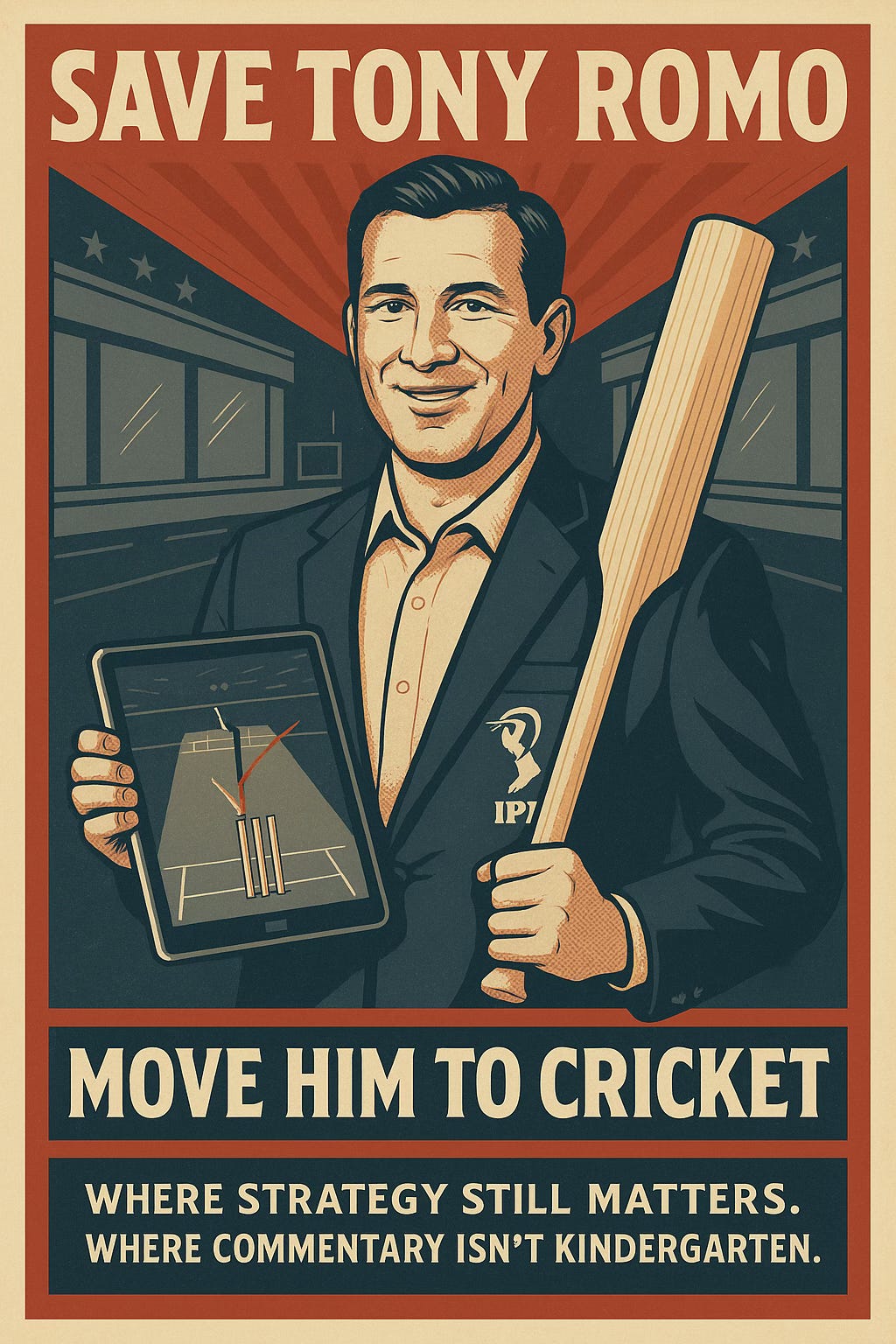
Picture two screens, side by side. It’s 2025.
Screen One: Indian Premier League, Mumbai Indians vs. Chennai Super Kings. There’s a stumping appeal—the batsman’s back foot lifted for a fraction of a second. The camera cuts to the third umpire’s booth. You hear everything: “Okay, let me see this frame by frame. Front-on camera first... now square leg angle... checking when the bails were dislodged... yes, I can see air between foot and ground when the keeper breaks the wicket. I need one more angle to be certain... Ultra-Edge shows no edge... that’s out, stumped.” The whole process takes 90 seconds. The decision is explained. The crowd understands. The broadcast moves on.
Screen Two: NFL, Ravens vs. Chiefs, AFC Championship. There’s a potential pass interference—a crucial play that could change the game. The referee jogs to the sideline like a man walking to his execution. He disappears under a blue hood and stares at a small monitor. Sixty million viewers wait. And wait. Four minutes pass. The referee emerges, makes a hand signal, and announces: “The ruling on the field stands.” No explanation. No reasoning. No transparency. Fans explode on social media with conspiracy theories about rigged games. Sports gambling-related accusations fly. Nobody knows what the referee actually saw or why he made that call.
My friend Bob—former college football player, more knowledgeable about the game than I’ll ever be—and I commiserate constantly about the decline of the NFL. All we ever want, in any football game, is something simple: a well-coached, well-played, and well-refereed game.
Those are becoming rarer and rarer.
Sure, we’ve both shouted at the TV countless times. Sometimes at coaches (who, to be fair, are slowly improving their understanding of statistics and fourth-down analytics). But mostly at referees who keep making dumb call after dumb call after dumb call.
And here’s what drives us insane: Cricket had the exact same problem—and they fixed it.
The LBW Revolution: How Cricket Proved Technology + Transparency Works
Let me tell you about leg before wicket (LBW)—cricket’s most controversial dismissal.
The rule: If the batsman stops the ball from hitting the wicket with his body instead of his bat, he’s out. (There are technicalities, but that’s the basic idea.)
Before instant replay, LBW decisions were terrible. Umpires relied on rules of thumb that were just wrong:
- “He’s too far down the pitch, can’t give that out”.
- “Can’t be out if the bowler’s going around the wicket”
- Various other nonsense based on guesswork rather than physics.
Batsmen would rage. Bowlers would curse. Captains would lose their minds. Teams would feel robbed. The cricket field was a constant zone of LBW controversy.
Then instant replay arrived. With ball-tracking technology (Hawk-Eye), suddenly everyone could see the truth: those rules of thumb were completely wrong. The umpires’ traditional methods bore no relation to reality.
You know what happened?
The umpires got better. Massively better.
Because they could see their mistakes, they adjusted their judgment. They learned. LBW decisions now are (a) vastly, vastly better, and (b) the few that slip through are fixed by instant replay—the Decision Review System (DRS) that lets teams challenge calls.
Result? No more unpleasantness. No more cursing. No more fights. The cricket field is remarkably calm now compared to the 1990s.
Cricket proved something crucial: Technology + transparency = improvement + trust.
The NFL has the technology. Cricket has shown them exactly how to use it. The NFL just... refuses.
And Bob and I sit there watching games deteriorate, knowing the solution exists, screaming at screens while referees jog to blue tents of mystery.
The Tony Romo Tragedy: A Genius Forced to Dumb Down
Let me tell you about the greatest sports broadcasting tragedy of the 21st century.
Tony Romo is a genius. Not “pretty good for a former quarterback” genius. Not “better than most color commentators” genius. Actual genius. The kind that happens maybe once in a generation.
When Romo started broadcasting in 2017, he did something revolutionary: He treated NFL viewers like intelligent adults capable of understanding strategy. He would predict plays before they happened—”They’re going to run play-action here because the defense is showing single-high safety and the linebacker is cheating toward the run”—and then explain, in real-time, the chess match unfolding between coaches and players. He’d break down offensive line blocking schemes, coverage rotations, the decision trees quarterbacks navigate in milliseconds.
It was glorious.
For the first time in NFL broadcasting history, someone was explaining that football isn’t just “big hit, touchdown, commercial”—it’s athletic, violent chess played by two teams with a four-star general (the head coach) and a three-star general (the quarterback) doing an enormous amount of strategic thinking. Not to mention the very complicated dynamics of offensive line play, defensive line play, coverage schemes, play-calling trees, route combinations, defensive disguises, pre-snap adjustments...
The NFL is, strategically, one of the three most complex sports on Earth. More strategic than basketball, baseball, hockey, golf, tennis. In terms of pure tactical sophistication, only cricket and squash match it.
Then the complaints started rolling in.
“Why is he talking so much?” “I don’t understand all these terms.” “Just show me the big hits!” “Stop trying to sound smart, Tony.”
And CBS, terrified of alienating the lowest common denominator, told Romo to dial it back. Dumb it down. Stop predicting plays. Stop explaining strategy. Give them what they want: “Oh man, that really cleaned his clock!” “Huge hit!” “Did you see that?!”
Now Romo still does good work—he’s still the best NFL commentator by a country mile—but he’s operating at maybe 40% of his capability. Like watching Picasso forced to paint by numbers because art gallery visitors complained his cubism was “too confusing.”
The problem isn’t Romo. The problem is that large numbers of NFL fans are basically morons. (I say this with love, but also with truth.) They watch for the violence, the spectacle, the gambling angles—”I got $100 that says the Dolphins score a touchdown in the 47th minute!” All of that is fine. Enjoy sports however you want.
But networks prioritize those viewers over the ones who actually want to understand what they’re watching. So they force commentators to talk down. Way down. Kindergarten down.
Now contrast this with cricket.
Every major cricket commentator is a former player. Almost all are Hall of Fame level. And they do not talk down to their audience.Turn on an IPL broadcast and you’ll hear Ravi Shastri, Sunil Gavaskar, Harsha Bhogle (okay, he never played, but he’s been studying cricket for 40 years), Ian Bishop, Michael Holding, Shane Warne (RIP), or any of a dozen other legends having actual strategic conversations.
They’ll discuss field placements, bowling plans, batting matchups, powerplay strategies, death-over tactics, the impact player substitution, why a captain is holding back a specific bowler for a specific batsman. It’s shop talk. It’s insider baseball (or insider cricket, as it were). And viewers love it because they’re learning the game at a deeper level.
Same with squash, the other ultra-strategic sport. Commentators are all former champions who explain shot selection, court positioning, tactical patterns, psychological warfare. They assume viewers want to understand the game’s complexity.
But American sports broadcasting? Nope. Gotta keep it simple for the “huge hit!” crowd.
The Solution: Save Tony Romo—Move Him to Cricket!
I’m dead serious.
Tony Romo is a cricket-level commentator stuck in an NFL world that doesn’t deserve him. He should be calling IPL matches. He’d be perfect. He has the strategic mind, the ability to read plays before they develop, the enthusiasm, the explanatory gift.
Not a single commentator on US sports that I have heard—NOT ONE—comes close to Romo. Romo is cricket-level. Everyone else is basically kindergarten.
If cricket can poach the world’s best players from every country, why not poach the world’s best commentator from the NFL? Teach him the game for six months, put him in the booth, and watch him explain T20 tactical nuances in ways that make viewers smarter.
Romo could possibly outshine many of even the Hall of Fame cricket commentators in terms of strategic insight. And add depth of knowledge to his analysis coming from his incredibly deep knowlege of another sport. But he’s the ONLY American broadcaster who could. There are exactly zero other American sports commentators that could (RIP, John Madden). And that says everything about both cricket’s broadcasting standards and American sports’ race to the bottom.
The Replay Revolution: Why Can’t the NFL Do What Cricket Does?
Here’s the question that Bob and I keep asking while watching games devolve into replay confusion: Why can’t the NFL’s replay system be remotely as good as cricket’s?
The technology exists. The infrastructure exists. Cricket figured it out years ago. Yet somehow the richest sports league on Earth—the NFL generates $21.2 billion annually—still uses a replay system that seems designed to maximize confusion and conspiracy theories.
Let me break down what cricket does that the NFL refuses to do:
1. Centralized review: Cricket uses the third umpire—a dedicated official watching from a booth with access to every camera angle. No referee jogging to the sideline. No blue tent. No five-minute delays. The on-field umpires signal for a review, and the third umpire handles everything.
2. Complete transparency: Every camera angle the third umpire sees, viewers see. Every word the third umpire says, viewers hear. “Let me check front-on... now square leg... checking frame by frame... yes, that’s clearly grounded... the batsman is out.” It’s broadcast in real-time with full audio.
3. Educational value: Because viewers hear the decision-making process, they learn the rules. They understand edge detection, ball-tracking, frame analysis, what constitutes “conclusive evidence.” Trust scales with transparency.
4. Entertainment value: Replays in cricket are exciting. The crowd waits, the tension builds, and everyone learns something. It’s not dead time—it’s a mini-drama where viewers get insider access to the decision process.
The result? Even controversial calls are accepted because everyone saw the same evidence and heard the reasoning.
Now compare to the NFL:
The referee runs to the sideline (why?), stares at a tiny hooded monitor (why?), gets advice from officials in New York (who we can’t hear), takes five minutes (why?), emerges, and announces a decision with zero explanation of the reasoning.
Fans learn nothing. Trust erodes. In the age of legalized sports gambling, conspiracy theories explode. “The league is rigged!” “The refs bet on the Chiefs!” “That call changed my parlay!”
NFL executive Troy Vincent acknowledged in 2024 that the league has a “burden to not only get calls correct but to do so with transparency.” Yet the NFL has implemented exactly zero transparency measures.
Mike Florio of NBC Sports wrote: “Currently, those decisions are made in secret. The league rarely explains anything. One very easy way to push back [against rigging allegations] would be to open the windows and let the sun shine in.”
The NFL’s response? Sound of crickets. (Ironic.)
Meanwhile, cricket broadcasts actual umpire conversations, fans learn how decisions are made, trust increases, and everyone goes home understanding what happened.
It’s. Not. Complicated.
Cricket proved this with LBW. They had the same problem—controversial calls, angry players, eroded trust. They fixed it with technology and transparency. The NFL just refuses to learn the lesson.
The Officiating Disaster: Part-Time Refs in a Full-Time League
Here’s another absurdity that cricket fixed and the NFL won’t:
Cricket uses professional, full-time umpires. Elite panel IPL umpires earn ₹1,98,000 ($2,650) per match, plus ₹12,500 daily allowance, totaling around ₹40 lakhs ($50,000) per season for regular workers. They undergo rigorous ICC certification with multiple levels of training, written exams (80% minimum pass), oral assessments, continuous professional development, and published error rates.
The NFL uses part-time referees who maintain other full-time jobs.
Read that again.
The richest sports league on Earth—$21.2 billion in annual revenue—uses officials who referee on weekends while working their “real jobs” during the week.
Current NFL referees include:
- Software quality assurance managers.
- Attorneys
- Sales representatives.
- Non-profit CEOs.
- Financial advisors.
- Aerospace engineers.
- Tax managers.
They earn $205,000-$270,000 per year (which is good money!), but it’s supplemental income to their primary careers. In 2017, the NFL announced plans to hire full-time officials. That plan never materialized.
In 2023, Aaron Rodgers called for full-time referees, saying officials “deserve to be paid appropriately where they can make this their full-time gig.” He noted the best referees were leaving for TV analyst jobs instead of staying with the league.
The quality shows. In recent seasons, NFL officiating has been described as “the worst in NFL history.” The 2024 season alone featured:
- Obvious pass interference in the AFC Championship not called, essentially ending the Ravens’ season.
- A clearly offsides player blocking a field goal (Patriots vs. Dolphins) with no penalty.
- Multiple phantom roughing-the-passer calls or missed obvious hits.
- A Seahawks-49ers replay where officials claimed they “didn’t have a conclusive camera angle” despite clear video.
MLB isn’t better: Umpires made 27,336 missed calls in 2024. Angel Hernandez—widely considered the worst umpire in baseball—worked for 33 years before retiring in May 2024. His final season gem: calling a strike on a pitch 6.78 inches outside the zone. Managers won 53.3% of challenges in 2024—meaning umpires are losing most reviews.
Cricket holds umpires to high standards, trains them rigorously, evaluates them continuously, and operates with transparency that makes their decisions understandable even when controversial.
The NFL could do this tomorrow. They just... don’t.
How the IPL Stole American Ideas and Made Them Better
Let’s give credit where it’s due: The IPL didn’t invent franchise sports. It stole the playbook from American leagues—cheerleaders from the NFL, dugouts from MLB, auctions, entertainment spectacle, commercial breaks filled with content.
Then it improved everything.
Cheerleaders: The NFL has cheerleaders standing on the sidelines looking pretty. The IPL has cheerleaders with fireworks, choreographed dance numbers, live music, and actual entertainment value during breaks. Families enjoy it. Kids love it. It’s a show, not just decorative background.
Dugouts: Baseball invented dugouts. The IPL uses them for live strategy discussions that viewers can see. Coaches and players huddle, discuss tactics, make substitutions—all visible to the broadcast. It adds drama and insight.
Live mics: The NFL mics up players occasionally for after-the-fact sound bites. The IPL has live microphones where commentators can talk to fielders during play, asking about strategy, field placements, the game situation—in real-time, while the match is happening. Viewers get insider access to the tactical conversation as it unfolds.
Entertainment: American sports treat commercial breaks as dead time. The IPL fills breaks with content—highlight packages, player interviews, statistical analysis, cheerleader performances, fan interactions. The in-stadium experience includes music, lights, fireworks, constant energy.
Women’s league: The NFL still doesn’t have a successful women’s league. The IPL launched the Women’s Premier League (WPL) in 2023 with five teams, ₹951 crore ($114 million) in media rights, and top players like Smriti Mandhana earning ₹3.4 crore ($400,000). Equal match fees for the women’s national team. From day one.
Pace and time: T20 cricket matches last approximately three hours—two innings of roughly 85 minutes each, a 20-minute break, two 2:30 strategic timeouts per innings. It’s codified in playing conditions with penalties for slow over-rates. Meanwhile, NFL games drag past 3.5 hours with excessive commercial breaks, and MLB games were averaging 3+ hours before the pitch clock intervention.
The IPL took the American entertainment model, added Indian energy, removed American inefficiencies, and created something that’s genuinely better for viewers.
Lalit Modi Deserves Credit
I need to say this clearly: Lalit Modi, who conceived and launched the IPL, deserves enormous credit regardless of whatever controversies followed.
Modi studied at Duke University. He saw how American sports franchises worked, understood the entertainment value, recognized cricket’s untapped commercial potential, and mashed it all together into something revolutionary.
Was he later forced out of the BCCI amid allegations of financial irregularities? Yes. Has his reputation been controversial? Absolutely. Is any of that my concern for evaluating what he created? No.
The IPL concept—franchise model, auction system, short-format entertainment, global player pool, Bollywood glamour mixed with athletic excellence—was Modi’s vision. He built a $723 million startup in 2008 that became an $18.5 billion industry by 2025.
In 17 years.
The richest cricket board on Earth went from needing Lata Mangeshkar to sing at fundraisers for free (1983) to controlling 80% of cricket’s global revenue (2025). That transformation doesn’t happen without Modi’s blueprint.
He took American ideas, improved them, and created a sports entertainment empire that now makes American leagues look amateur. That deserves recognition, whatever else happened later.
The Friedman Angle: Why Monopoly Breeds Mediocrity
Here’s the economic explanation for why the IPL innovates while the NFL stagnates:
Competition forces innovation. Cricket had to get better or die. When the IPL launched in 2008, cricket was competing against football (soccer), entertainment options, shorter attention spans, and the death of traditional Test cricket’s appeal to younger viewers. The IPL had to innovate—faster games, better entertainment, transparent officiating, professional infrastructure—because failure meant irrelevance.
Monopoly power removes pressure to improve. The NFL faces no existential threats. The MLB faces no existential threats (other than total boredom and lack of interest from younger viewers). They have captive audiences, monopoly positions in their markets, revenue streams that flow regardless of product quality. Owners make money despite bad officiating, despite terrible replay systems, despite games that drag on forever.
Fans complain, but where are they going to go? Americans don’t have alternatives for professional football. Baseball fans are locked in by tradition and nostalgia.
So why would NFL owners invest in full-time referees? Why would they implement transparent replay systems? Why would they shorten games or improve commentary? They have no incentive to do so.
Milton Friedman understood this: Markets work when competition punishes bad decisions and rewards innovation. Monopolies work when they can ignore consumer preferences and still profit.
The invisible hand only works when there are multiple hands to choose from.
Cricket learned this lesson the hard way. After watching field hockey die from European rule changes (India’s eight Olympic golds becoming zero medals from 1980-2016), Indian cricket officials realized: Own the infrastructure. Control the governance. Make the economics so dependent on Indian viewership that you’re too big to sideline.
The IPL exists as an insurance policy against ever being ruled out of your own sport again.
The NFL? Doesn’t need insurance. It already owns the market.
Full Circle: From Prasanna’s Engineering Job to ₹27 Crore for Rishabh Pant
So here we are, 53 years after EAS Prasanna carried a six-year-old into a cricket stadium.
In 1972, cricket meant so little that India’s greatest spin bowler needed an engineering job to survive.
In 2025, cricket means so much that:
- The IPL is worth $18.5 billion.
- Rishabh Pant was auctioned for ₹27 crore ($3.2 million) for two months of cricket.
- The BCCI controls 80% of cricket’s global revenue.
- IPL has professional umpires, transparent replays, brilliant commentary, and games that respect viewer intelligence.
- 400+ million fans watch the IPL, making it the second-most-viewed sports league on Earth after the NFL.
Meanwhile, the NFL—worth more, earning more, commanding more attention—still:
- Uses part-time referees with day jobs.
- Hides replay decisions under blue tents.
- Refuses to broadcast umpire reasoning.
- Forces genius commentators like Tony Romo to dumb down their analysis.
- Lets teams bring their own footballs (yes, really, until 2025).
- Makes games last 3.5+ hours with 70+ commercials.
The richest sports league on Earth learned nothing from a startup that launched 17 years ago.
And that tells you everything about monopoly power versus competitive innovation.
The Conclusion: Cricket Isn’t Just a Sport, It’s the Whole Story
You can’t understand India without understanding cricket.
Cricket is colonialism—a British import that India claimed, transformed, and now dominates economically.
Cricket is identity—the lens through which India sees itself, projects itself, and exports itself globally.
Cricket is economics—a story about markets discovering value, entrepreneurs innovating, and the invisible hand working through holiday mode becoming economic history.
Cricket is segmented pluralism—regional franchises, linguistic diversity, religious coexistence, all coordinated through sport rather than synthesis.
From Bombay maidans in the 1800s to Parsi cricket clubs to the 1983 World Cup miracle to the IPL revolution, cricket traces India’s arc from colony to economic superpower.
The engineer who carried me into that stadium in 1972 helped create a sport that, eleven years later, would change everything—and thirty-six years later would make cricket teams so valuable that only rich entrepreneurs (who are frequently real engineers) could afford to own them. The first IPL auction in 2008? IT executives and pharmaceutical entrepreneurs buying franchises for hundreds of millions.
Prasanna’s engineering job paid Rs. 300/month because cricket was economically worthless. Now engineering executives own cricket teams worth billions because the sport Prasanna helped build became India’s economic superpower story.
And somehow, through all of it, cricket got better. More professional. More entertaining. More strategic. More transparent. More respectful of viewer intelligence.
While American football got worse despite making more money.
The invisible hand works in mysterious ways. Usually slowly. Usually predictably. But occasionally—just occasionally—it works through six-year-olds being carried into stadiums by engineers who become legends, through sightseers booking vacation tickets who become heroes, through holiday mode that becomes history, through rhododendron photographers who accidentally document economic revolution, and through a league that borrowed American ideas and made them better because they had to compete while America’s leagues could coast on monopoly power.
Save Tony Romo. Move him to cricket. He deserves an audience that appreciates genius.
And the rest of us deserve sports broadcasting that treats us like intelligent adults capable of understanding strategy, appreciating transparency, and following along when experts explain what they’re seeing.
Cricket figured that out.
American sports still haven’t.
This concludes the cricket saga—four posts tracing the arc from 1972 (when cricket meant nothing and engineers carried children into stadiums) to 2025 (when cricket means everything and children buy teams). From colonial relic to $18.5 billion insurance policy. From Prasanna needing a day job to Rishabh Pant earning $3.2 million for two months. From holiday mode to economic revolution. From the sport that Europeans invented to the sport that India perfected, professionalized, and now controls. Sometimes the colonized civilization doesn’t just catch up—they leap ahead and show the colonizers how it should have been done all along. The end.
If you like this, you will like my book, “The Science of Free Will.” I have a lot of interesting stuff in it form why we can’t trade with ants (they can detect cancer) and what does that have to do with the future of AI to why we need a Supreme Court if the world is deterministic. You can get it on Amazon (https://amzn.to/4aMQJD1) or anywhere else that books are sold.
The India Paradox is a series exploring how the world’s most diverse democracy somehow functions despite—or perhaps because of—its beautiful contradictions. [Previous posts: 1. The Paradox | 2. The Diaspora | 3. Wedding Wars | 4. Economics | 5. WhatsApp Uncles | 6. Startups | 7. Cafeteria Wars | 8. Language Wars | 9. Gods in the Machine | 10. Gender Paradox | 11. The Future | 12. Macaulay’s Children | 13. Language Part 2 | 14. Property Chaos | 15. Whiskey Paradox | 16A. When Holiday Mode Became Economic History | 16B. The Greatest Economic Accident in Sports History | 16C. Cricket in Morningside Heights]
Thanks for writing this. What if NFL streamed referee thoughts?