The Gatekeepers
Or, How Indians Didn't Just Export Indian Culture — They Decided What Western Culture Was

Previously: In The Conquest Nobody Planned, we established the thesis — India’s soft power is spontaneous order, not central planning, and it rests on 5,000 years of civilizational openness. China spends $10 billion and gets suspicion. India spends nothing and gets a Russian figure skater wearing a bindi at the Olympics. Now: what does India actually export? And — more importantly — who are the people behind it?
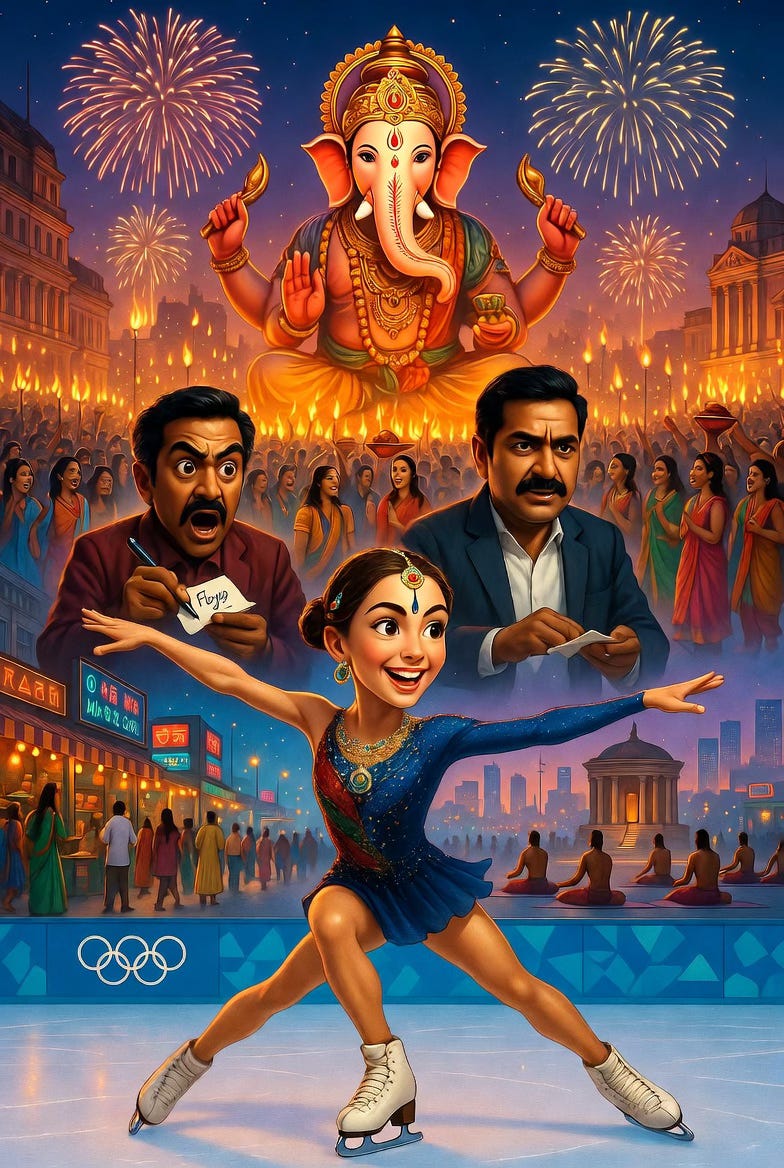
Five Things India Exports That No Five-Year Plan Could Produce
India’s cultural export stack is enormous, chaotic, and almost entirely uncoordinated — which is, as we’ve established, exactly why it works. Let’s walk through it.
Film: 2,500 Movies Nobody Asked For
India produces over 2,500 films per year in more than 20 languages. China makes 792. The United States — home of Hollywood, the place that invented the concept of a global film industry — makes roughly 510. India makes more movies every year than Hollywood and China combined, and it isn’t particularly close.
Why does this matter? Because scale increases the probability of export hits. More experiments mean more breakthroughs. It’s evolution by natural selection, not intelligent design. Most mutations fail. Some become Baahubali [The One With Strong Arms].
And it’s not just “Bollywood” anymore. That’s the word Western journalists use because it’s cute and they can’t be bothered to learn about the rest. The real story is the pan-Indian revolution. Telugu cinema — Baahubali, RRR, Pushpa [Flower], Anaganaga Oka Raju [Once Upon a Time, a King], which grossed ₹100 crore at the worldwide box office in a language most humans don’t speak. Tamil cinema — Ponniyin Selvan [Son of the Kaveri River]. Kannada cinema — Kantara [Mystical Forest]. And Hindi blockbusters like Dhurandhar [Stalwart], now being skated to at the Winter Olympics. RRR won an Oscar. Nobody in Hollywood saw that coming, largely because nobody in Hollywood knew what Telugu was.
Netflix’s global engagement data tells the story in numbers corporations understand: Maharaja drew 25 million views. Do Patti drew 20 million. IC 814: The Kandahar Hijack drew 12 million — in a single reporting period. Dhurandhar trended in 22 countries on Netflix, reaching number one in Pakistan, where Indian films are officially banned. It was reportedly downloaded 2 million times through piracy sites in Pakistan within a week — making it the most pirated film in the country. India’s soft power is so potent it penetrates even deliberate government blockades.
Are most of these films terrible? Many of them, yes. I speak as someone who found even Padosan [The Lady Next Door] merely tolerable. The plots are formulaic, the acting is stylized to the point of abstraction, and the musical numbers interrupt the narrative with the subtlety of a monsoon. But that’s the point. Soft power isn’t about quality control. It’s about volume, reach, and emotional resonance. India produces cinema the way it produces everything else: chaotically, excessively, and somehow effectively.
A confession. In Post 8, The Mother Tongue Wars, I quoted some of Hindi cinema’s most gloriously absurd dialogue. “Raabert, isko liquid oxygen mein daal do. Liquid usko jeene nahin dega. Aur oxygen usko marne nahin dega.” (Robert, put him in liquid oxygen. The liquid won’t let him live. And the oxygen won’t let him die.) Scientifically nonsensical, linguistically magnificent. Also: “Michael, tum cycle pe jao. Aur Mona darling, tum nahati raho.” I quoted these with the confident authority of a man surveying his cultural heritage. Here is the thing: I have never seen any of those movies. Not one. I have no idea what they are about. I simply heard people quote them — at dinner parties, on school buses, in living rooms — the way one absorbs Scripture without ever opening the book. That is how Indian cinema works. The films are almost beside the point. The dialogues escape into the culture and take on a life of their own, passed from person to person like oral tradition, quoted by millions who couldn’t tell you the plot if their lives depended on it. Including, for that matter, Sholay — the greatest Indian film ever made, according to everyone. Never saw it. Don’t know what it’s about. Can quote approximately none of it. This is Indian soft power in its purest form: you don’t even have to watch the product for it to colonize your brain.
Music: The Man Behind the Music
Before we get to Spotify, let’s talk about the Indian who shaped Western rock.
Vijaya Bhaskar Menon was born in Thiruvananthapuram — the capital of Kerala, a city whose name alone exhausts Western phonetic capacity. He was educated at the Doon School (India’s Eton) and Christ Church, Oxford. His father, K.R.K. Menon, was India’s first Finance Secretary — the first one-rupee notes issued after independence bore his signature. In 1971, Bhaskar Menon became the first Asian to run a major Western record label when he took over Capitol Records in Los Angeles.
Capitol was in trouble. The Beatles had broken up the previous year. The label had lost $8 million — in 1970 dollars, which is real money. The American executives had essentially given up on a British progressive rock band whose albums weren’t selling in the States.
Menon hadn’t.
In 1972, he flew to the South of France, where Pink Floyd was performing. After an all-night negotiation session, they agreed on a deal. Menon commemorated the terms on a cocktail napkin and brought it back to Capitol’s legal department in Los Angeles. Then he put the full force of the company’s marketing machine behind The Dark Side of the Moon.
Nick Mason, Pink Floyd’s drummer, said it plainly in the 2003 documentary The Making of The Dark Side of the Moon: “The story in America was a disaster, in that we really hadn’t sold records. And so they brought in a man called Bhaskar Menon who was absolutely terrific. He decided he was going to make this work, and make the American company sell it. And he did.”
The album spent 950 weeks on the Billboard 200 — the longest run in history. It is the fourth highest-selling album of all time. More than forty million copies. Without Bhaskar Menon — without an Indian from Kerala who believed in the album when Capitol’s own American executives didn’t — there is quite possibly no Dark Side of the Moon as we know it and most likely, none of its incredible follow ups. If we exclude the Beatles as sui generis, has anyone produced a batch of albums, conseccutively, that is anything close to Meddle, Dark Side of the Moon, Wish You Were Here, Animals and The Wall? I suppose Led Zeppelin came close, but as much as I adore them, they’re not quite the same quality. In my entirely not humble opinion (if you don’t agree with me, well, you can quietly leave by the side door), Echoes (the entire second side of Meddle) is the single best piece of music I have ever heard, as I tell my friends ad nauseam.
And then he did it again.
When a rival label threatened to release bootleg Beatles concert recordings from Hamburg, Menon called George Martin — the Beatles’ legendary producer — and asked him to revisit the Hollywood Bowl tapes from 1964 and 1965. Tapes that had been sitting in a Capitol vault for over a decade. Tapes that everyone, including Martin himself, had dismissed as unsalvageable.
Martin’s initial reaction: “I said to Bhaskar, ‘I don’t think you’ve got anything here at all.’”
Menon persisted. Martin listened again, was amazed by the rawness and vitality, and together with engineer Geoff Emerick produced The Beatles at the Hollywood Bowl. It hit number one in the UK and number two in the US. Sold more than two million copies.
An Indian from Kerala — whose wife later recalled that when they married in 1972, he told her “There are only two Indians in LA: Ravi Shankar and me” — gave the world Pink Floyd’s masterpiece and the only official live Beatles album.
Try doing that with a Confucius Institute.
And while we’re on the subject of Indians as gatekeepers of Western culture, consider Ajai Singh “Sonny” Mehta.
Born in Delhi. Father in the Royal Indian Air Force, among the first diplomats of independent India. Educated at Lawrence School, Sanawar — one of India’s fanciest boarding schools, perched in the Himalayan foothills like something out of a Kipling novel — then Cambridge, where he worked on Granta.
Mehta became only the third editor-in-chief in the century-long history of Alfred A. Knopf, America’s most prestigious literary publisher. He ran it for over thirty years. Under his watch, Knopf published six Nobel literature laureates: Toni Morrison, Kazuo Ishiguro, Alice Munro, Orhan Pamuk, V.S. Naipaul, Imre Kertész. Also Jurassic Park, The Girl with the Dragon Tattoo, Maus, and Persepolis. He launched the Picador imprint, creating what The Times called “the Picador Generation” — Salman Rushdie, Ian McEwan, Julian Barnes, Bret Easton Ellis. He was described, without hyperbole, as “the world’s most important anglophone publisher.”
His wife, Gita Mehta (née Patnaik), was a documentary filmmaker and writer. Her father was Biju Patnaik, the legendary Chief Minister of Odisha. Her brother, Naveen Patnaik, governed Odisha for 24 consecutive years. Vanity Fair put Sonny in the Best-Dressed Hall of Fame. Publishers Weekly named him Person of the Year. John Grisham dedicated a novel to his memory.
So: an Indian from Thiruvananthapuram was among those who shaped what the world listened to. An Indian from Delhi was among those who shaped what the world read. These weren’t Indians exporting Indian culture. These were Indians who became gatekeepers of Western culture itself. That’s not soft power in the usual sense. That’s the keys to the kingdom.
And since we’re on the subject of Indians and literature: the Jaipur Literature Festival — started twenty years ago on the margins of a crafts fair by Namita Gokhale, William Dalrymple, and Sanjoy Roy — has become what Martin Puchner, writing from this year’s edition, calls “The Greatest Literary Show on Earth.” Hundreds of thousands of visitors annually. Tens of millions online. Authors treated like rock stars on open-air stages. Basic tickets entirely free — radical openness as operating principle. Some visitors can’t even read, but they come anyway because JLF turns literature into a performed event. The festival has now spawned satellites across the globe — North Carolina, Seattle, Boulder, Houston, New York, Belfast — and is conducting cultural diplomacy on the island of Ireland, launching an all-island edition that crisscrosses from Belfast to Dublin, bridging divisions that European cultural institutions couldn’t. As Puchner notes, JLF isn’t the product of government funding or a national campaign. It’s a single festival that became so successful it now projects Indian cultural influence worldwide. Nobody planned it. Nobody approved it. Hayek again.
A personal footnote: years and years ago, from Columbia, I wrote a couple of columns for Namita’s magazine at the time — probably late 1980s — about life and cricket at Columbia. All I remember is talking about a bunch of sweaty guys playing cricket on the Columbia lawns. She liked it, as I recall. (Namita, if by some miracle you read this, write and say hi!)
Now, the Spotify numbers. Indian artists’ international streaming grew 2,000 percent between 2019 and 2023. In 2024, Indian artists were discovered 11.2 billion times by first-time listeners. Close to 50 percent of royalties now come from outside India. And the journey of how Indian music reached global ears is itself a parable of spontaneous order: Punjabi folk dance became bhangra became 1980s Birmingham immigrant dance music became 50,000 cassettes a week sold in the UK became Bally Sagoo and Panjabi MC became EDM and hip-hop fusion on global playlists. Nobody planned it. Immigrants just... danced.
Food: The Ultimate Low-Friction Diplomacy
Food is the most low-friction form of soft power. You don’t need to agree with a country’s politics to crave its food. You don’t need to understand its language or approve of its government. You just need taste buds.
No less an authority than Tyler Cowen — economist, food obsessive, visitor to more than 100 countries — declared from Kerala in his Bloomberg column in December 2024 that India has the best food in the world. His argument is essentially an economist’s case for Indian soft power through cuisine: short supply chains (often farm to table within 50 kilometers), intense competition (mediocrity means death in a country where everyone is a food critic), low labor costs enabling absurd specialization (a separate chef per cuisine is economically viable), and a culture where the question isn’t “was it good?” but “was it transcendent?” We used Cowen’s column in Post 7, the cafeteria wars. It bears repeating here, because when the world’s most respected foodie economist says India’s street food routinely outperforms Michelin-starred Parisian restaurants, that’s not an opinion. That’s a data point.
Indian cuisine is the 4th most popular globally, according to NBER research. There are more than 10,000 Indian restaurants in England alone. Over 9,000 in the United States. In 2001, British Foreign Secretary Robin Cook declared chicken tikka masala “Britain’s true national dish” — a dish created by Bangladeshi chefs in the UK to suit British palates. India’s soft power is so effective that even its cuisine is a remix produced by people from a different country.
Lucknow was named a UNESCO Creative City of Gastronomy in 2025, joining Hyderabad. Mughal court culture — itself a Persian-Central Asian-Indian fusion — metabolized by India and re-exported globally as biryani. As I noted in Post 7: Indian food is arguably the world’s first fusion cuisine. Potatoes, tomatoes, and chilies came from the New World. Tea came from China. Coffee came from Ethiopia. Naan came from Central Asia. What is uniquely Indian is that all these influences were absorbed, remixed, and re-exported as something so extraordinary that a libertarian economist writing from a houseboat in Kerala calls it the best food on the planet.
Yoga: From Spiritual Practice to $100 Lululemon Pants
I don’t do yoga. After multiple back surgeries, the Downward Dog is less a path to enlightenment than a path to the operating theater. So here I am, a man who doesn’t watch Indian movies AND doesn’t do yoga, writing about India’s two most famous cultural exports. I am, as established, spectacularly unqualified. Onward.
The global yoga industry is worth $64 billion as of 2025 and is projected to reach $120 billion by 2034. Three hundred million people practice yoga worldwide. In the United States alone, 38.4 million practitioners contort themselves into poses named after Hindu deities in studios that charge more per hour than an Indian family spends on food per week.
The UN adopted the International Day of Yoga in 2014, co-sponsored by 177 nations — a record for a General Assembly resolution. The first celebration, in 2015, drew 35,985 people from 84 nations to Rajpath in Delhi, earning a Guinness record. In 2016, UNESCO recognized yoga as Intangible Cultural Heritage.
There is a backstory here that is worth savoring. By the time Modi proposed International Yoga Day, American entrepreneurs had been busy doing what American entrepreneurs frequently do: monetizing someone’s heritage. Bikram Choudhury had claimed copyright over “Hot Yoga.” A website called YogaGlo tried to patent a “method and apparatus for yoga class.” The United States held numerous yoga-related IP rights worth millions — on mats, chairs, devices, pants, and poses that Indian ascetics had been doing for free since before America existed. India’s response was magnificent in its simplicity: the Ministry of Science and Technology compiled 1,500 yoga poses into the Traditional Knowledge Digital Library, the same database India uses to protect Ayurveda from bio-piracy, making it impossible to patent poses that are documented prior art going back millennia. Indian courts ruled that yoga asanas cannot be subjected to IP laws — they have been in the public domain “from time immemorial.” And then Modi went to the UN and declared yoga “free from copyright, patents or royalties” — India’s gift to the world. It was simultaneously the most generous and the most strategically devastating cultural move imaginable: you cannot own what we have given away. The one time the Indian government did something deliberate about soft power, the play was to make yoga un-ownable. Even India’s one act of intentional cultural strategy was Hayekian — not to control, but to liberate.
The dark comedy writes itself. An ancient spiritual discipline, developed over millennia by ascetics seeking liberation from the cycle of rebirth, has become a $182.5 billion yoga tourism market feeding Instagram influencers in $100 yoga pants doing warrior poses while sipping oat milk lattes. Somewhere, a Himalayan sadhu who has been sitting in the same position for forty years is weeping.
But that’s soft power. It doesn’t stay pure. It mutates. It commercializes. It becomes unrecognizable to its originators. And it works.
The Other Thing India Gave Away
While we’re on the subject of India open-sourcing things: it wasn’t just yoga. India did the same thing with financial technology — and this time, it was arguably even more consequential.
The India Stack — a suite of open APIs built on Aadhaar (digital identity for 1.4 billion people) and UPI (instant, zero-cost, real-time payments) — achieved in six years what the Bank for International Settlements estimated would have taken forty-seven: 80 percent financial inclusion. A country where, in 2011, only 35 percent of adults had a bank account went to 77.5 percent by 2021. The chaiwallah on the corner now accepts UPI. The vegetable vendor accepts UPI. The auto-rickshaw driver who cannot tell you how to get to your destination accepts UPI.
And then India gave it away. During its G20 presidency in 2023, India offered the entire stack — identity, payments, document storage, health records — to any country that wanted it. Open-source. No cost. Twenty-three countries have signed MoUs for adoption. UPI is now live in eight countries including the UAE, Singapore, France, and Sri Lanka. MOSIP, the open-source identity platform, has been adopted by more than twenty countries. India is building the financial rails of the Global South the same way it handled yoga: here, take it, it’s yours.
The yoga move was defensive — preventing Americans from copyrighting poses that Indian ascetics had been doing for millennia. The India Stack move is offensive — projecting influence through utility. Both follow the same Hayekian logic: give it away, let it spread, and the influence follows organically. China builds the Belt and Road with debt traps and surveillance infrastructure. India builds UPI with open APIs and says help yourself. One creates dependency. The other creates gratitude. Soft power, once again, from the country that can’t get its AI summit delegates home from dinner.
Cricket: A Quick Cross-Reference
I covered cricket’s transformation from colonial pastime to subcontinental religion extensively in Post 16A through 16D, so I’ll spare you the full replay. But the data point worth repeating: IPL media rights fetched $6.2 billion for the 2023-27 cycle. That’s not a sports league. That’s a cultural operating system with its own GDP.
The Ashram-to-IPO Pipeline
In 1964, a California surfer named Kermit Michael Riggs followed the hippie trail to India and became “Bhagavan Das.” He led a Harvard psychologist named Richard Alpert to a blanket-wrapped baba in the Kumaon hills — Neem Karoli Baba, a Hindu mystic about whom almost nothing is reliably known except the effect he had on everyone who met him.
Alpert became Ram Dass. Wrote Be Here Now. Sold more than a million copies. Became the spiritual godfather of the American counterculture.
In 1974, a 19-year-old Steve Jobs traveled to India specifically to visit Neem Karoli Baba’s ashram at Kainchi Dham. The baba had died the previous year. Jobs stayed anyway. Wandered India for seven months. Shaved his head. Came home and built Apple. He reportedly kept a photograph of Neem Karoli Baba with him until his final days.
Years later, during Facebook’s early turbulent period, Jobs told Mark Zuckerberg to visit the same ashram. Zuckerberg visited, planned to stay one day, stayed two. Found “Sub ek” — all is one. Came back and, well, connected everybody.
Larry Brilliant — epidemiologist, philanthropist, inaugural director of Google.org, and Neem Karoli Baba devotee — took Google’s Larry Page and eBay’s Jeffrey Skoll on pilgrimage to Kainchi Dham.
Julia Roberts was drawn to Hinduism by a photograph of Neem Karoli Baba.
Let me be explicit about what this means. The three most important technology companies of the 21st century — Apple, Google, Facebook — have spiritual DNA traceable to a blanket-wrapped baba in a remote ashram in the Kumaon foothills of the Himalayas. The total combined market capitalization of these companies exceeds $8 trillion. The ashram doesn’t have a website.
Try doing that with the Great Firewall.
The Beatles’ 1968 pilgrimage to Maharishi Mahesh Yogi’s ashram in Rishikesh had a similar catalytic effect. As one chronicler noted, “by the early Seventies, the numbers of travellers on the hippie trail had swollen from a stream to a deluge.” Dozens of Westerners adopted the sadhu life and never went home. Time magazine, in 1968, credited the movement with “historical precedent as far back as the ‘Sadhu’ of India.” Rishikesh is now officially the “Yoga Capital of the World” — a designation that owes more to four lads from Liverpool than to any government tourism initiative.
The Maharishi, incidentally, was a friend of my uncle. They went once to visit one of his “audiences” — one of those gatherings where the guru sits before a crowd of enraptured seekers radiating cosmic consciousness and enlightenment. The Maharishi spotted them, recognized my uncle, and hissed at them to shoo off because they would ruin the experience for the others. Come back later.
This is the most Indian thing I have ever heard. The spiritual master whose ashram attracted the Beatles, whose teachings launched a global meditation industry, whose brand of transcendence conquered the Western counterculture — telling his actual friends to get lost because their insufficiently reverential presence would spoil the vibe for the paying customers. If you wanted a one-sentence summary of the relationship between Indian spirituality and Indian commerce, you could do worse than: “The guru told his friends to come back later so the foreigners could have their experience undisturbed.”
None of this was planned. No government program attracted Steve Jobs to Kainchi Dham. No Ministry of External Affairs arranged Zuckerberg’s visit. No five-year plan budgeted for the Beatles’ spiritual awakening. India’s spiritual soft power operates like its cuisine — organically, through individual encounters, without central direction. It’s Hayek’s spontaneous order applied to enlightenment.
35 Million Unpaid Ambassadors
The Indian diaspora numbers 35.42 million people across 200 countries — the world’s largest. They sent home $135.46 billion in remittances in fiscal year 2025, a record, up 14 percent year-over-year. For comparison, China’s diaspora sent $48 billion. China’s share of global remittances is at a 20-year low. India’s is at an all-time high.
But remittances are just the money. The soft power is the living.
Eleven Fortune 500 companies are led by CEOs of Indian heritage: Satya Nadella at Microsoft, Sundar Pichai at Alphabet, Shantanu Narayen at Adobe, Neal Mohan at YouTube, Arvind Krishna at IBM, Leena Nair at Chanel, Raj Subramaniam at FedEx, Jayshree Ullal at Arista Networks, among others. Their combined market capitalization exceeds $6.5 trillion — more than the GDP of Japan.
The first Indian-origin Fortune 500 CEO was Ramani Ayer, who took over The Hartford in 1997. The trend was, to borrow Hemingway’s line about bankruptcy, “at first gradual, then sudden.”
Here’s a question nobody thinks to ask: How many Fortune 500 companies are run by Chinese-origin CEOs who grew up in China?
I’ll let the silence do the work.
In politics: Rishi Sunak became Prime Minister of the United Kingdom. Kamala Harris served as Vice President of the United States. Indians are visible at the highest levels of global politics in ways the Chinese diaspora simply isn’t — partly because India’s diaspora doesn’t trigger the same surveillance anxieties that decades of Chinese state-sponsored espionage scandals have produced.
Diwali in Trafalgar Square draws 35,000 people, 23 consecutive years, organized by the Mayor of London. Diwali in Times Square. Holi celebrations in Berlin, Sydney, São Paulo. These aren’t government programs. Nobody recruited these 35 million people to be cultural ambassadors. They just... lived. Cooked their food. Celebrated their festivals. Ran their companies. Raised their children bilingually. Started businesses. Won spelling bees. The Indian diaspora is soft power as a natural byproduct of emigration.
Here’s the connection that ties the whole series together: in Post 18B, The Escape Valves, we explored how emigration served as India’s escape valve — Indians leaving because the domestic system couldn’t accommodate them. Reservation policies, caste rigidity, economic suffocation, bureaucratic despair. Escape as the loudest form of voice. The people India’s systems couldn’t absorb.
It turns out the people India couldn’t keep became India’s greatest advertisement.
The Dark Comedy: Why It Almost Doesn’t Work
Now, before I’m accused of writing a tourism brochure — and rest assured, the Indian tourism board couldn’t afford one anyway — let’s look at the embarrassing numbers.
India ranks 30th in the Global Soft Power Index, scoring 49.8 out of 100. China is 2nd with 72.8. By the formal metrics, China is crushing it. (Amusingly, in the latest rankings, India fell to 32nd, China stayed at #2 and now ranks higher than the US on 19/35 attributes, including overtaking US in “Reputation” for first time. I’m sorry, but whoever compiles this is nuts. Totally insane. Certifiable. But I digress, as usual.)
Foreign tourist arrivals: 9.5 million in 2023. For context, Thailand gets about 28 million. France gets roughly 90 million. India — a country that has been open for trade since before Rome existed, that has the Taj Mahal, the Himalayas, Kerala’s backwaters, Rajasthan’s palaces, and the best food on earth — gets fewer tourists than Malaysia.
The Indian government’s response to this situation has been characteristically Indian. In 2024, they slashed the overseas tourism promotion budget by 97 percent, to ₹30 million — roughly $350,000. Three hundred and fifty thousand dollars. That is less than the catering budget for a single Bollywood film. Less than what a mid-range Delhi wedding spends on flowers. It is the budgetary equivalent of showing up to a knife fight with a strongly worded letter.
Only 30 percent of tourist circuits have adequate roads and sanitation. India ranks 116th in the Global Peace Index. The visa system, despite the e-visa upgrade, remains an exercise in bureaucratic archaeology.
And the honest critique goes beyond logistics. India’s communal tensions — especially under the current government — alienate parts of the diaspora and global audiences alike. Bollywood faces growing debates about creative freedom and ideological conformity. The press environment has real pressures; the direction of travel under Modi, as I’ve noted, is worrying. You can’t tout democracy as soft power while making journalists nervous.
But here’s the thing that makes this consistent with every other paradox in this series: the culture travels anyway.
Despite the infrastructure. Despite the government. Despite the politics. Despite a tourism promotion budget that wouldn’t cover lunch at Nobu. India’s soft power is so organically embedded in global life that it survives — even thrives on — institutional dysfunction. The movies get watched despite terrible roads to the cinema. The food gets eaten despite questionable hygiene ratings. The yoga gets practiced despite the fact that the country marketing it can’t build a sidewalk. The tech CEOs keep coming despite a domestic system that drove them to emigrate in the first place.
India works not because of its systems but despite them. We’ve said this before. It remains true. It will always remain true.
Shruti Rajagopalan, who runs the Indian economy program at the Mercatus Center, captured the pattern perfectly writing about India’s AI summit: “The government identifies a genuine need, commits real money and political capital, and the project stalls somewhere unglamorous that nobody in Delhi was paying attention to. The soil under the fab. The compliance process around the subsidy. The balance sheet of the electricity distributor.” Her exhibit A: Tata Electronics built a $10 billion semiconductor fabrication plant — the flagship of India’s semiconductor mission — and discovered that the soil at the site was too soft. Clay-heavy, saline, silty reclaimed land that couldn’t support a precision facility requiring near-zero vibration. The site was in Gujarat, which happened to be the Prime Minister’s home state. The building had to be redesigned from the foundations up. India’s AI ambitions, quite literally, built on soft ground.
And then there’s the video from the same AI summit that went viral: hundreds of conference delegates — white-collar tech professionals, many of whom had flown in from Bangalore and abroad — walking kilometers through Delhi fog at night because Prime Minister Modi’s dinner had shut down every surrounding road. No Uber, no Ola, no Rapido, no shuttle. International attendees and Indian engineers alike, stumbling past Raj Ghat in the dark, conference lanyards swinging, trying to find an active route where a car could reach them. The narrator’s opening line is the whole series in one sentence: “Why is talent leaving India? These are all white-collar people paying 30% tax, walking one kilometer so that they can go to an active route to get a vehicle.” India hosts the world’s AI leaders and can’t get them home from dinner. The country that wants to compete with the US and China on artificial intelligence cannot solve the problem of transportation.
Back to the Living Room
My father died some years ago. He never did develop a taste for Indian cinema. Neither did I. We remained, to the end, the two people in the Varma household who retreated to the other room when the music started — a fighter pilot and a physicist, undone by song-and-dance sequences, united in our aesthetic exile.
He would have loved this post’s argument, though. Not the movies — god, no, not the movies — but the economics. The idea that India’s greatest export isn’t something any ministry produces or any committee approves. That the invisible hand applies to culture the same way it applies to markets. That would have appealed to the man who refused to cover the 1980 Moscow Olympics on principle, who understood that freedom produces better outcomes than coercion in every domain, including entertainment he personally couldn’t stand.
India doesn’t export culture the way China tries to — through state programs, planned initiatives, billion-dollar propaganda budgets, and language centers that come with strings thicker than the curriculum. India exports culture the way it does everything else: chaotically, accidentally, magnificently, through millions of individual decisions made by millions of individual people who are just... living. Cooking dinner. Playing music. Dancing at a wedding. Doing yoga. Running a tech company. Publishing Nobel laureates. Championing Pink Floyd on a cocktail napkin. Skating to a Bollywood soundtrack at the Winter Olympics while wearing a bindi.
Milton Friedman spent his career arguing that spontaneous order outperforms central planning. He was talking about markets. But the principle applies to culture, too. India’s soft power is the bazaar. China’s is the department store. The bazaar is messier, louder, more confusing, occasionally gives you food poisoning, and has no customer service desk. But you keep coming back. Because the bazaar has something the department store can never replicate: it’s real.
This is segmented pluralism in its export version. India manages internal diversity by “living together separately” — a thousand communities, a thousand cuisines, a thousand gods, a thousand grudges, all somehow coexisting on the same train. When that diversity encounters the world, it doesn’t present a single, curated national narrative. It presents thousands. In twenty languages. Set to music. With a three-hour intermission and a “Rukhavat Ke Liye Khed Hai” just when you were getting comfortable.
Somewhere in Milan, a Russian-Georgian figure skater is wearing a bindi and doing Punjabi folk steps on ice. Somewhere in San Francisco, a Bhangra troupe is performing at an NBA game. Somewhere in London, a British family is ordering chicken tikka masala and calling it English food. Somewhere in a boardroom, an Indian CEO is running a $2 trillion company. Somewhere in the Kumaon hills, an ashram that shaped Silicon Valley sits quietly without a website.
And somewhere in Connecticut, a guy who has seen exactly five Indian movies — and liked only one of them — is writing about how India conquered the world without trying.
That’s soft power. The kind that works precisely because nobody planned it.
If you like this, you will like my book, “The Science of Free Will.” I have a lot of interesting stuff in it from why we can’t trade with ants (they can detect cancer) and what does that have to do with the future of AI to why we need a Supreme Court if the world is deterministic. You can get it on Amazon or anywhere else that books are sold.
The shift from Indians being participants in Western culture to being the gatekeepers who define it is a massive pivot in soft power. We've moved past the 'curry and yoga' export phase into a period where the structural influence of the diaspora is rewriting media, the business landscape and policy boundaries globally. A return of the soft power observed over the last 1000 years albeit with a 200-300 year nap.
“There is a backstory here that is worth savoring. By the time Modi proposed International Yoga Day, American entrepreneurs had been busy doing what American entrepreneurs frequently do: monetizing someone’s heritage.”
That thing was lying there, silent, for decades in independent India, and all Indians of ability did was disparage their own heritage. It got picked up by someone else, and they walked away with the heritage and the money. Can’t complain.
As for the sadhu, he wouldn’t be crying; he would be happy that someone has taken his heritage forward, having lost hope in his own country’s people.
India expresses, but does not consider. That may be the problem. It is not that India doesn’t have experiences; it is not curated enough to suit a modern traveller’s taste and wallet. I don’t call for a national policy; but everyone must be encouraged to improve the quality of their offering. It would help if the authorities respected Indian tourists as much as they would feel short not being able to serve foreign tourists.
India’s problem, in short, is self-loathing.