Trading 000: Your Thesis Cannot Post Margin
How a -67% month separated AI foresight from risk management.

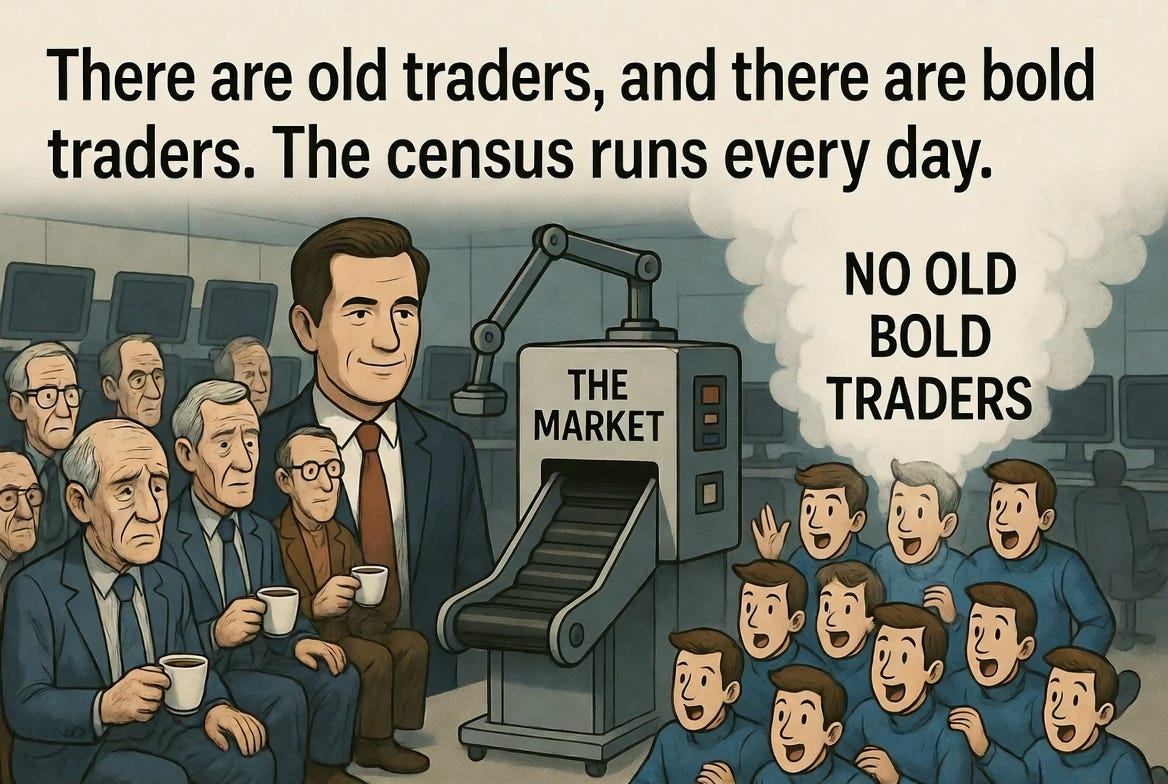
There are old traders, and there are bold traders. But there are no old bold traders. — trading-floor proverb (stolen from the pilots, as traders steal everything that works)
The Wall Street Journal reconstructed the week almost cinematically, and I could not improve on the staging if I tried. As the week began, Leopold Aschenbrenner, 24 years old, was preparing for his wedding: a multiday celebration in Carmel, ceremony at a Tuscan-style villa, send-off at a spa in the forest, and — because this is San Francisco money in the year 2026 — a pre-wedding colloquium, with breakout sessions, so the guests could discuss ideas. The couple’s only request: no gifts.
By the time the guests began to arrive, his $45 billion hedge fund was reportedly being carved up on the phone at midnight. Lenders were issuing margin calls. Rival desks were reportedly trading against his anticipated forced sales. And Ken Griffin’s Citadel was negotiating to buy the bulk of his public portfolio — roughly $16 billion of stock, per the Financial Times — at a discount of more than 10% to market. The deal was struck just before Thursday’s open, while the caterers were presumably confirming headcount.
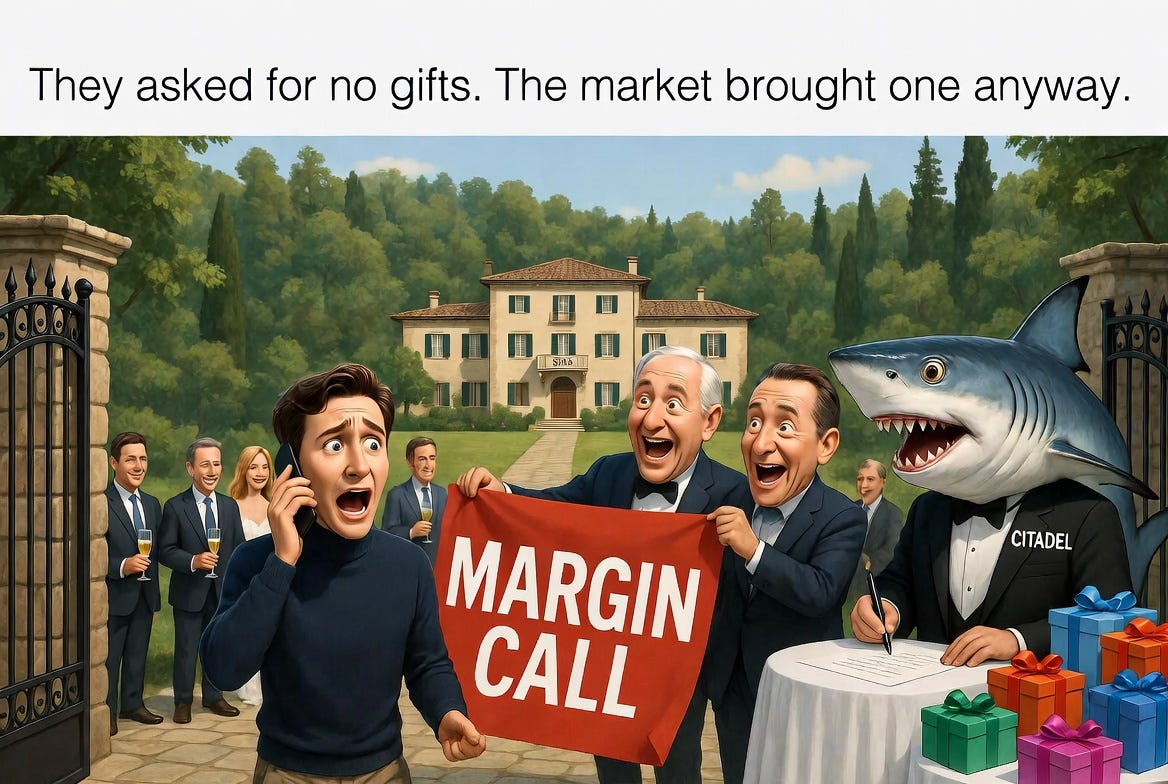
The couple had asked for no gifts. The market brought one anyway.
The Nostradamus of AI
Let me compress two years for you.
In 2024, Aschenbrenner — a former OpenAI researcher barely out of college, who had departed the lab after a disputed dismissal — published a 165-page essay about the coming of superintelligence. It went viral. Michael Dell shared it. Ivanka Trump shared it. And the essay became the intellectual foundation of a hedge fund: he named the firm Situational Awareness, after the manifesto, and described it as a “brain trust on AI.” Within a year it managed $1.5 billion. The pitch was simple: nobody understood AI like he did, and therefore — therefore — nobody could invest in it like he did. “We’re going to have way more situational awareness than any of the people who manage money in New York,” he told a podcast. Note the logical structure of that sentence. We will return to it, with a crowbar.
And for a while, the returns were spectacular. Up 47% after fees in the first half of 2025. A stumble when DeepSeek hit in January of that year, quickly recovered; up roughly 200% for 2025. Then the real fireworks: up about 439% for 2026 through June, assets swelling past $20 billion and, per the Journal, toward $45 billion — a size that took Ackman and Loeb decades to reach, achieved in under two. Jane Street, a firm that almost never allocates to outside managers, wrote a check. The quarterly 13F filings were treated as scripture; a retail app rolled out a feature to copy his disclosed trades; Tim Ferriss called him the Nostradamus of AI, “as close to clairvoyant as you could possibly be.” He wore dark turtlenecks and rarely appeared in public, which in this business is worth at least 200 basis points of mystique.
Then July 2026 arrived, the AI complex wobbled, and Situational Awareness lost 67% in a month.
Not 67% of profits. Sixty-seven percent of the fund. In one month. And here is a fact I will not hide from you, because we will need it later: even after that, the fund reportedly remained up roughly 80% for the year. Both things are true at once, and the arithmetic checks.¹ The letter to investors — written, per the Journal, as the wedding guests were arriving — has since been published in full, and I would encourage you to read it, because it is better than the coverage of it suggests. It opens: “We let you down this month,” a sentence that does a great deal of load-bearing work with the word “month.” It also contains the line “I take full responsibility for these events,” and it does not hide behind the market. It notes adverse trading in names publicly associated with the firm and likens the dynamic to a bank run — vulnerability begetting more vulnerability — but the framing throughout is that a fund must be structured to take a loss and survive. That is the correct lesson, stated plainly, by the man it cost the most. Hold that thought too; we will need it at the end.
So here is the question this post exists to answer: how does a man with no track record raise billions from the most sophisticated names in American finance and then lose two-thirds of it in thirty days? The short version involves two clocks running at different speeds, and we will get to them. But first, the arithmetic — because I promise you it is short.
IDIOT!
Let me teach you everything you need to know about risk management. It will take one paragraph. There are no prerequisites. There is no math beyond addition and multiplication. This is not Trading 101. This is Trading 000.
Start with the financing. One dollar of investor capital plus three borrowed dollars buys four dollars of assets. Lose 25% on those assets and the investor’s equity is gone — all of it. Borrow four dollars instead and the wipeout threshold falls to 20%. Options can push it lower still. Now the other half of the index card: any tech stock can drop 30% at any instant. Not “might, in a bad year” — at any instant. This is true of real, profitable, moat-owning giants; Google, Amazon, Apple and Meta have all done it, some of them inside a few weeks. It is certainly true of a Korean memory-chip maker, a fuel-cell company, and a cloud-computing provider whose common thread is that they all appear in the same manifesto. Now put the halves together, and notice the horror: the move that kills you is smaller than the move that happens routinely. That’s the whole course. It fits on an index card. And according to the Journal’s reporting, Situational Awareness was borrowing $3 to $4 for every $1 of investor capital — “or sometimes more” — with options layered on top for extra spice.
I should note, because it is too perfect to leave out, that Aschenbrenner had made a habit of deriding “wordcels” — his term for people who traffic in words rather than mathematics, and who therefore could not see the AI revolution coming in the numbers. He was not wrong about the numbers he was looking at. He was undone by a different set of numbers, requiring one operation, taught in primary school.
I can hear the objection forming: but he was hedged! He shorted the AI losers! Think, for one moment, about what that short book actually was. It did not hedge the AI thesis. It expressed the thesis a second time: long the companies expected to build the future, short the companies expected to be eaten by it. That construction may reduce ordinary market beta. It offers no protection against the one unwind that matters — AI longs falling while crowded AI-victim shorts are squeezed upward by everyone else covering to meet the same margin calls. Both legs lose. Everyone attempts the same exit through the same door.
You do not have to take my word for this. Pull up the tape for July, from the June 30 close to the July 29 close — the last session before the block trade cleared the book. His disclosed longs: Sandisk down 55%, Nebius down 46%, Bloom Energy down 46%, CoreWeave down 39%, Micron and IREN down 36%. Over the identical twenty sessions the enterprise-software complex went the other way: Workday up 37%, Adobe up 28%, Intuit up 28%, Salesforce up 20%, Veeva up 17%.⁴ He had been perfectly explicit about this trade — on Dwarkesh Patel’s podcast in June 2024 he said he was bearish on the software “wrapper companies” because they were “betting on stagnation.” Both legs. Simultaneously. Precisely as constructed.
Matt Levine put the general form of this well last week: a thematic long-short book has not reduced risk, it has rotatedit. You remain insulated against the market and completely naked to your one idea. Which is exactly what buyers found when the book came up for sale. Situational’s representatives reportedly told rival firms they were selling hedges — modest protective positions, now in distress. The rivals opened the file and found monster directional bets against companies like Adobe, forming a huge share of the firm’s total investments. They were hedges only in the narrow sense that they were short something while the fund was long something else. Against the risk that actually materialized, they were an accelerant.
You need not take my characterization of this either. Here is the man himself, in the letter: many AI names drew down by half or more, he wrote, while the fund’s positive long/short spread reversed violently. That is the whole mechanism, conceded by the person who built it. The longs fell, and the thing that was supposed to cushion the fall did the opposite, at the same time, on purpose, by construction.
And there is a name for what happened to the market that week, which turns out to matter more than “AI selloff.” Per BTIG, Morgan Stanley’s sector-neutral Momentum Index fell 17.4% in four trading days — the worst such move on record, surpassing the dot-com unwind, the pandemic shock and the 2022 bear market. BTIG’s chief market technician called it the largest and fastest momentum crash in modern history, and not particularly close. The momentum ETF had posted its best month ever in April and its worst on record in July. Situational Awareness was not really long AI and short software. It was long momentum and short anti-momentum, at four or five times, and momentum picked that fortnight to do the thing momentum does. Readers of the Emperor series will know why I find this less than shocking: momentum is not a stable factor you can lean against. It is a tradable measurement of non-stationarity, which is a fancy way of saying it works until it violently doesn’t, and nobody rings a bell.
And now the number that should be tattooed somewhere visible. Over that same stretch, the S&P 500 fell 2.32%.
Two and a third percent. Nvidia — supposedly the beating heart of the AI trade — fell 5%, and finished July up slightly. There was no crash. There was a rotation, out of the capital-hungry end of the AI complex and into the cash-generating end, which is to say out of everything he owned and into everything he was short. The broad market barely flinched, and a $45 billion fund lost two-thirds of its value. That is not a market event happening to a portfolio. That is a financing structure converting an ordinary Tuesday into an extinction.
And notice what kind of risk this really is, because the vocabulary matters. This was not ordinary stock-picking risk — not the kind a diversified book washes out. It was concentrated thematic risk wired directly into funding risk: the same market move that hurt the portfolio also raised collateral demands, made lenders nervous, and announced to every rival desk that a very large fund might soon be forced to sell. You can diversify away a company-specific accident. You cannot diversify away a financing structure that forces you to sell precisely when everyone knows you must. And here is the part that should genuinely worry you: I have watched experienced professionals fail this exam in person, with the answer key open on the table. Hold that thought.
You Levered a Thesis and Called It Alpha
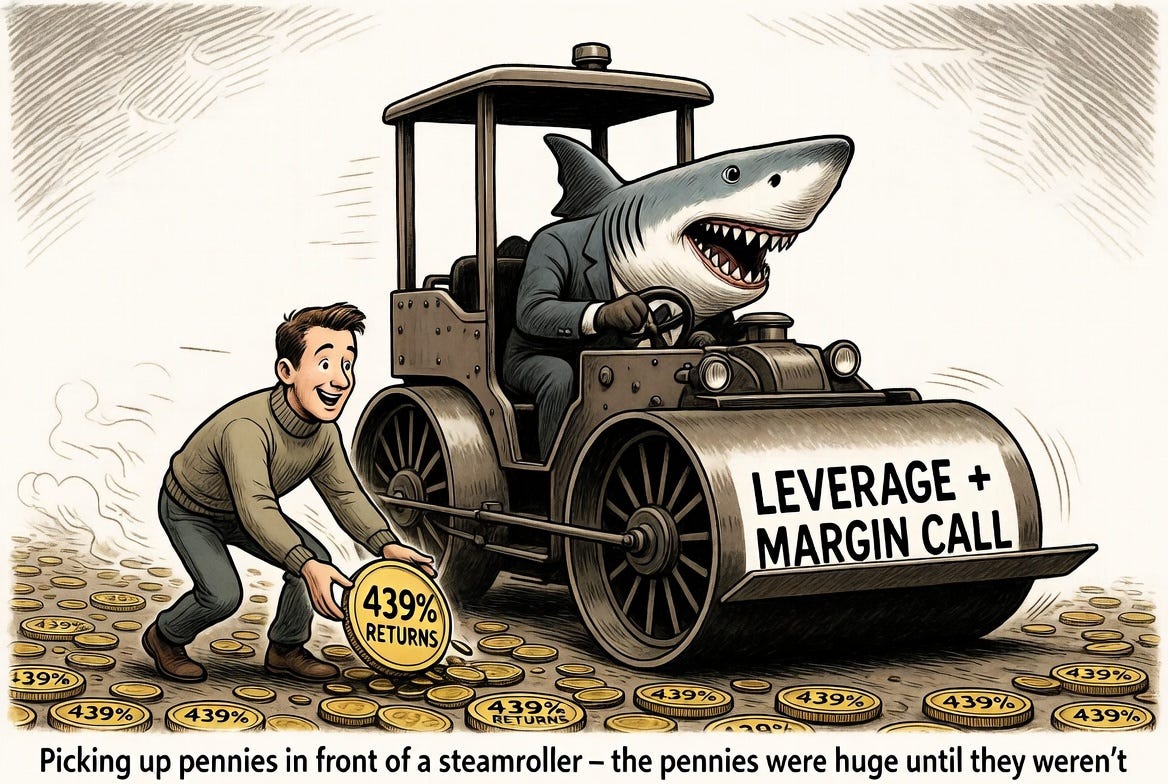
Imagine a fund that does exactly one thing. Every morning the manager comes in, pours his coffee, sells put options on the S&P a few percent below wherever the market opened, and goes to lunch. That is the entire strategy. It will be up almost every single month. Its Sharpe ratio will be magnificent, its investor letters serene, its manager interviewed about his process and his edge. And then one day the market gaps down through his strikes and he loses, in one session, on the order of everything he has made since inception — quite possibly more.² Given enough repetitions the tail stops being theoretical, and it need arrive only once before your financing horizon ends. This is called picking up pennies in front of a steamroller: the pennies are not small in dollars — they can be 439% in six months — they are small relative to the steamroller.
Now, a levered long book is not literally a short put; a quant can draw the two payoff diagrams and have me arrested before lunch. But under a margin constraint it sets the same trap for the allocator. Calm markets produce repeated gains and the financing tail is simply absent from the sample, so the returns look smooth, the Sharpe looks superb, and the allocator concludes he is watching skill. Then a drawdown raises collateral demands, forced sales worsen prices, rivals smell the seller, and a linear mark-to-market loss becomes a path-dependent fight for survival. Static leverage magnifies losses. The margin clock makes them nonlinear. Every month the market failed to gap down, Situational was collecting the financing premium and booking it as genius — until it was clawed back in a single July, at the lows, at a 10%-plus discount, by a buyer who had been standing beside the steamroller for decades. We will get to him.
And there is a mechanical detail here that deserves more attention than it gets, which Matt Levine has made in print twice now, first about Bill Hwang and again this week. When you borrow to buy stocks and the stocks go up, you deleverage automatically: the same debt now sits under a larger pile of assets. So a manager committed to a target leverage level must, every morning after a good day, borrow more and buy more. That is a machine for buying high. Run it for two years in a bull market and you arrive at the top of the move holding the largest position you have ever held, financed by the most debt you have ever owed. Situational returned something like 1,000% since inception and was reportedly still running at four to five times. The natural question — after a 1,000% run, why would you still need the leverage? — apparently did not come up.
The lenders, to their credit, did eventually ask it. Bloomberg reported that as its positions were making all-time highs, Situational went looking for more prime-brokerage capacity, and Barclays turned the firm away out of concern about its exposure to a single sector. Sit with that. Before the margin calls, before the rout, before any of this was obvious — a bank looked at the book and said no. The risk was visible from the outside, in advance, to a party whose only job is to ask what happens when the collateral falls.

Why can’t the thesis save you? Because — put this on the index card too — your thesis cannot post margin.Aschenbrenner’s thesis may well be right. AI may eat the world roughly on his schedule; I suspect much of it will. Irrelevant. The thesis runs on a decade. The margin clock runs on T+1. Correctness on the slow clock buys you nothing — nothing — on the fast one. Many of LTCM’s positions eventually recovered enough for the rescue consortium to unwind the book in an orderly way. That did not restore the partners’ capital, and it did not make the financing structure sound. The market does not pay you for being right about the future. It pays you for remaining solvent while being right, and those are different products with very different prices.
Now the best objection to everything I have just written, which I have seen made forcefully in the past few days: leverage is only a magnifying glass. It explains how fast he lost, not why. He lost because his thesis was wrong — wrong about the software companies, which turn out to sell the rails rather than the labor, and wrong about whether the capital that builds a transformative network ever earns its cost. All true, and worth its own essay. But it is answering a different question than the one a risk system exists to answer. Being wrong is not an anomaly in this business; it is the base case. Everyone is wrong, regularly, and the good ones are wrong perhaps four times in ten. Plenty of managers were long that same second-derivative complex in July and are sitting at their desks this morning, bruised and employed. What distinguished Situational Awareness was not the error. It was that the error was fatal. At one times capital, being that wrong costs you a quarter of the fund and a humiliating letter. At four or five times, with lenders holding a same-day option on your survival, the identical wrongness ends the firm. The thesis determines whether you lose money. The financing structure determines whether you survive losing money. Only one of those is under your control on the morning it matters.
And this is not merely a saying. It is a theorem, and Cliff Asness reached for it within days of the collapse: you never go full Kelly — a phrase he suggested filing under things of which one should be situationally aware.
The Kelly criterion answers the question “given a genuine edge, how much should I bet?” The answer is a specific fraction of capital, and the fraction is finite. Bet less than Kelly and you grow more slowly than you might have. Bet more than Kelly and something remarkable happens: your growth rate starts falling, even though your edge has not changed at all. Bet exactly twice the Kelly fraction and your long-run growth rate is precisely zero. Bet more than twice and it goes negative — you now lose money, with certainty, over time, while continuing to be right.
Read that again, because it is the entire post compressed into a sentence of mathematics. Beyond a threshold, position size alone converts a winning strategy into a losing one. No change in the thesis is required, no error of analysis: the edge can be real and durable and exactly as advertised, and the overbet destroys you anyway. I ran the numbers to be sure — with a healthy edge, sizing at three times Kelly leaves the median outcome below where you started. The strategy works. The bettor is bankrupt. Which is why professionals bet a half or a quarter of Kelly: you never know your edge exactly, and overestimating it pushes you past the ruin threshold without your noticing.
So when the Journal reports borrowings of three to four dollars per dollar of capital, with options on top, in a concentrated single-theme book — the question is not whether he was right about AI. Kelly does not care whether you are right. Kelly cares how much you bet on being right, and it has a number, and the number was exceeded by a wide margin.
The truly damning part is that he had already taken the practice exam, and had been handed the answer besides. January 2025: DeepSeek drops, Nvidia and the whole AI complex convulse, Situational takes real losses. The fire alarm went off. He stood in the parking lot and concluded that the lesson was dips recover. And well before that, in June 2024, on his friend Dwarkesh Patel’s podcast, Patel had raised the shelf of business-history books about investors who got the thesis right and the timing wrong, and asked whether he had thought about how these things blow up. His answer: “not blowing up is task No. 1 and 2.” He knew the words. He did not know the thing the words refer to. On July 24, one week before the fire sale, he reportedly wrote to investors that the sell-off was creating some of the most attractive opportunities since early 2025 — which, in a certain light, it was. Just not for him.
So Who’s the Idiot?
Here is where I am supposed to pile on the 24-year-old, and believe me, the material is there. But let’s be honest about what happened. A 24-year-old with no investing experience, handed billions in a raging bull market for his exact theme, levered it to the moon and blew up. Is that surprising? That is the base case. That is what the model predicts. He performed his role in this drama flawlessly. He at least has the excuse of being 24.
The more interesting question is the checks.
The Collison brothers. Daniel Gross and Nat Friedman. Later, Jane Street — with minimum check sizes reported at $25 million for some investors, and multi-year lockups. What were they actually buying? Strip away the mystique and the honest answer is: nobody outside could tell, and that is precisely the problem. The 1,000%-plus since inception did not, by itself, identify skill. It was compatible with skill, with genuinely privileged private access (the early Anthropic stake was, to be fair, a real coup), with levered thematic exposure in a roaring bull market, with luck — or with some combination the headline number could not disentangle. Readers of the Emperor series will recognize this instantly: it is an identification problem, the same one I’ve spent three posts (so far — the emperor has many more clothes to not wear) documenting in the academic literature. The professors run factor regressions and call the residual skill. The allocators looked at a return that was compatible with SHORT FINANCING PREMIUM in forty-foot letters and called it foresight. A high Sharpe measured before the tail is not a tail-risk model. Steady gains plus a rare catastrophic loss produce a beautiful Sharpe right up until they produce a crater — and the beauty of the Sharpe is precisely the evidence that you have not yet seen the tail.
Now, in fairness: I cannot see Jane Street’s position size, side letters, or portfolio construction. Perhaps they knowingly bought a small, carefully sized slice of exactly this tail; perhaps the venture access dominated the economics; a $25 million check can be socially enormous and economically trivial to a firm of that scale. It is also reported that when the book came up for sale last week, Jane Street looked at it and passed — which tells you something about how they price risk when they can actually see it. And I would extend them a courtesy I would not extend to an allocator: Jane Street is a proprietary trading firm. It was risking its own capital, not somebody’s pension. A prop shop taking a sized bet on a volatile young manager and eating the loss is not a scandal; it is Tuesday. The people who owe someone an explanation are the ones who were investing other people’s money. But that is exactly why the rest of the market could not rationally treat the Jane Street name as a substitute for its own arithmetic. Their check revealed almost nothing about how much risk they had accepted. In public, however, the name functioned as permission.
My diagnosis — and I offer it as diagnosis, not as a transcript of anyone’s mental state — is that in the Valley, diligence is a social graph. Once the Collisons are in, Gross and Friedman follow; once Jane Street allocates, the questions stop. The problem was not necessarily that no one had done diligence. It was that each successive investor treated someone else’s participation as evidence whose underlying calculation remained invisible. It was social proof all the way down.
And now the detail that turns that diagnosis from a hunch into something closer to a controlled experiment. When Aschenbrenner took the fundraising tour east, New York was distinctly unimpressed. Rob Copeland reports in the New York Times that three people he pitched declined, describing him as a lightweight and a one-hit wonder; Blackstone, the largest hedge fund investor on earth, passed. One investor who took the meeting asked him the single question the entire enterprise turned on — what is the plan if the AI revolution doesn’t arrive as hoped? — and reports getting no detailed answer. Aschenbrenner simply believed it would work out.
That is the whole post in one anecdote. The same manager, the same pitch, the same numbers, presented to two populations. One asked what happens if you’re wrong, got no answer, and declined. The other had built its fortunes on being right about the future and heard, in his certainty, a familiar and admirable sound. The money that got destroyed was not the money that failed to understand AI. It was the money that understood AI and had never been asked to price a margin call.
The easy version of this is that New York is smarter than San Francisco, and since I have spent thirty years running money an hour outside New York, you should discount me accordingly. New York is not smarter. New York bought Amaranth, funded Archegos through five separate prime brokers none of whom knew about the other four, and invented Long-Term Capital Management. What New York has is not judgment. It is scar tissue. Those allocators have personally been carried out before, which is why “what happens if you’re wrong” is not a clever question for them but a reflex, asked in the same tone as “where are the fire exits.”
Which is to say: the split isn’t geographic at all. It is variolation, applied to allocators rather than to traders. The New York money got its inoculation in 1998 and again in 2008 and has the antibodies to show for it. The pool of capital that has flooded into the AI trade has, structurally, never seen the down. It is not stupid. It is immunologically naive, which is a different condition with the same symptoms and a much better prognosis, because this is exactly how you acquire immunity. Last week was the first dose.
And the same applies, with more force, to the manager. The Financial Times made the point with admirable dryness: in his defense, Aschenbrenner was in his infancy when the financial crisis hit. He was six or seven years old in 2008. Every market he has ever traded has gone up. This is not an excuse — the arithmetic was available to him, in books, at any point — but it is a mechanism, and mechanisms predict. If you want to know which manager blows up next, do not look for the one with the worst thesis. Look for the one who has never personally watched a thesis fail to matter.
And here is what the discipline looks like when it has been earned. Some years ago, a Nobel laureate in economics came around pitching a new fund to a large institution I know well. The institution asked the ordinary questions — what is the strategy, what is the thesis, what is the risk management. His answer, in substance: I have a Nobel Prize. Invest with me.
They passed.
That is the entire discipline in one meeting. Not cleverness, not superior insight into whether the man was right — he may well have been right, he had a Nobel Prize — but the refusal to accept a credential as a substitute for a process. And note the exquisite detail that the pitch ignored: the most spectacular leverage-driven collapse in the history of finance, the one everybody on Wall Street reached for the moment Situational Awareness started sliding, was run by a firm with two Nobel laureates in economics on its masthead. In this particular industry, the prize is not merely insufficient evidence. It has a track record.
“We’re going to have way more situational awareness than any of the people who manage money in New York” is the same sentence. It is a credential offered where a process was requested. The people who manage money in New York had, in fact, considered his credential and passed — not because they knew more about AI than he did (they certainly did not), but because he could not tell them what would happen if he was wrong, and they had all met someone before who could not answer that question.
None of which is an argument against ambition. There is nothing whatever wrong with wanting to change the world, and nothing wrong with taking outsized risk to do it — the entire venture model is built on outsized risk, correctly sized and honestly disclosed, and it has produced more value than any other allocation of capital in modern history. There is, however, something wrong with being an idiot about the financing. Those are separable, and the separation is the whole ballgame.
But here is the detail that should end the argument about whether anyone was misled. The Times reviewed an investor document in which Situational Awareness stated that it would set no limits on the types of investments it might make, nor on the concentration of its investments, nor on the amount of leverage it might use. No limits. In writing. In the documents. Before a dollar went in.
So let us dispense with the idea that this was hidden. It was disclosed, in the plainest possible English, in the one document every allocator claims to read. Nobody was deceived about the leverage. They were told there would be no limit on it, and they wired the money anyway, because the returns were 439% and the manager was clairvoyant and the Collisons were already in. That is not a failure of disclosure. It is a failure to believe the disclosure — which is a much older and much more human problem, and one no regulation has ever fixed.
One more distinction the headline numbers erase: return since inception is not investor experience. The LP who wired money at launch is still, even now, sitting on a multiple. The LP who wired money in May, at peak mystique, has been vaporized. Same fund, same manager, same thesis — entirely different outcomes, sorted purely by entry date. When the marketing quotes “1,000% since inception,” ask which investor actually lived it.
You want to know how deep the underlying confusion runs? It is not a Silicon Valley failure. It is not an amateur failure. Let me tell you about the professionals.
The Exam, Administered in Person
Years ago I consulted for a well-known hedge fund. Experienced traders. Real careers, real track records, people who say “risk-adjusted” without air quotes. They had a position they were very pleased with: long Google, short eBay. Dollar neutral. The market could do whatever it wanted. Low risk, they told me.
I gently pointed out that this trade was riskier than simply buying the S&P.
They did not believe me. Fair enough — extraordinary claims and all that. So I ran a full-scale bootstrap analysis and put the distributions side by side. In the sample we tested, the loss distribution of the Google–eBay spread was worsethan the S&P’s. Because dollar neutrality is not beta neutrality, and beta neutrality is not risk neutrality. They had cancelled a broad, diversified source of variation — the cheap risk, the kind the market pays you to hold — and retained a concentrated residual spread containing two distinct ways to be unpleasantly surprised on the same morning.³ Google could miss earnings while eBay caught a takeover bid, and the trade would lose on both legs simultaneously, on a day the S&P closed green.
They looked at the bootstrap. They looked at me. And they left the room muttering: but it’s dollar neutral... how can it be risky... I don’t get it...
They were right about exactly one thing.
These were professionals with decades of combined experience, and they could not price the difference between “dollar neutral” and “risk neutral” with the answer key on the table. Now take the same misunderstanding, hold it with the same sincerity, run it at four-to-five times assets over equity, scale it toward $45 billion, and make the short book express the same theme as the longs. The Google/eBay boys at least had the decency to run it small.
The Variolated Shark
One more thing, because the universe has a sense of humor and I would hate for you to miss it.
Who bought the forced sale? Ken Griffin. And Griffin did not invent this playbook last week. In September 2006 he and JPMorgan took Amaranth’s energy portfolio off its hands after $6 billion of natural-gas losses. In July 2007 he bought Sowood’s distressed book — a deal reportedly agreed at half past three in the morning, because Citadel’s team was still working when everyone else had gone home. Note the hour. Some habits are load-bearing.
Then, in 2008, Citadel itself nearly died. The flagship Kensington and Wellington funds lost roughly 55%, the firm was running something like seven-to-one leverage, the correlations that were supposed to be independent went to one, and Griffin gated redemptions for the better part of a year to avoid liquidating into a frozen market. Counterparties wondered aloud whether the firm would survive. It did — in part because Citadel had studied LTCM closely and pre-negotiated far stronger financing terms with its prime brokers, which is the single most underrated sentence in this entire post. The firm returned 62% the following year.
And what has Griffin said about 2008 since? He told Institutional Investor that the firm’s large leveraged balance sheet had been its Achilles heel, and that the episode was incredibly humiliating. He has repeatedly accepted the blame, called it his low point, and admitted he had not understood how precarious the banking system was. He did not, so far as the record shows, blame the short sellers. That is what separates a variolation from a grievance.
He is not alone. Stanley Druckenmiller — as good as anyone has ever been at this — piled into a handful of tech names at the top of the dot-com mania and got destroyed. His own verdict, delivered years later: the first thing he was ever taught in the business was that bulls make money, bears make money, and pigs get slaughtered, and he was here to tell us he had been a pig. That is a man who has been inoculated. You can hear it in the tense.
Because that is what 2008 was: a sublethal dose, survived, conferring immunity. And it is precisely because he has been variolated that Griffin was ready this July when a 24-year-old’s phone needed answering at midnight — the standing playbook, the fortress liquidity, the patience to wait beside the steamroller for however many years it takes. The apex predator in this business is not the one who never came close to blowing up. It is the one who came close once, at survivable scale, and never forgot.
The staging was almost too neat. Griffin is 57. Izzy Englander, circling on behalf of Millennium the same night, is 77. Both were phoning in from Europe well past midnight. On the other end was a 24-year-old whose fund was named for his ability to see what others could not. eFinancialCareers ran the story under the observation that the wunderkind had been saved by the old guys, which is the proverb at the top of this post reduced to a headline. And the trade was, for Citadel, a fat pitch of exactly the kind Griffin has been swinging at since Amaranth: Bloomberg reported that Citadel’s Wellington fund had been up less than fifty basis points for the month through July 24 — a nothing month — before it bought a portfolio at a double-digit discount and watched those names rebound better than 20% the following day. Patience beside the steamroller does not merely keep you alive. Periodically it pays the rent.
You see now what the proverb at the top of this post actually is. It is not a warning. It is a census. There are no old bold traders because the market runs the selection experiment continuously — the fragile are removed, and the survivors are, by construction, the ones who learned. And note the fine print, because Citadel is hardly a monastery devoted to timidity: Griffin got old not by ceasing to be bold, but by separating boldness from fragility. The census does not count the bold. It counts the bold who could not survive being wrong on the wrong day.
Class Dismissed
Back to Carmel, briefly. I hope the wedding was lovely — by every account the couple asked only that nobody bring gifts, and I find that genuinely endearing. But if the breakout sessions needed a discussion topic, the groom’s own investor letter supplied one. “Vulnerability begetting more vulnerability,” he wrote of the market’s dynamics — apparently without noticing he was describing his financing structure, not the market. The market supplied the shock, and what a modest shock it was: the S&P fell 2.32%. The market does that on a schedule it never conceals. The leverage is what converted an ordinary month into a survival event.
So: was he an idiot? A Wall Street source gave the New York Post the verdict that will probably stick — a leveraged idiot who was right until he was wrong. It is a good line, and it is very nearly correct; I would only move the emphasis. The leverage was idiotic — that is simply what the arithmetic says, and the arithmetic is not open to interpretation. But he was bold, in the precise actuarial sense of the proverb: bold traders are the ones the census has not counted yet. And the census, this time, has not quite counted him. The fund survived — because Citadel provided an exit for the public book, at a price his investors will remember. It reportedly remains up roughly 80% for the year, has kept its Anthropic stake, and has removed its leverage. Early investors may still be substantially ahead. None of this vindicates the risk system. It separates two questions that spectacular P&L had temporarily fused: did the trade make money, and was the amount of capital placed at risk rational? A bridge can survive an overload. That does not validate the engineering.
He is 24. The tuition has been paid — in full, in public, largely with other people’s money. The expensive question is whether survival gets read as vindication or as instruction, and the letter is genuinely better than I expected on this. He takes full responsibility, in those words. He closed every short and removed all leverage. He now runs the public book fully paid for — long stock and long fully-paid-for options, no margin, no liquidation risk. He writes that the fund must always be structured so that it can take a loss and fight another day, which is precisely the right sentence.
And then there is one clause, and it is the whole ballgame. The public book will be run on a fully-paid-for basis, he writes, while we draw the lessons from these developments. While. The Times noted the same thing: he stopped short of pledging not to borrow again. So the leverage is not gone; it is suspended, pending the completion of learning, on a schedule he sets himself. Somewhere in the next bull market there is a morning when the lessons will feel sufficiently drawn, the opportunity set will look extraordinary — the letter already says the current opportunity set looks extraordinary — and the prime brokers will be delighted to hear from him. That morning is the exam. Everything before it is the review session. Victor Niederhoffer, having sold naked puts into the crash of October 1997, sued the exchange alleging that floor traders had colluded to drive the market down and force him out; ten years later he blew up again. The scars were expensive. They are only invaluable if they are permanent.
And I am afraid the surrounding ecosystem is not helping. Within seventy-two hours the comeback chorus had assembled — don’t count him out, the man has a track record, he still has billions and a strong view of the future. One prominent voice put it almost perfectly: if he is right, and keeps playing the risk-taking game, there is a high probability he generates tens of billions for his partners.
If he is right.
Read that sentence and then read this post again. He was right. He was right about AI for two solid years, right enough to return more than 1,000%, right enough that the Journal wrote him up as an oracle and a retail app let strangers clone his trades. Being right is what got him to $45 billion. Being right is not what took it away, and being right is not what will bring it back. The chorus, seventy-two hours after watching a fund lose two-thirds of itself in a month, has already reconstructed the exact syllogism that produced the wreckage: he sees the future, therefore he will make money. That is the error. Not the leverage — the leverage is downstream. The error is the therefore.
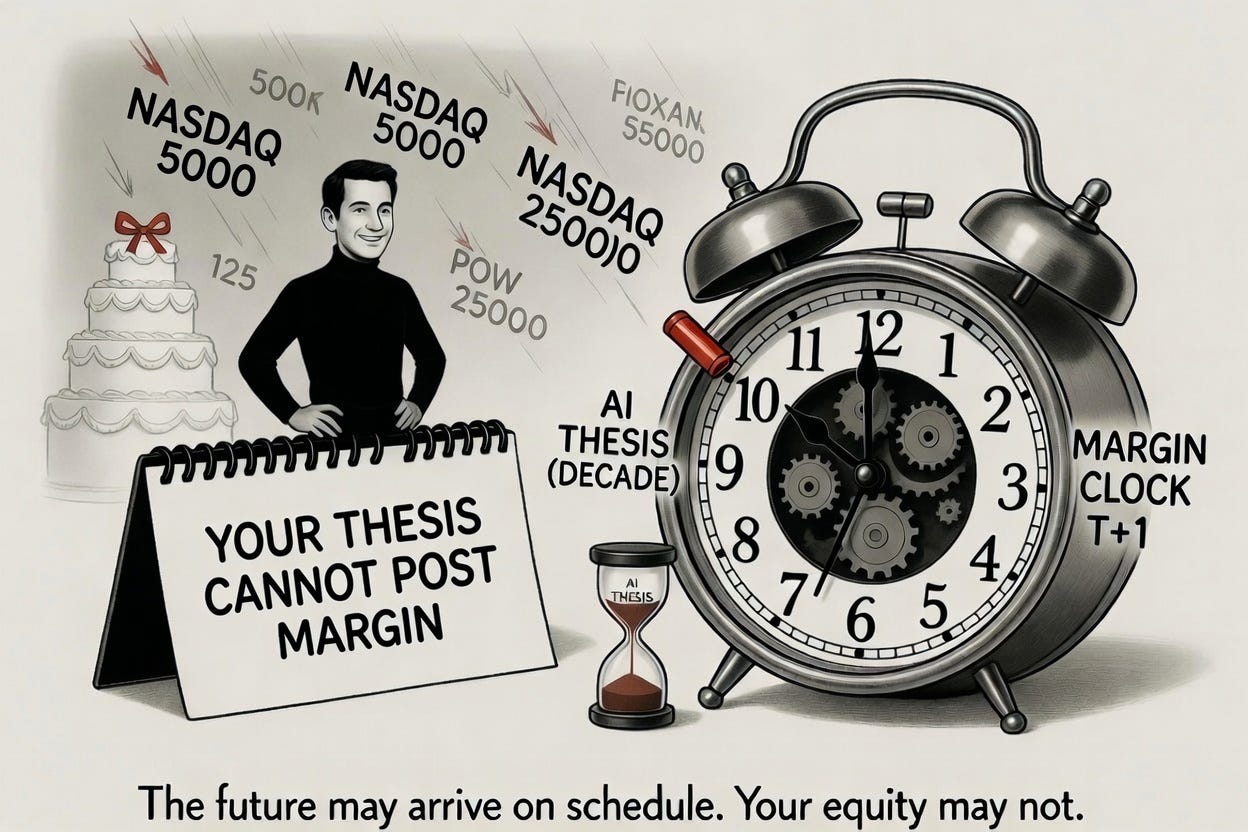
The index card, one last time. One dollar of equity plus three borrowed dollars buys four dollars of assets; lose 25% and the equity is gone. The thesis may be brilliant. The future may arrive exactly on schedule. Your thesis cannot post margin. There are old traders, and there are bold traders.
Class dismissed.
¹ Reuters reports the fund gained about 439% through June, then lost 67% in July: 5.39 × 0.33 ≈ 1.78, i.e. up roughly 78–80% on the year. The reported numbers cohere, which in stories sourced to “people familiar with the matter” is a small miracle worth savoring.
² How much more depends on strike distance and sizing, so I claim the direction and not the magnitude; the universal statement is that the one bad day is of the same order as the accumulated winnings, and it need only arrive once. The graveyard offers confirming instances rather than a theorem. Victor Niederhoffer, having sold naked S&P puts alongside puts on Thai bank stocks, was wiped out on October 27, 1997, when the Dow fell 554 points — 7.2% — and the resulting margin call exceeded roughly $130 million he did not have; his Matador Fund then blew up again in September 2007, down more than 75%, on rising margin requirements against overexposed options positions. Or consider XIV, the inverse-volatility note: on February 5, 2018, it fell from $108.37 to $4.22 — about 96% — on a day the S&P 500 was down all of 4.1%. Credit Suisse announced the acceleration the next morning. Read that pair of numbers again: 4.1% and 96%. That is what negative convexity does to you, and it is the same arithmetic as the leverage in this post, wearing a different hat.
³ For the quants: the spread variance is σ_G² + σ_E² − 2ρσ_Gσ_E. Cancellation requires the right covariance structure, not equal dollar signs on opposite sides of a blotter. Remove the common factor and what remains is the residual risk of both names — the risk the market does not pay you to hold.
⁴ Price moves are my own, computed from daily closes, June 30 to July 29, 2026. The quoted remarks about the wrapper companies are from the June 4, 2024 Dwarkesh Podcast episode, as is the exchange about blowing up. One necessary caveat on the positions: 13F filings disclose long positions in U.S. stocks, not short positions, so the long basket above is a matter of public record while the short basket is not. Adobe has been reported as a short; the remaining software names are the complex he was on record as bearish about, not confirmed positions. The direction of the argument does not depend on the exact roster — what matters is that the theme he was long and the theme he was short moved violently in opposite directions, against him, at the same time.
A note on sourcing, and on a genuine discrepancy. Peak assets are reported at roughly $45 billion by the Journal and Business Insider, but at around $30 billion by the New York Times; what remains is put at about $10 billion by the FT and about $8 billion by the Times; the stock sold over those thirty hours is $16 billion per the FT and roughly $20 billion per the Times. I use the larger figures where the Journal supports them and flag that the range is real — which is itself instructive, because a firm whose size cannot be pinned within 50% a week after the fact is a firm whose risk nobody outside was in a position to measure. The 67% July loss, the $3–4 of borrowing per $1 of capital, the 10%-plus Citadel discount, the ~439% through June and ~80% year-to-date come from reporting by The Wall Street Journal, Reuters, the Financial Times, Bloomberg, CNBC and the New York Times between July 30 and August 3, 2026, much of it attributed to people familiar with the matter: the WSJ’s wedding-week reconstruction, Citadel purchase, July losses and June profile; Reuters on the July letter and year-to-date figures and the Citadel transaction. The investor letter is quoted from the full text published by Business Insider; I have relied on the letter itself rather than on characterizations of it, and recommend the same to anyone writing about this. The Barclays refusal and the leverage-seeking at all-time highs are Bloomberg’s reporting (Burton, Natarajan, Gillespie and Kumar); the New York fundraising reception, the Blackstone pass, the Goldman margin call, the mislabeled “hedges,” the “no limits” investor document and the Pfeffer quote are Rob Copeland’s in the New York Times; the momentum-crash figures are BTIG’s, via CNBC; the Citadel Wellington month-to-date figure, the ages of the principals and the “saved by the old guys” framing are Sarah Butcher’s in eFinancialCareers, citing Bloomberg and the FT; the comeback-chorus remarks were collected by Business Insider; the Asness remark on full Kelly, Griffin’s Institutional Investor comments, the Druckenmiller quote, the FT’s line about Aschenbrenner’s infancy and the New York Post verdict all come via Joe Nocera’s account in the Free Press; the deleveraging-ratchet observation and the rotated-risk framing are Matt Levine’s in Money Stuff, where he has been making the first of them since Archegos in 2021. I claim directions confidently and hold magnitudes loosely — though note the verdict is insensitive to the error bars: the arithmetic condemns the financing at 3x or at 5x, at $30 billion or at $45 billion, which is rather the point.
If you enjoyed watching a cherished story about foresight collide with arithmetic, my book, The Science of Free Will, asks an equally uncomfortable question about an equally cherished story: what if seeing the future — even correctly — was never the same thing as controlling it?
New here? Start with The Paradox of India or browse the full India series. And if institutional decline is your genre, Albion is about Britain’s version — which I first saw coming in 1979.
The Emperor series resumes shortly. The news declined to wait.
Two distinct modes of learning on display here; one is borderline academic and the other is as personal as it gets. The latter is the one that forges character.