
“Where have you gone, Joe DiMaggio? A nation turns its lonely eyes to you.” — Simon & Garfunkel
In 1979, a thirteen-year-old boy arrived at Heathrow carrying contraband.
Not drugs. Worse. Ideas.
Friedman. Hayek. Rand. In socialist India, where the government controlled what you could produce, what you could import, what price you could charge, and approximately how much hope you were permitted to have, these books were more dangerous than heroin. Heroin merely destroyed your body. Friedman destroyed your faith in central planning.
I had been reading these forbidden texts in Delhi, where the temperature regularly hit 110°F and the economy regularly hit new lows. India in 1979 was a place where you waited ten years for a telephone, one year for a scooter, and your entire life for the government to get out of your way. We had a 97.5% top marginal tax rate. We had ration cards for sugar. We had one model of car—the Ambassador—available in your choice of white, off-white, or “please, I’ll take anything.”
And I had a hypothesis.
The Indian government, in its infinite wisdom, had warned us about Britain. Loose women. Dangerous streets. Racism. Rude people. A dying empire full of desperate, declining Englishmen who probably ate their children when the dole ran out.
But I was, even at thirteen, a scientist. And scientists test hypotheses against evidence.
So I arrived at Heathrow with my parents, prepared to confront reality.
Reality won.
The first thing I noticed was that the air was cool. Not air-conditioned cool—naturally cool. This was July, and I needed a light jacket. In Delhi, July meant your shirt was soaked through by 9 AM and you spent the afternoon fantasizing about death as a form of temperature relief.
The second thing I noticed was that everything was green. Impossibly, ridiculously, fairy-tale green. The grass looked fake. The trees looked painted. Coming from a city where “green” meant the color of mold on your monsoon-soaked walls, this was visual assault.
The third thing I noticed was the newsagent’s.
I stood there, a refugee from scarcity, staring at a wall of chocolate. Not a shelf. A wall. Cadbury’s Dairy Milk. Fruit & Nut. Whole Nut. Caramel. Flake. Twirl. Crunchie. Wispa. Bounty. Mars. Milky Way. Maltesers. Galaxy. Aero. Kit Kat. Yorkie. Lion Bar. Double Decker. Boost. Picnic. Topic. Fudge. Turkish Delight. AND THOSE WERE JUST THE ONES I COULD SEE WITHOUT MOVING MY HEAD.
In India, we had maybe five kinds of chocolate, and you had to know a guy.
I may have whimpered.
Then came the food. Over the next few weeks, traveling through England, I had roast beef with Yorkshire pudding. I had pheasant. I had duck. I had quail. I had an avocado and pigeon salad that I still remember forty-six years later. I had fish and chips wrapped in actual newspapers, the grease seeping through the headlines, the malt vinegar sharp enough to make your eyes water, the whole glorious mess eaten with your fingers while standing on a street corner.
The British food jokes can stop now, by the way. They were never that funny, and they’re certainly not accurate. This was 1979, and the food was magnificent. Today, London has eighty-five Michelin-starred restaurants including six three-stars. It is, by most objective measures, the best food city on Earth. So kindly shut up about British cuisine.
But the food wasn’t even the revelation.
The revelation was the order.
Traffic flowed. Not “flowed” in the Delhi sense, meaning “moved chaotically in approximately the intended direction while honking continuously.” Flowed in the sense of: people stayed in lanes. They signaled before turning. They stopped at red lights even when no one was watching. EVEN WHEN NO POLICE WERE PRESENT.
I had never seen anything like it.
And the queues. Oh God, the queues. People waited in line. Voluntarily. Without pushing. Without cutting. Without treating the concept of “next” as a philosophical abstraction open to interpretation. At bus stops, a queue. At shops, a queue. At the post office, a queue. An elderly woman could arrive at a shop and people would simply... let her have her turn. No negotiation. No bribery. No existential struggle.
I watched a man drop a pound note. The person behind him picked it up and returned it to him.
I may have wept.
This was Britain in recession. The Winter of Discontent had just ended. Callaghan had fallen. Thatcher was about to arrive. Garbage had piled up in Leicester Square. The dead had gone unburied. By British standards, this was a catastrophe.
By Indian standards, it was paradise.
I fell in love. Not with a woman—with a civilization.
Of course, they’re also completely insane.
I should have realized this when I first encountered the phrase “bacon butty.” A butty, I learned, is a sandwich. But only certain sandwiches. A ham sandwich is a sandwich, but a bacon sandwich is a butty. Unless it’s a bacon sarnie, which is the same thing. A chip butty is chips (which are fries, not crisps, which are chips) in bread. This is considered food.
Then there are Belisha Beacons—the orange flashing globes at zebra crossings—named after Leslie Hore-Belisha, the Minister of Transport who introduced them in 1934. Only the British would name critical road safety infrastructure after a long-dead politician whose surname sounds like a venereal disease.
The linguistic madness runs deep.
Spotted dick is a dessert. (Stop snickering. I said stop.) Toad in the hole contains no toads and no holes—it’s sausages in Yorkshire pudding batter. Bubble and squeak is leftover vegetables fried together. Bangers and mash is sausages and mashed potatoes, and no one knows why sausages are called bangers, but everyone accepts it.
The boot of a car is the trunk. The bonnet is the hood. The pavement is the sidewalk. The first floor is the second floor. A fortnight is two weeks, because why use a number when you can use a word from Middle English? “Taking the piss” is a form of mockery, but “being pissed” is being drunk, while “pissed off” is being angry. Good luck, immigrants.
And the understatement.
The evacuation of 338,000 soldiers from Dunkirk while under continuous Nazi bombardment was described as “a bit of a pickle.” The Blitz—fifty-seven consecutive nights of bombing that killed 43,000 civilians—was “rather inconvenient.” A British person will tell you they’re “not very well” when they are actively dying. “Mustn’t grumble” is the national motto, recited while grumbling.
Then there’s Guy Fawkes Night.
Every November 5th, the British celebrate a failed terrorist by burning his effigy while eating jacket potatoes and watching fireworks. A man tried to blow up Parliament in 1605. He failed. He was tortured and executed. And now, four centuries later, British children make effigies of him, British adults set them on fire, and everyone has a lovely time.
In America, this would be a hate crime. In Britain, it’s a family outing.
And cricket. Five days. FIVE DAYS. For a single match. Which can still end in a draw. With breaks for tea. And lunch. The players wear white. The ball is red. The pitch is tan. Nothing makes sense. A batsman can score a century and still be on the losing side. You can be out LBW, which stands for “Leg Before Wicket,” a concept so baffling that even lifelong cricket fans periodically forget what it means.
THIS IS THE SPORT THEY GAVE THE WORLD.
I love all of this. Every absurd, inexplicable, tea-drinking, queue-forming, butty-eating bit of it. The eccentricity is not separate from the genius—it IS the genius. This is a nation weird enough to invent parliamentary democracy, the industrial revolution, the Beatles, AND Morris dancing, a folk tradition involving grown men waving handkerchiefs and hitting sticks together while wearing bells on their legs.
A nation that apologizes when you bump into them.
A nation that maintains a monarchy for vibes.
A nation that loses an empire and responds by inventing the sitcom.
How could you not love them?
Over the years, I went everywhere.
Not just London—though London is, by any reasonable measure, the greatest city on Earth. (New York is an overgrown, disorganized, very expensive village in comparison. Houston is cosmopolitan but lacks culture. Toronto is trying valiantly but isn’t world-class in anything except food and politeness. Singapore is efficient but sanitized. Only London combines everything: history, culture, finance, food, transport, diversity, eccentricity, and a population that will queue for anything.)
I went to Taunton. Maidenhead. Stroud. Tewkesbury (many times). Edinburgh, which isn’t England but is very much Britain. The Home Counties. Somerset. The Cotswolds, with their honey-colored stone villages that look like they were designed by hobbits. Hampstead Heath, where people walk dogs and pretend they’re in the countryside while fifteen minutes from Piccadilly Circus.
I went to the boring suburbs: Bexley, Bexleyheath. They were still better organized than most Indian cities.
Everywhere I found the same things: beautiful countryside, lovely people (once you got past the reserve), decent weather (a bit of rain is WONDERFUL when you grew up at 110°F), shops that were full, things to do. Pubs with warm beer and cold welcomes that somehow felt welcoming anyway. Churches older than my entire country’s relationship with modernity. History layered on history, Roman on Saxon on Norman on Tudor on Stuart on Georgian on Victorian, all of it still standing, all of it still used.
In 2024, I saw David Gilmour at the Royal Albert Hall.
Two hundred fifty dollars for box seats. Three minutes through security. Champagne at intermission. Ice cream. A view so perfect you could see the calluses on his fingertips. Acoustics that made “Comfortably Numb” sound like God clearing his throat. The whole thing was civilized.
A month later, I saw the same show at Madison Square Garden. Seven hundred fifty dollars for floor seats. NO VIEW. They didn’t bother to raise the back floor seats, so unless you were in the first ten rows, you stared at the backs of other people’s heads. Forty-five minutes queueing to enter. Fifteen minutes queueing to pick up our “free gift” as VIPs.
The free gift was a VIP pass.
The VIP pass entitled you to wear a VIP pass.
That’s it. That was the privilege. You could display your status while enjoying exactly the same experience as everyone else, except angrier because you’d paid three times more and waited an extra fifteen minutes to receive a lanyard.
New York thinks it’s a world city. New York is adorable.
And then something happened.
I don’t know exactly when. Maybe it was gradual—a slow slide, like a batsman losing his wicket ball by ball until suddenly he’s walking back to the pavilion wondering what went wrong. Maybe it was sudden—the Brexit vote, the Truss implosion, the first arrest for silent prayer.
But at some point, I started reading the news from Britain and thinking: What are you doing?
Not in the tone of a critic. In the tone of a friend watching another friend drink himself to death. The tone of someone who loves you, has loved you for decades, and cannot understand why you’re setting yourself on fire.
Roger Waters wrote: “Hanging on in quiet desperation is the English way.”
He meant it as observation. You’ve turned it into aspiration.
Let’s talk about free speech, the thing you invented.
Britain arrests thirty-three people per day for offensive online messages. That’s 12,183 in 2023 alone—up fifty-eight percent from 2019. The conviction rate is under ten percent, which suggests the point isn’t prosecution. The point is intimidation.
Here are some things that are now crimes in the United Kingdom:
Silent prayer. Adam Smith-Connor, fifty-one, served in Afghanistan. His son was aborted years ago, a decision he came to regret. He stood fifty meters from an abortion clinic, head slightly bowed, hands clasped, praying silently for his deceased child. He was arrested. He was convicted. The judge ruled his prayer “amounted to disapproval of abortion because at one point his head was seen slightly bowed and his hands were clasped.”
The price of silent prayer in modern Britain: nine thousand pounds.
JD Vance cited this case at Munich in 2025 as evidence of Britain’s “backslide away from conscience rights.” When American politicians are lecturing you about freedom, something has gone terribly wrong.
Isabel Vaughan-Spruce, forty-seven, has been arrested multiple times for the same offense—praying silently near clinics where she had prayed for twenty years. The viral footage of police asking “Are you praying?” played around the world, and not in a way that made Britain look good. She won thirteen thousand pounds in compensation for wrongful arrest. Then she was charged again in December 2025 under new laws.
Inflammatory tweets. Lucy Connolly, forty-one, childminder, mother, posted a bad tweet during the Southport riots. She deleted it within hours. She was sentenced to thirty-one months in prison—longer than many violent offenders receive.
Tyler Kay posted something similar and retweeted Connolly with a solidarity hashtag. He was imprisoned within two days of posting. Thirty-eight months.
Meanwhile, Labour councillor Ricky Jones, who urged “cutting people’s throats” at a counter-protest, was acquitted. I’m sure there’s a principled distinction here. I just can’t see it.
Jokes. Mark Meechan, a Scottish comedian, taught his girlfriend’s pug to raise its paw at “Sieg Heil” because, as he explained, he wanted to turn the dog into “the least cute thing I could think of, which is a Nazi.” It was a joke. The joke was “Nazis are bad.” He was convicted of a hate crime and fined eight hundred pounds.
Ricky Gervais responded: “If you don’t believe in a person’s right to say things that you might find ‘grossly offensive,’ then you don’t believe in freedom of speech.”
Tweets about gender. Graham Linehan created Father Ted and The IT Crowd—two of the greatest British comedies ever made. In September 2025, he was arrested at Heathrow by five armed officers for tweets about transgender issues. FIVE. ARMED. OFFICERS. For a comedian. For tweets.
John Cleese’s response: “It took five London policemen to arrest a comedian. Meanwhile, people in Chelsea have learned not to waste their time reporting burglaries.”
Burning a book. Hamit Coskun, an atheist from Turkey, burned a Quran during a protest. He was convicted and fined two hundred forty pounds. His attacker, Moussa Kadri, who stabbed him with a knife during the incident, pled guilty to assault with a bladed weapon. Kadri’s sentence? No jail. The judge said he’d merely “lost his temper and self-control.”
Let me make sure you understand this correctly. The man who burned a book: criminal. The man who stabbed the book-burner: understandable.
Two days after another Quran-burning case, Greater Manchester Police publicly disclosed the suspect’s home address. This, after Swedish Quran-burner Salwan Momika had been assassinated. The police published where the guy lives.
Freedom House downgraded UK internet freedom in 2025, citing “the proliferation of criminal charges, arrests, and convictions concerning online speech, including speech protected under international human rights standards.”
The nation that gave us John Stuart Mill and On Liberty. The nation where free speech was born. The nation that stood alone against fascism when it actually mattered.
That nation now arrests people for praying.
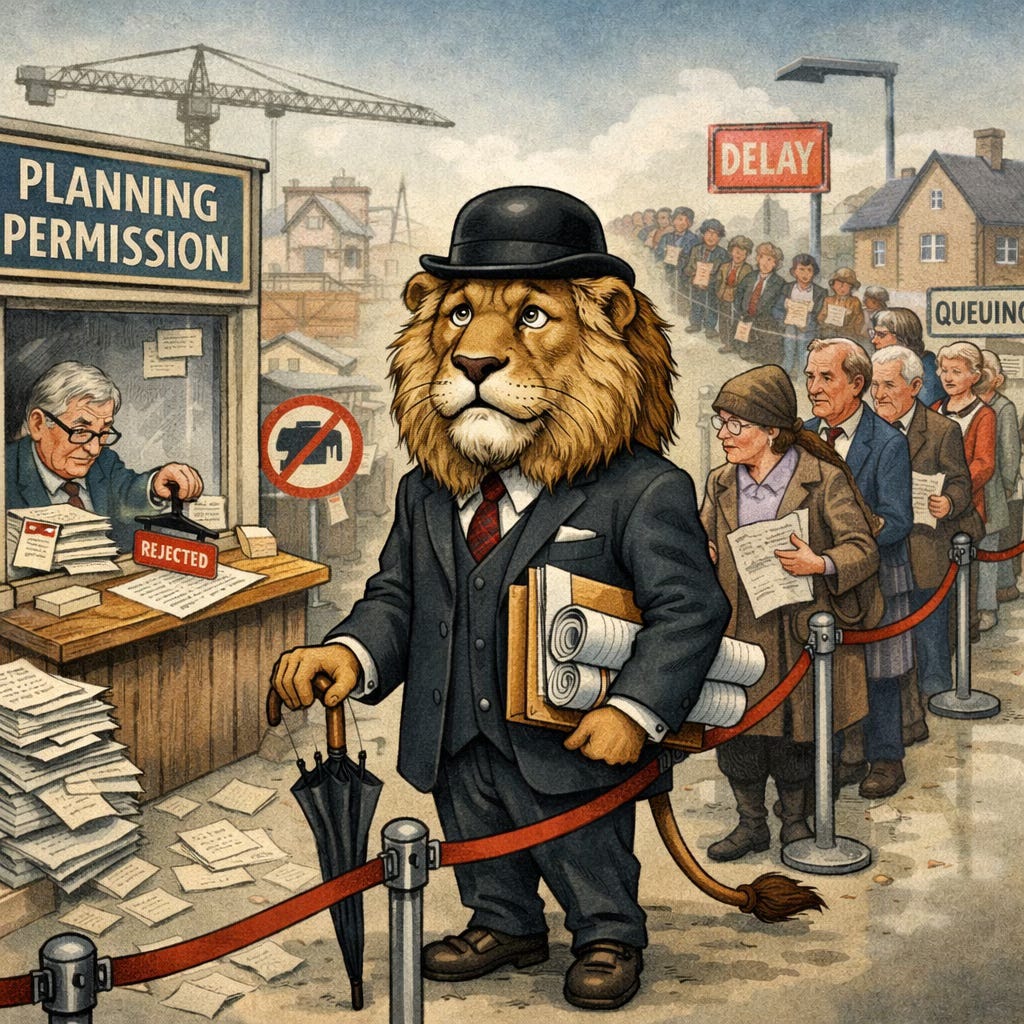
Let’s talk about housing, the thing you can no longer afford.
In 1947, the Town and Country Planning Act nationalized development rights. Before 1947, you could build unless the government specifically prohibited it. After 1947, you couldn’t build unless the government specifically permitted it.
You stole property rights from your own citizens and handed them to local planning committees, whose members are typically retired busybodies with nothing better to do than ensure no one builds anything taller than a shrub within view of their morning tea.
The results:
Britain has a 4.3 million home backlog compared to Western European averages. Not a shortage—a backlog. Houses that should exist but don’t. People who should have homes but can’t.
The house price-to-income ratio has doubled: 4.1x in the 1970s to 8.8x today. In 1984, houses cost 3.6 times annual income—the most affordable year in fifty-seven years of data. In 1984! When Thatcher was in power and everyone was complaining about how terrible things were! Those were the good old days.
Homeownership among middle-income 25-34-year-olds has collapsed from sixty-five percent in 1995-96 to twenty-seven percent in 2015-16. That’s a thirty-eight-percentage-point drop in twenty years. An entire generation locked out of the most basic form of wealth-building.
The absurdities are endless. A fourteen-flat development in Walthamstow—ten minutes from the Victoria Line, exactly where you’d WANT housing—required a 1,250-page planning application with over seventy separate documents. It was still waiting after a year. In the 1930s, London flats got approved in three weeks.
Green belt policy blocks two-thirds of suitable housing locations within commuting distance of major cities. Around London, nine out of ten suitable sites are in the green belt. Building on all identified suitable land would reduce the green belt by less than five percent. But no government will touch it, because homeowners vote, and homeowners don’t want their views disturbed by... other people having homes.
You want to know why Britain can’t build infrastructure? HS2 costs three hundred ninety-six million pounds per mile. French high-speed rail: thirty-one million. Britain pays TWELVE TIMES MORE for the same thing. Tokyo builds sixty-two thousand homes per year. London manages thirty to forty thousand.
This isn’t a natural disaster. It’s not an act of God. It’s a law passed in 1947 that you’ve simply chosen not to change. You could fix this tomorrow. You could repeal Section 106 agreements, reform compulsory purchase, liberalize the green belt, and watch housing supply respond to demand like it does in every other functioning economy.
You choose not to.
Sam Dumitriu at Britain Remade has documented this lunacy in excruciating detail. I recommend his Substack if you want to understand exactly how a great nation decided to strangle itself with paperwork.
Let’s talk about healthcare, the thing you worship.
7.4 million people are on NHS waiting lists. That’s roughly ten percent of your entire population. One in ten Britons is waiting for medical care.
The median wait has nearly doubled: 7.6 weeks in October 2019 to 13.3 weeks today. Some 171,000 patients have waited over a year. 161 have waited over two years.
The number waiting over twelve hours in A&E has exploded from 1,100 in November 2019 to 50,600 today. That’s a forty-six-fold increase, and it’s linked to an estimated 16,600 excess deaths in 2024 according to the Royal College of Emergency Medicine.
Seventy-nine percent of NHS trusts now treat patients in corridors. Not occasionally. Routinely. The Royal College of Nursing documented nurses caring for up to forty patients in a single corridor, unable to access oxygen, cardiac monitors, or defibrillators. Their January 2025 report found patients dying in corridors and going undiscovered for hours. Pregnant women miscarrying in corridors. Intimate examinations conducted in public areas.
The UK has 2.8 doctors per 1,000 people; the OECD average is 3.6. The UK has 2.5 hospital beds per 1,000; the OECD average is 4.4. The King’s Fund says the UK would be “in the relegation zone” if health resources were a football league.
British people now fly to Lithuania for hip replacements. 248,000 UK residents traveled abroad for medical treatment in 2019—double the 2015 figure.
You have socialized healthcare that doesn’t provide healthcare. You have free medicine that you can’t access. You have a National Health Service that operates like a shrine: untouchable, unquestionable, and increasingly unable to perform its basic function.
Let’s talk about dentistry, the thing that’s become DIY.
Britain has a catastrophic dentist shortage. Ninety-seven percent of new patients trying to access NHS dental care were unsuccessful. Over half of England’s population cannot see an NHS dentist. There are 5,500 unfilled dental positions—nearly half a million days of lost NHS activity annually.
At the same time, thousands of qualified foreign dentists cannot work because of bureaucratic bottlenecks.
The Overseas Registration Examination Part 2 has only 144 places per sitting. Booking fills within two minutes of the online portal opening. If you don’t have the fastest internet connection, you don’t get a slot.
In June 2024, a technical error opened booking two days early. Some candidates secured spots. When the official window opened: “fully booked within seconds.” The General Dental Council acknowledged around eighty candidates were affected. No action has been taken.
Mohamed Ibrahim is an Egyptian dentist with six years of experience. He submitted his application in December 2023. The GDC cancelled it, claiming they “had not received documents, and their whereabouts remain unknown.” After months of complaints, it was finally processed in March 2024—but by then he’d missed the booking window. Two years later, he’s still working as a dental nurse.
Ahmed holds a postgraduate master’s degree in dental implantology. He is currently working at McDonald’s.
The human cost of this bureaucratic incompetence is genuinely Dickensian. Ten percent of Britons have performed dental work on themselves. Thirty-four percent have tried to pull their own teeth. Thirty-two percent have given themselves fillings. Linda Colla, seventy-five, pulled her own teeth after a seven-year wait for an NHS dentist.
When an NHS dentist opened registrations in Warrington, queues of over a hundred people formed at 2:30 AM. Police were called for crowd control in Bristol—”more typical of a Taylor Swift concert than a dental waiting room.”
The government announced a solution in February 2024: provisional registration allowing supervised practice without the examination. As of February 2025, it remains unimplemented.
Ministers in October 2024 described the situation as “truly Dickensian.”
They were not exaggerating.
Let’s talk about Brexit, the thing that broke your brain.
The 2016 referendum was legally advisory. The House of Commons Briefing Paper told MPs explicitly: the referendum was “advisory only, and would not be binding on Parliament or government.” The Minister for Europe confirmed it in Commons debate: “The referendum is advisory.”
No threshold was set. No supermajority requirement. No minimum turnout. Only thirty-seven percent of the total electorate voted Leave.
Parliament is sovereign. Parliament cannot bind itself. This is basic British constitutional law. A referendum cannot compel Parliament to do anything.
Yet Parliament treated an advisory referendum, with no specified terms, won by a minority of the electorate, as an irrevocable mandate to pursue the hardest possible exit from the largest trading bloc on Earth.
The campaign promised three hundred fifty million pounds weekly for the NHS. The UK Statistics Authority chair called continued use of this figure “misleading and undermines trust in official statistics.” The actual net contribution was closer to £136-248 million. The IFS called the claim “clearly absurd.” The NHS funding increases since came from tax rises and borrowing, not any Brexit dividend.
Here’s what Brexit could have been: Singapore-on-Thames. No import or export taxes. Minimal regulation of commerce. Open immigration with a bonding requirement. A free-trading paradise, nimble and unencumbered, the Hong Kong of Europe.
Here’s what Brexit became: the same regulations, more paperwork, less trade, and an economy that has permanently underperformed its potential.
The numbers are brutal. UK goods exports to the EU fell eighteen percent below 2019 levels by 2024. The Trade and Cooperation Agreement caused a twenty-seven billion pound reduction in total goods exports. 16,400 firms that previously exported to the EU simply... stopped.
Studies estimate six to eight percent GDP loss compared to remaining. Investment is twelve to eighteen percent lower. The pound experienced the largest single-day depreciation of any major currency since Bretton Woods—eleven percent against the dollar, eight percent against the euro.
Four hundred forty financial services firms relocated operations to the EU. Nine hundred billion pounds in bank assets moved—ten percent of the UK banking system. Honda closed Swindon. Sony and Panasonic moved their European headquarters to the Netherlands.
Philip Hammond floated the Singapore vision in 2017. It died with Liz Truss’s mini-budget. Corporation tax was raised, not cut. The UK in a Changing Europe tracker shows the government “did not lack for ideas about rewriting EU regulation, but ultimately delivered little substantive change.”
You shot yourself in the foot, then complained about the hole in your shoe.
The political chaos since Brexit would be comic if it weren’t so depressing.
Six Prime Ministers in eight years. The same number as in the previous thirty-seven years.
Liz Truss lasted forty-nine days—the shortest-serving PM in British history. The Daily Star started a live YouTube stream of a lettuce to see whether she’d resign before it wilted.
The lettuce won.
Her forty-five billion pounds in unfunded tax cuts triggered the pound’s collapse to record lows and forced the Bank of England into a sixty-five billion pound emergency intervention to prevent pension fund collapse. The IMF took the unusual step of openly criticizing UK policy. Kwasi Kwarteng became the shortest-serving Chancellor in fifty years at just thirty-eight days.
Here’s the tragedy: her ideas weren’t entirely wrong. Lower taxes, less regulation, pro-growth policies—these are defensible positions. The execution was catastrophic. The sequencing was insane. The political management was nonexistent. Good ideas, implemented so badly that they discredited themselves and empowered the opposition.
And what an opposition. Keir Starmer now holds the worst Prime Minister approval rating since Ipsos began tracking in 1977: negative sixty-six net satisfaction. Thirteen percent satisfied, seventy-nine percent dissatisfied. Labour’s voting intention has fallen to eighteen percent—equaling the party’s all-time low.
His “loveless landslide” won Labour 33.7 percent of the vote—the lowest for any governing party since 1830, on the most disproportionate election result in modern UK history.
The Conservatives have responded by electing Kemi Badenoch as leader—the first Black leader of any major British party. Rishi Sunak was the first Hindu, first British Asian PM. In both cases, race was essentially a non-issue.
This deserves acknowledgment. While everything else falls apart, Britain’s multicultural democracy continues to work remarkably well. A cow-blessing Hindu became Prime Minister, and no one cared about his religion. A Nigerian-British woman became Conservative leader, and the main questions were about her policies, not her ethnicity.
This is genuinely wonderful. This is Britain at its best—the quiet, practical tolerance that absorbed wave after wave of immigrants and somehow made them all British.
If only the institutions worked as well as the diversity.
Now let me tell you about my country.
India in 1991 was about to collapse. We had two weeks of foreign exchange reserves. We had to airlift sixty-seven tons of gold to London as collateral for an IMF loan—a national humiliation broadcast to the world.
Our share of global GDP, once 23-27 percent before colonization, had fallen to three percent at independence. The British had extracted wealth for two centuries, systematically deindustrialized the subcontinent, and left behind a nation so poor that its per capita income was lower than it had been two hundred years earlier.
Then we had our own socialist disaster. The License Raj. The Inspector Raj. Government permission required for everything. We grew at 3.5 percent annually—the “Hindu rate of growth”—while Asian tigers roared ahead at eight to ten percent.
In 1991, facing total collapse, we liberalized. We did what we should have done in 1947. We let markets work. We let people build. We let businesses compete.
The results:
India’s GDP in 1991: $266 billion, eleventh globally. India’s GDP in 2025: $4.187 trillion, fourth globally.
We passed the UK in 2022—seventy-five years after independence. We passed Japan in 2025. Growth that averaged 3.5 percent under socialist insanity now runs at 6.4-7.8 percent.
Poverty fell from 16.2 percent in 2011-12 to 2.3 percent in 2022-23. That’s 171 million people lifted out of extreme poverty. Not through charity. Through growth.
Our Unified Payments Interface now processes over 640 million transactions daily—surpassing Visa’s 639 million. UPI handles fifty percent of the world’s digital transaction volume. Unlike Visa’s 1.5-3 percent fees, transactions are free or nearly free.
In 2024, the Reserve Bank of India returned 100 tonnes of gold reserves FROM the UK for the first time since the 1991 crisis. We took our gold back.
Tata Group now owns Jaguar Land Rover, Tetley Tea, Corus Steel, and British Salt. Ford executives once questioned whether Tata should be making cars. Tata bought JLR from Ford for $2.3 billion.
In July 2025, Modi flew to Britain to sign a trade deal. The Financial Times headline: “What India’s economy can teach the UK.” The Lowy Institute: “Reverse colonialism?”
Starmer led a 125-person delegation to Mumbai, including Rolls-Royce and the London Stock Exchange Group, positioning Britain as India’s “gateway to going global.”
The colony is teaching the colonizer.
The irony is not subtle.
You taught us parliamentary democracy. We implemented it at a scale you never imagined—900 million voters in our last election.
You gave us common law. We still use it.
You gave us cricket. We made it profitable. The IPL is now worth twelve billion dollars. Indian cricket essentially subsidizes English cricket.
You gave us the English language. We made it ours—India now has more English speakers than Britain.
And you taught us, by example, exactly what not to do. We watched your socialism. We imitated it. We suffered for forty-four years. Then we learned.
In 1991, we chose growth over ideology. We chose markets over planning. We chose the future over the past.
Why can’t you?
Britain possesses perhaps the most extraordinary collection of structural advantages of any nation on Earth.
You have Oxford, ranked the world’s best university for the tenth consecutive year.
You have London, ranked the world’s best city for the tenth consecutive year.
You have the world’s language. 1.5 billion people speak English. Every international business contract, every scientific paper, every air traffic communication—English.
You have the world’s preferred contract law. Twenty-seven percent of the world’s legal jurisdictions are based on English common law. It contributes thirty-eight billion pounds to your economy annually.
You have the Beatles—best-selling band in history, 600 million records sold. You have Pink Floyd, whose “Dark Side of the Moon” spent 937 weeks on the Billboard 200. You have Monty Python, which taught the world that comedy could be intelligent. You have Paul McCartney and David Gilmour, still performing, still genius, living treasures for all humanity.
You have the BBC, reaching 450 million people weekly. You have the British Museum, 6.5 million visitors annually. You have the Royal Shakespeare Company, the National Theatre, the Proms.
You invented football, rugby, tennis, golf, cricket, badminton, squash, and table tennis. You gave the world sport.
You have a genuinely successful multicultural society where a Hindu becomes Prime Minister and a Nigerian-British woman leads the Conservative Party and nobody much cares about their ethnicity because you’ve quietly figured out how to make diversity work.
AND YOU CANNOT BUILD HOUSES.
You cannot let qualified dentists take an exam.
You cannot stop arresting people for silent prayer.
You cannot figure out how to leave the EU without shooting yourself in the face.
A nation with all this—ALL OF THIS—is strangling itself with planning permission.
I have loved you for forty-six years.
I loved you before you loved yourself—your irony makes self-love impossible, I understand.
I loved you when I was a thirteen-year-old testing propaganda against reality and discovering that reality was better.
I loved you through Thatcher and Major and Blair and Brown and Cameron and May and Johnson and Truss and Sunak and Starmer. I loved you through the Winter of Discontent and the Falklands and the crash of ‘08 and Brexit and COVID.
I loved you when you gave the world the Beatles and Python and Pink Floyd. I loved you when you stood alone in 1940. I loved you when you invented parliamentary democracy and common law and the industrial revolution and the abolition of slavery (yes, after centuries of benefiting from it, but you did abolish it).
I loved the bacon butties and the Belisha Beacons and the queueing and the apologizing and the understatement and the warm beer and the cold reserve that somehow feels like welcome once you understand it.
I love you still.
But what are you doing to yourself?
You’re arresting comedians with armed officers while burglaries go unsolved.
You’re preventing houses from being built while young people live with their parents into their thirties.
You’re letting qualified doctors and dentists work at McDonald’s while your citizens pull their own teeth.
You’re treating an advisory referendum as an unquestionable mandate while your economy shrinks.
You’re cycling through prime ministers faster than Italy while lecturing other countries about stable governance.
Why?
The positive Brexit still exists. It’s not too late.
Slash the regulations that serve no purpose. Fix the planning laws—they’re just laws, you can change them. Let people build. Let people speak. Let dentists practice. Become the free-trading, low-tax, high-growth economy you could have been.
Stop listening to the NIMBYs. Stop empowering the busybodies. Stop prosecuting thought crimes. Stop pretending that the EU is responsible for problems you created before EU membership and have continued since leaving.
Learn from us. Your former colony figured it out. We stopped the socialist insanity in 1991. We liberalized. We grew. We’re not perfect—God knows we’re not perfect—but we learned.
You taught us what not to do. Now let us return the favor.
In 1979, a thirteen-year-old boy fell in love with a civilization.
In 2025, a fifty-nine-year-old man watches that civilization punch itself in the face, repeatedly, for no apparent reason.
The chocolate is still good. The queues are still orderly. The pubs still have warm beer and cold welcomes. The eccentricity is still magnificent—the butties, the beacons, the silent apologies, the five-day cricket matches that end in draws.
But somewhere along the way, the nation that invented freedom forgot what it meant.
Figure it out, Britain.
The rest of us are watching.
And some of us still love you—even when you make it very, very difficult.
“Hanging on in quiet desperation is the English way.”
Maybe. But you don’t have to hang on in desperation.
You could, you know, just stop doing the stupid things.
It’s allowed.
If you enjoyed this post, consider subscribing to The India Paradox. I write about India, economics, culture, and apparently now Britain’s inexplicable decline.
Check out my book, The Science of Free Will. It’s not about India, or Britain, but about what it means to have free will in a deterministic universe. What does that mean for the future of AI? Why can’t we trade with ants? Why do we have/need a Supreme Court in a deterministic universe? What is this feeling of free will that we all have, really?
You can find all my previous posts at samirvarma.substack.com.
Samir Varma is a recovering physicist (but still publishing in Physics) who writes about India, economics, and the absurdity of human institutions. He first visited Britain in 1979 and has been in love ever since, though he increasingly feels like a spouse watching his partner develop a drinking problem. He can be found at samirvarma.substack.com, where he mostly writes about India but occasionally ventures into interventions for other countries. He also likes to write about physics, science and finance.
Having briefly skimmed your article (apologies, I will read it in full tomorrow), I'm left wondering why immigration wasn't mentioned as an issue. Regardless of whether you're ultimately pro-immigration or not, the way it was handled in the last few years has utterly undermined voters faith in the traditional parties (hence the explosion of Reform).
Surely this deserved a significant mention in such an article cataloguing the different points of failure in British society.
Charming piece and the complements are well received, but we never had freedom of speech. We used to rely on our natural reserve and politeness to avoid conflict, but online that is clearly insufficient.
Neither have we had freedom of religion or religious expression and an American should know that.