Mediocre at Nothing
Why a nation of 1.4 billion produces world champions and world’s-worsts, and almost nobody in between.

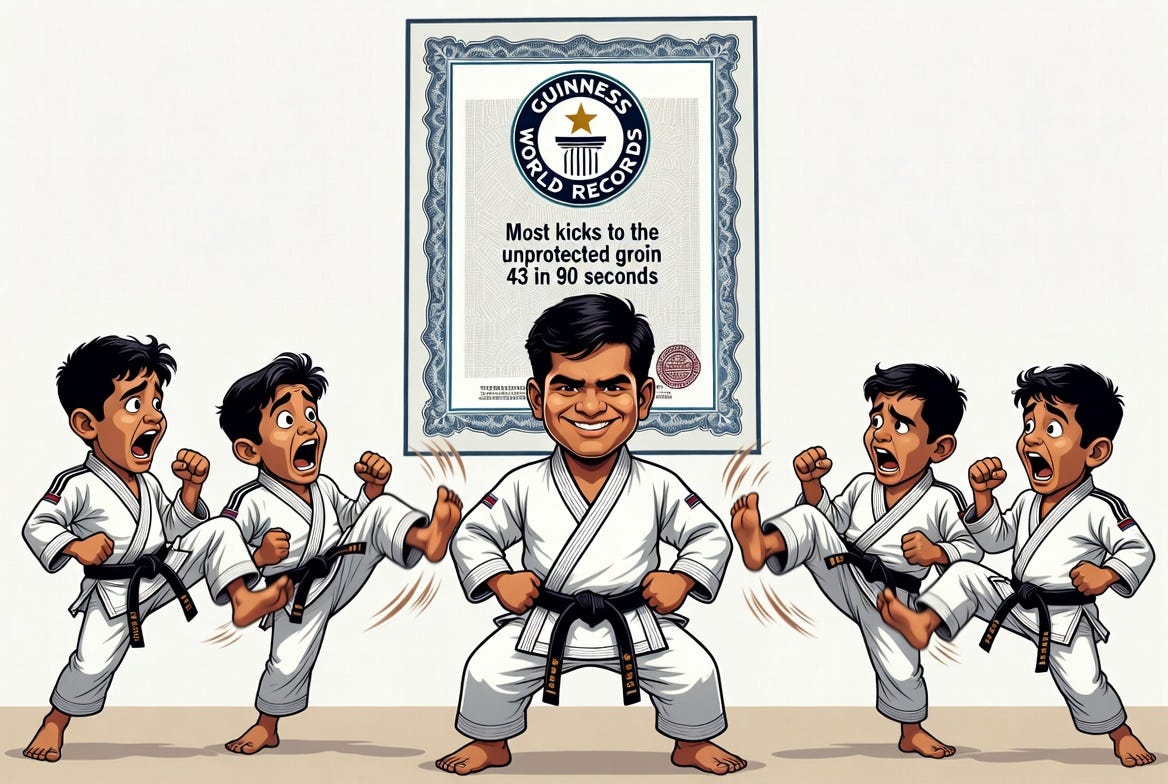
There is an Indian journalist named Bibhuti Bhushan Nayak who holds a world record for being kicked in the groin.
I want to be precise about this, because the precision is the joke. In 1998, Nayak — a journalist and martial artist associated with the Times of India — invited four of his karate students to kick him, unprotected, in the groin. They managed forty-three kicks in ninety seconds. He was not content with this. He went on to set a record for the most concrete slabs broken over his groin with a sledgehammer (three), the most one-handed cartwheels in a minute (thirty-four), and 1,448 sit-ups in an hour. Often he set three records in a single day, having given himself no time to practice.
Hold that man in your mind. We will come back to him, because he is not a curiosity. He is the entire argument.
The thing about a billion people
I was watching the World Cup recently — Egypt, Cape Verde, Curaçao, Morocco. Curaçao has a population of about 150,000 people. That is not a typo. It is roughly the population of a mid-sized Indian suburb that nobody outside India has heard of. And Curaçao was at the World Cup — they lost 7–1 to Germany, a result they earned the hard way, against a Germany that was actually trying. India would never make Germany try. The gap would be so total that the Germans would stop of their own accord somewhere around the eighth goal, not out of mercy but out of sheer pointlessness, the way you stop pressing a button that no longer does anything — unless, of course, they decided to keep going purely to see how high the number could climb. (Number go up.) India, 1.4 billion people, one in every six humans alive, has never played in a World Cup at all. Not once. (India technically qualified for the 1950 tournament, by the elegant mechanism of every other Asian team withdrawing, and then withdrew. This is the most Indian sentence I will write today.)
The men’s national football team hovers somewhere around 140th in the FIFA rankings, in the company of nations you would struggle to find on a map. And before you reach for the comforting explanation — cricket-mad country, football just isn’t the thing — look at the Olympics, which span everything humans have invented to do with their bodies. At the 2024 Paris Games, India won six medals. Zero gold. Six medals for 1.4 billion people works out to roughly one medal per 233 million human beings, which places India, reliably, Games after Games, among the very worst large nations on Earth by any per-capita measure. Grenada did better. Dominica — population seventy thousand — did spectacularly better, winning the first Olympic medal in its history, a gold. Saint Lucia did better. Pretty much every speck of a country that medaled at all did better, per person, than the nation of 1.4 billion.
Now hold that in your mind, next to the man being kicked in the groin, and notice that something does not add up.
Because here is the same country. India produced Viswanathan Anand, who held the world chess championship for years, and then a whole generation of grandmasters behind him — Gukesh, who in 2024 became the youngest undisputed world chess champion in history, Praggnanandhaa, Erigaisi, an entire conveyor belt of teenagers dismantling the world’s best. India was the dominant force in field hockey for an era, with eight Olympic golds. India is, in cricket, simply the center of gravity of the entire sport — its best players, its biggest league, its money, its future. And in the long, strange tail of human achievement — spelling bees, memory competitions, the Guinness book itself — India shows up again and again and again.
So which is it? Is India terrible at sport, or world-class at it?
The answer is: both, and the gap between the two is the most interesting thing about the country. India is either historically, catastrophically, almost-comically bad at something, or it is at or near the best on the planet. What India is almost never is mediocre. It does not do the vast, boring middle of the distribution. It lives in the tails.
Why the middle goes missing
Here is the strongest version of the objection, and it deserves a fair hearing. India is poor. For most of its modern history it was very poor, and decades of childhood undernutrition do not build Olympic sprinters. There are no playing fields. There is no money. A talented kid in Lagos or São Paulo has more grass to run on than a talented kid in most of urban India. Poverty is real, and it is not nothing.
But poverty cannot be the whole story, for the simple reason that poverty is a property of the whole country — and the whole country is the thing that simultaneously tops the chess world and fields one of the worst football teams on Earth. If deprivation were the explanation, it would suppress everything uniformly. It would not pick chess to win and football to lose. Something is selecting. And once you ask what, the answer falls out, and it is not about money. It is about what kind of machinery a given pursuit requires.
Consider what it takes to be merely good — not great, just solidly, professionally competent — at football. You need youth academies. You need coaches who themselves were coached. You need leagues with a hundred clubs and a thousand journeymen, a scouting system, age-group competitions, physios, pitches, a whole institutional pyramid whose entire function is to manufacture the fifty-thousandth-best player in the country and make him good. Excellence in football sits at the top of a very tall pyramid of competence. No pyramid, no peak. You cannot skip the middle, because the middle is the thing that produces the top.
Now consider what it takes to be the best chess player in the world. You need a board. You need an opponent, or these days a laptop. And you need one obsessive human being, drawn from a very large population, who will not stop.
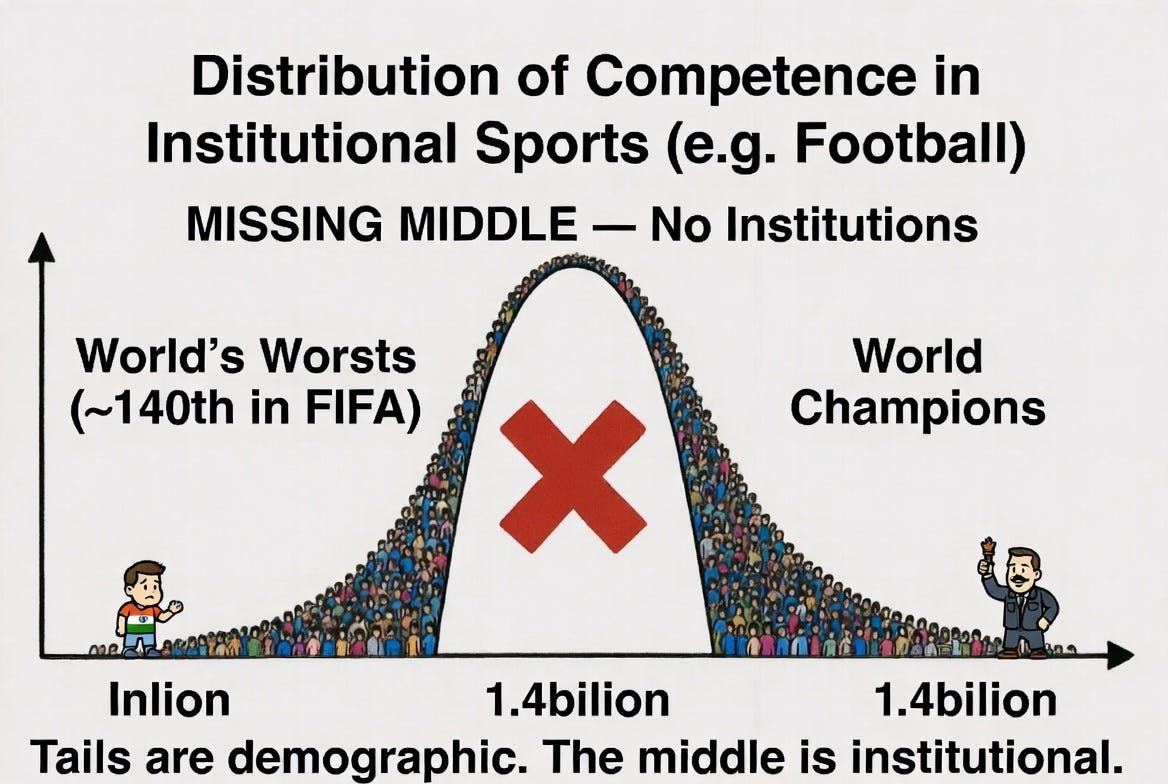
That is the whole difference. The tails are demographic. The middle is institutional. Excellence in a board-and-a-fanatic pursuit can emerge from raw population times raw obsession: take one human in ten million who is wired for it and refuses to quit, and out of 1.4 billion people you have produced a hundred and forty potential world-beaters with no system required. But competence — the dull, dependable, fiftieth-percentile-of-a-deep-field competence that you can only get by building it — requires exactly the thick institutional middle that India, for reasons this entire series has been about, never built.
India has the demographics. India lacks the institutions. So India gets the tails and misses the middle. Football needs a system, and India is bad at systems. Chess needs a genius, and India has, by the pitiless arithmetic of scale, an enormous number of geniuses. The empty World Cup qualifying table and the world chess crown are not two facts. They are one fact, seen from two angles.
Let me give you the missing middle as I watched it happen with my own eyes, when I was nine years old. Delhi, 1975, the DCM Trophy — one of the big domestic football tournaments of the day. South Korea, for reasons I have never fully understood, sent a university team: Hanyang University. Students. They were playing against the best professional clubs India had. And in their opening match — I do not remember the opponent — these Korean undergraduates were such obvious gentlemen that they visibly took it easy, coasted, and won by a single goal, plainly operating at about five percent of their actual capacity. One of the Delhi papers ran a solemn column the next day about how the South Koreans had disappointed in their opener. As Dave Barry would say, I am not making this up.
Here is the part I think about. I was nine, and even I could see what the journalist could not: the Koreans were not disappointing. They were being kind. They were holding back to spare their hosts’ feelings — the way you let a small child win at cards — and a grown professional sportswriter looked at that mercy and mistook it for the limit of their ability. Hanyang, having been thus chided, proceeded to wake up and dismantle every subsequent opponent, and in the final they beat East Bengal — then as now one of the two greatest clubs in the country — 2–0. A college side. Touring undergraduates, knocking over India’s finest professional team to win the trophy, while the local press worried they weren’t quite living up to expectations.
And here is the detail that elevates the whole thing from anecdote to indictment, the part I did not appreciate until I went back and looked at the records decades later: 1975 was not a fluke. It was the beginning of a habit. Hanyang came back the very next year and shared the title, having drawn its finals against the Border Security Force. Then Myongji University won it in 1981. Then Incheon University won the 1982–83 tournament. Then Kyung Hee University won it in 1990. Then Incheon University won again in 1992–93, beating East Bengal in the final for the second time in the tournament’s history. Four different South Korean universities, six titles between them, across seventeen years — visiting students treating one of India’s flagship football tournaments as a kind of working holiday, with India’s best professional clubs lining up obligingly to be the runners-up. That is the missing middle, rendered not as a single embarrassing afternoon but as a two-decade structural fact that nobody in Indian football apparently found alarming enough to do anything about: India’s best could not reliably beat other nations’ undergraduates, and the gap was sometimes so wide that the undergraduates had to pretend, out of politeness, that it was closer than it was.
The billiards room at the Gymkhana
Let me tell you about Michael Ferreira.
Ferreira — “the Bombay Tiger” — is a lawyer and a three-time World Amateur Billiards Champion. In 1978 he became the first amateur in history to break the thousand-point barrier, scoring 1,149. He was, for a stretch of the 1970s and 80s, plausibly the best player of English billiards alive. He was also a man who understood the argument of this post in his bones, and was furious about it: he spent his playing career campaigning for India to give some facilities, any facilities, to sports other than cricket and hockey. He felt it so keenly that in 1981 he refused the Padma Shri — a national honor — in protest, on the grounds that the cricketer Sunil Gavaskar had been given the more prestigious Padma Bhushan and that his own world titles were worth no less. (The Padma Bhushan did eventually follow, after his third world title; the official award rolls list it in 1984. He had made his point.) Here was a world champion, produced by a country that had given him essentially nothing, who spent his career angry about the missing middle. He is the thesis with a civilian award.
Ferreira was a friend and colleague of my mother’s. And one day my father and I took him to the billiards room at the Gymkhana Club in Delhi.
You need to understand the Gymkhana. It is one of those colonial-era institutions where the waiting list for membership is measured in decades and the disapproval is measured in micrometers. My father was a member. Michael Ferreira — three-time champion of the world — was not, and that is the whole point. Ferreira is a Bombay man, a Bombay lawyer; in Bombay he had his clubs and his tables. But he was in Delhi, away from home, and the best billiards player alive wanted somewhere to practice — and in Delhi the way that happened was for a member of a club like the Gymkhana to sign him in as a guest and lend him a table. Read that sentence again. A reigning world champion, visiting the national capital, could not simply walk in somewhere and find a table to keep his eye in; he had to be somebody’s guest. This is the missing middle you can stand next to. It is a man with three world titles standing at the door of a Delhi club he did not belong to, waiting to be signed in, so that he could go inside and be the best on Earth at the thing the club happened to own a table for.
So my father signed him in, and got, as his reward, the privilege of being Ferreira’s practice partner. I put “partner” in quotes too, and “play,” because playing billiards with Michael Ferreira consisted of the following procedure. You broke. Then you sat down. Then you watched, in respectful silence, as he ran the entire table — every ball, methodically, without apparent effort, the way you or I might tidy a desk. Then, when he was finished, you got up, you broke again, and you sat back down. That was the game. You were not an opponent. You were the man who occasionally reset the balls so that the demonstration could continue.
Now here is what happened. Other members of the club, seeing a world champion at the table, began to drift over. And then they began to grumble. They wanted a turn. They felt that my father was hogging Ferreira — monopolizing him, refusing to let the rest of the room have a crack — as though a man’s own invited guest were a shared club facility, like the sauna or the good snooker cue, that it was somehow selfish of him to keep to himself.
My father started laughing, and could not stop.
Because think about what those men were asking for. They were lining up to “play” a three-time world champion as though he were a club amenity — the good cue, the corner table, a thing you sign up for in fifteen-minute slots. And the contest they were demanding a share of did not exist. There was no game to be had. The gap between Michael Ferreira and a competent, enthusiastic Gymkhana club member was not a gap you could play across. It was the gap between a world-class tail and a keen amateur — total, unbridgeable, and faintly absurd the moment you saw it laid out on green baize. You broke, and you sat down. That was all anyone in that room was ever going to do, member or not.
That billiards room is India. One man at the very top of the world, drawn from a vast population by sheer individual obsession. A queue of pleasant, capable amateurs who imagine the distance is smaller than it is. And no structure of any kind connecting the two — no rungs on the ladder, no middle to climb through, just the champion clearing the table and everyone else waiting for a turn that was never going to be a contest.
The tails of every distribution
Once you see it in sport, you see it everywhere, because it is not really a fact about sport. It is a fact about how India distributes excellence and competence across everything.
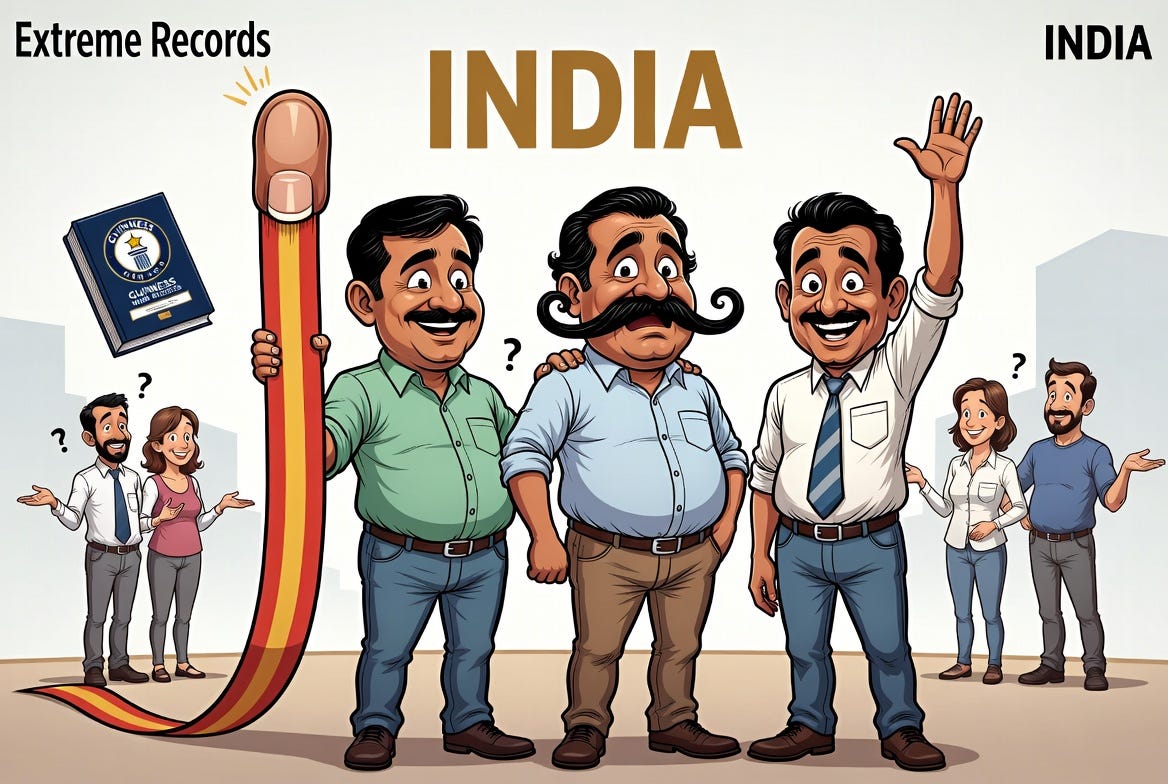
The man with the longest fingernails ever recorded on a single hand is Shridhar Chillal of Pune — an aggregate of 909.6 centimeters, about the length of a London bus, grown on his left hand over sixty-six years. He started in 1952, after a schoolteacher beat him for accidentally snapping the teacher’s own long nail and told him he would never understand the care it took not to break one. So he spent the next two-thirds of a century proving the teacher right. The man with the longest mustache is Ram Singh Chauhan of Rajasthan — roughly fourteen feet, untrimmed since 1970, oiled daily with coconut and mustard oil and once featured in a James Bond film. In Varanasi there are ascetics, the Khareshwari, who have taken a vow never to sit or lie down again, not even to sleep, for years on end. And there is Amar Bharati, a former Delhi bank clerk who, by every account, raised his right arm above his head in devotion to Shiva in 1973 and has not lowered it since — the muscles long withered, the fingers fused and feelingless, the arm now a thing he could not bring down if he wanted to. Half a century, pointing at the sky.
None of these is a record in the institutional sense — there is no federation of arm-raising, no national mustache development squad, no junior-varsity circuit feeding talent up to the Standing Babas. That is exactly the point. These are not the products of systems. They are the products of one human being, drawn from an ocean of human beings, who decided to do an extreme thing and would not stop. Population times obsession, with the institutions subtracted entirely. They are Gukesh and the empty football table wearing a different costume.
But they built the largest city on Earth
At this point a reasonable reader objects: if India is so hopeless at organization, explain the Kumbh Mela.
It is a fair challenge, and it nearly sinks everything, so let me take it seriously. Every few years, on the banks of the Ganges, the same Indian state that cannot reliably deliver tap water conjures the largest temporary city on the face of the Earth. Tens of millions of pilgrims — at the largest gatherings, well over a hundred million people across the full span — arrive at a stretch of riverbank that was empty mud a few weeks earlier and is now laid out with roads, pontoon bridges, electricity, water points, sanitation, hospitals, police, and a grid of camps stretching to the horizon. Then, when it is over, the whole thing is struck and the river takes the ground back. A metropolis the size of a major world capital, summoned and dissolved on a schedule, decade after decade. (Not flawlessly — there have been terrible crowd crushes, including recent ones, and I will not pretend otherwise.) But as a feat of mass logistics it is genuinely staggering, and it is unmistakably the work of the same government that elsewhere cannot keep a municipal drain clear.
So which is it — can India organize, or can’t it?
And the answer, again, is that the question is wrong, because it lumps together two completely different things. The Kumbh Mela is a project. It is a single, episodic, overwhelming mobilization toward one legible goal, with a hard deadline and the full weight of the civilization pointing at it. India is magnificent at projects. It put a spacecraft in orbit around Mars on a shoestring, on the first attempt. It runs the largest election in human history — nearly 970 million eligible voters, 642 million ballots actually cast in 2024 — every few years. It builds a city for a hundred million people and then takes it down. When India decides, all at once, to do one enormous thing, it is as good as anyone alive.
What India historically could not do is the other kind of organization — not the surge but the sustain. Not the project but the institution: the boring, permanent, unglamorous machinery that does the same modest task competently every single day for forty years with nobody watching and nobody’s salvation on the line. The Kumbh is the arm raised for fifty days. The functioning water utility is the pyramid maintained for fifty years. India has always been able to summon the first. It is the second that goes missing — and the second is precisely what produces the fiftieth-percentile midfielder, the mid-sized firm, the city that works on a Tuesday in March when nothing in particular is happening.
You can see the whole distinction inside a single Indian household. Indian homes are, very often, spotless — swept, scrubbed, polished to a gleam, maintained with fierce daily attention. Step outside the front door and the city is filthy as all hell. The same people, the same hands, the same standards of cleanliness — immaculate within the boundary of what an individual or a family can personally maintain, and a catastrophe the instant it requires a collective institution to do the maintaining. The house is the surge you own. The street is the sustain you have to build together, and the machinery for building it together is the thing that was never there.
And it is worth saying plainly why it was never there, because this is not some eternal Indian incapacity written into the soul. A great deal of that missing machinery was deliberately destroyed. When the British arrived, India was not a backwater waiting to be modernized — it was, in several of the most demanding industries on Earth, the world leader. In 1750 India produced something like a quarter of the entire planet’s manufacturing output; by 1900, after a century and a half of the Raj, that share had collapsed to about two percent. That is not a statistic about poverty. That is a statistic about demolition.
Take the two industries India most conspicuously dominated. The first was textiles. For centuries the handloom weavers of Bengal had made the most coveted fabrics in the world — muslins so fine they were described as woven air — exported west to Egypt and Persia and east to Java and Japan, the cloth of choice for European aristocrats who had nothing at home that could touch it. The British did not merely out-compete this; they also legislated against it — taxing Indian cloth, protecting Lancashire’s mills, and, once Bengal was theirs to administer, running the supply chain in reverse: extract the raw Indian cotton, mill it into fabric in England, and sell that fabric back to the people who used to make the best in the world. (Honest historians note the decline had other causes too — Mughal political fragmentation, drought, transport costs, and above all the brute productivity of the power loom — and I will not pretend Britain did all of it single-handed. But the policy of suppressing a rival by statute rather than beating it on quality alone is a matter of record.)
The second was shipbuilding, and here the detail is so good I can hardly believe it is true. Indian shipwrights built their hulls from Malabar teak, which is naturally resistant to the marine worms that bored through European oak; an Indian teak ship could stay at sea for fifty to eighty years, while a British oak ship was often scrapped after twelve. The Parsi Wadia family of Bombay built vessels said to be “vastly superior to anything built anywhere else in the world” — so superior that the Royal Navy itself commissioned warships from them. One of those Bombay-built ships was HMS Minden, and there is a persistent legend — disputed by the kind of historian who ruins parties, and most likely false, since the better-attested account has the man aboard an American truce ship — that it was on the Minden‘s deck that an American lawyer, watching a battle in 1814, wrote the poem that became the United States’ national anthem. The detail may be apocryphal; the dependency is not. The British Empire, at the height of its naval power, was having warships built for it by Indian craftsmen because it could not build better ones at home. And then, over the following century, that industry too was regulated and starved out of existence, until the masters of the Indian Ocean were spectators on their own coastline. As one historian put it, the decline was never due to a lack of skill. It was due to a lack of sovereignty.
This is the deepest layer of the missing middle. Chandni Chowk, the great commercial artery of Mughal Delhi, was once among the richest market streets on the planet, the beating heart of an institutional ecosystem — guilds, financiers, manufacturers, the whole connective tissue of a working economy — that the Raj hollowed out over generations until it became a monument to what had been demolished. India did not simply forget how to build the middle. In the industries where it was the best on Earth, the middle was taken apart on purpose.
And then — this being India, and this being the through-line of everything I have written in this series — the country took the wound the British had inflicted and, for its first forty-four years of independence, made it dramatically worse. From 1947 to 1991 India answered colonial deindustrialization with homegrown socialism so creatively destructive that it managed to suppress the middle the colonizers had missed. This is not hyperbole. In 1979 the Finance Minister, Charan Singh, stood up to deliver his budget and, in the name of “a ruthless curbing of luxury expenditure,” raised the excise duty on toothpaste from 10.5 percent to 25 percent — because in the socialist paradise, clean teeth were a bourgeois indulgence. (I am not paraphrasing; the man said it, and I quoted the speech in From Goddess Lakshmi to Ration Cards.) You do not rebuild a wounded economy by taxing toothpaste as a luxury and rationing the right to manufacture; you finish the demolition the empire started, only this time with your own hands and a five-year plan. The roots did not begin to grow back in 1947. They began to grow back in 1991, when India finally stopped strangling itself.
But here is the detail that proves the whole argument — that the missing middle was always a policy, never a people — and it comes, as the best evidence in my life usually does, from my own family. My grandfather was the accountant to the original Mr. Oberoi, the man who built what became some of the finest hotels on Earth. And those hotels were magnificent during socialism, in the depths of the License Raj, at the very moment the rest of the economy was queuing for a scooter it would receive a decade later. How? Because hotels brought in foreign exchange — and foreign exchange was the one thing the regime wanted badly enough to permit excellence in pursuit of it. (The same postdescribes the full horror of what that regime did to ordinary people who needed dollars — the pittance you were allowed to take abroad, the impossibility of paying for a college application.) So in a country that forbade competence almost everywhere, there was a narrow corridor where competence was allowed, and into that corridor India poured world-class hotels, instantly, as good as anyone’s anywhere. The Oberoi was the missing middle made visible — a glowing island of institutional excellence in an ocean of deliberate scarcity. And its existence proves the scarcity was a choice. Indians did not lack the capacity to build the dependable, world-beating middle. They were forbidden from building it, except where the state had a reason to look the other way.
I know this because I spent many happy hours in those hotels as a boy in the early 1970s. They had, among other marvels, air-conditioning — which in the India of that era was not a convenience but a frank luxury, a thing that marked a different and cooler universe. My own family could not afford an air-conditioner until I was much older, and when one finally arrived it was a gift from my mother’s brother — given, let the record show, to a decorated naval fighter pilot and a barrister trained at Lincoln’s Inn. Those were my parents. Between them, a man who had landed burning aircraft for his country and one of perhaps a few dozen Lincoln’s Inn barristers in all of India earned a combined sixteen dollars a month. Sixteen.
And now I can hear the objection forming, because I have heard it from every earnest defender of the era: ah, but that’s the dollar figure — purchasing-power parity, the rupee went much further at home. No. That objection is the very thing this essay is about, and it is wrong twice over. First, the sixteen dollars is the official exchange rate — and under FERA, the foreign-exchange regime, the official rate was a polite fiction miles from the black-market rate, for the simple reason that you were forbidden from actually obtaining dollars. The gap between the two rates was not a technicality. It was the strangulation, expressed as a number. And second, the whole premise of purchasing-power parity is that there is something to purchase — and there was, to put it precisely, almost nothing. You could not buy the car (ten-year waiting list), or the telephone (eight-year waiting list), or, past a certain excise bracket, the toothpaste. The rupee “went further” the way the wrong key goes further in a locked room — impressive in the hand, useless in the lock. That is what a socialist exchange rate and a rationed economy did to a household stuffed with exactly the kind of talent a functioning country builds its competent middle out of — it left them unable to buy a window unit, waiting on the generosity of a relative. The cool air of the Oberoi and the heat of our flat were the two Indias of the License Raj: the tiny permitted enclave where India was allowed to be the best in the world, and the vast rationed scarcity where everyone actually lived.
That is why this is a story of hope and not lament. The capacity was never missing. The permission was. And the astonishing thing — the thing you can walk into and feel for yourself — is how fast the middle has grown in the three decades since India finally granted itself that permission. Go and stay in an Indian luxury hotel now, the descendants of the ones my grandfather kept the books for. Not a tail event, not one freakish genius — a whole category, a deep bench of trained professionals maintaining a flawless standard every single day, which is to say the very competent middle this entire post has been mourning. The first time you experience it you may quietly conclude you do not especially want to stay anywhere else ever again. The difference between then and now is not that Indians got better. It is that India got out of their way.
The exception that proves the mechanism
Here is the test of whether any of this is real, rather than a clever story I have told myself — and this series has spent its whole run catching satisfying stories that did not survive scrutiny, so I am obliged to apply the knife to my own.
If the missing middle is genuinely institutional and not just a matter of national temperament or some mystical Indian incapacity for team effort, then the mechanism makes a falsifiable prediction: build the institution, and the middle should appear. Where India has actually invested — money, academies, coaching, a real pyramid — it should stop living only in the tails and start populating the middle that produces reliable, repeatable, plural success.
And that is precisely what you see. In shooting, where money, coaching, academies, and real international competition began to accumulate, India went from Abhinav Bindra’s lone, miraculous gold in 2008 to Manu Bhaker winning two medals at a single Olympic Games in 2024 — not one freak champion, but depth. In badminton, where an actual training ecosystem grew up around academies and serious institutional backing, India produced not just a single star but a cohort — Olympic medals, world championship medals, and in 2022 the Thomas Cup itself, won for the first time, which is a team trophy and therefore exactly the kind of thing the missing-middle thesis says India should fail at. Unless, of course, you build the middle. In which case it shows up, right on schedule.
This is not a defeat for the argument. It is the argument’s strongest confirmation. The mechanism predicts its own exceptions. India is not constitutionally incapable of the boring competent middle. It simply does not get the middle for free, the way it gets the tails for free, because the middle has to be built and the tails only have to be born. Give India the institution and the middle materializes. Withhold it, and you are left with a billion people, a handful of world-beaters thrown up by the law of large numbers, and an empty space where the journeymen should be.
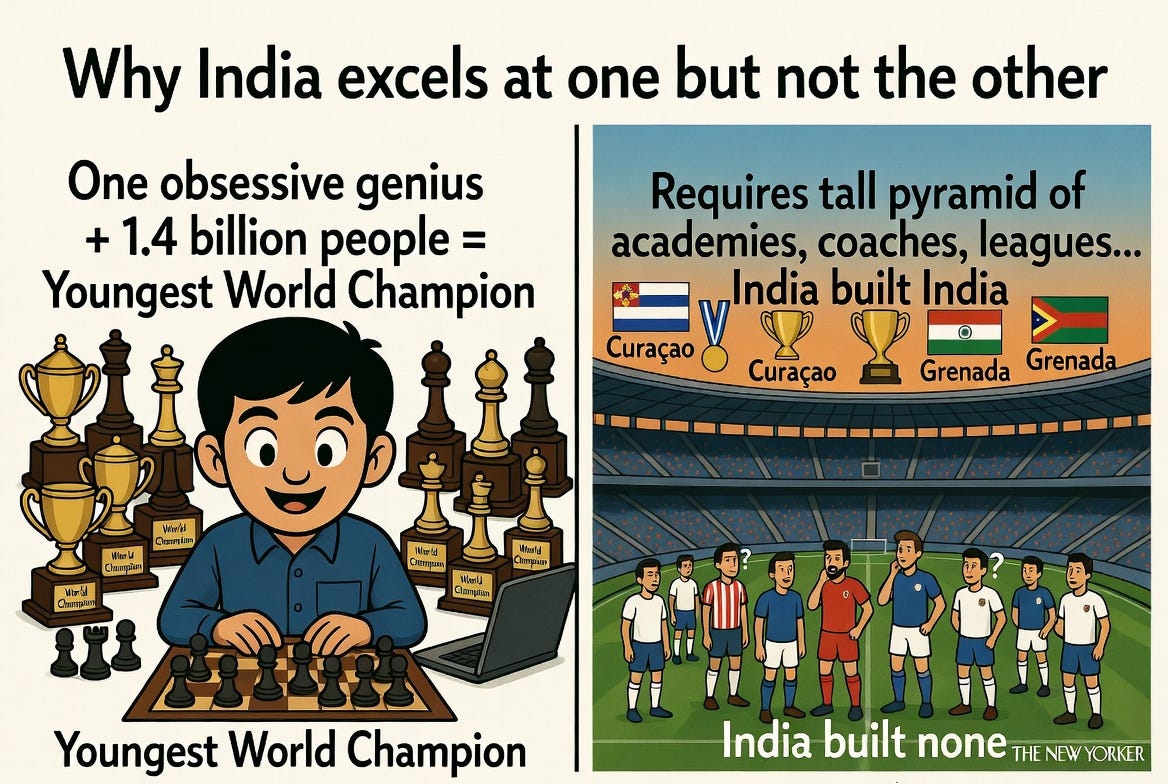
So the next time you wonder how a country of 1.4 billion cannot find eleven men to qualify for a World Cup, remember that it is the same country, governed by the same arithmetic, that produced the youngest chess champion in history and a man who let his students kick him in the groin forty-three times in ninety seconds. The midfielder India does not have and the sledgehammer-groin journalist it does are the same phenomenon. One requires a system India never built. The other requires only a single, magnificent, irreducible human being — and of those, India has always had more than its share.
You break. You sit down. And somewhere, someone clears the table.
If you found this essay worth your time, you may enjoy my book The Science of Free Will, which asks an equally uncomfortable question about an equally cherished story.
If you want to know more about India, start with The Paradox of India, the first essay — or browse the whole series.
Related country-specific work: Albion — Britain’s institutional decline, by someone who first saw the place in 1979.
Thank you for giving the backstory on India’s great hotel industry. No one does it better as experienced at our stay at the Hotel Oberoi Rajvilas in Jaipur and other high-end accommodations. Talk about personal attention and regard to detail! I often wondered how India could excel in this industry while languishing in others, and now I know. Following your Substack, and talking at length with the young people employed in these incredible hotels, has opened our eyes to the promise that modern India presents.