Big If True
Can a government roll its debt forever? A forgotten French bond supplies a strange piece of evidence — and a forty-six-page “if.”

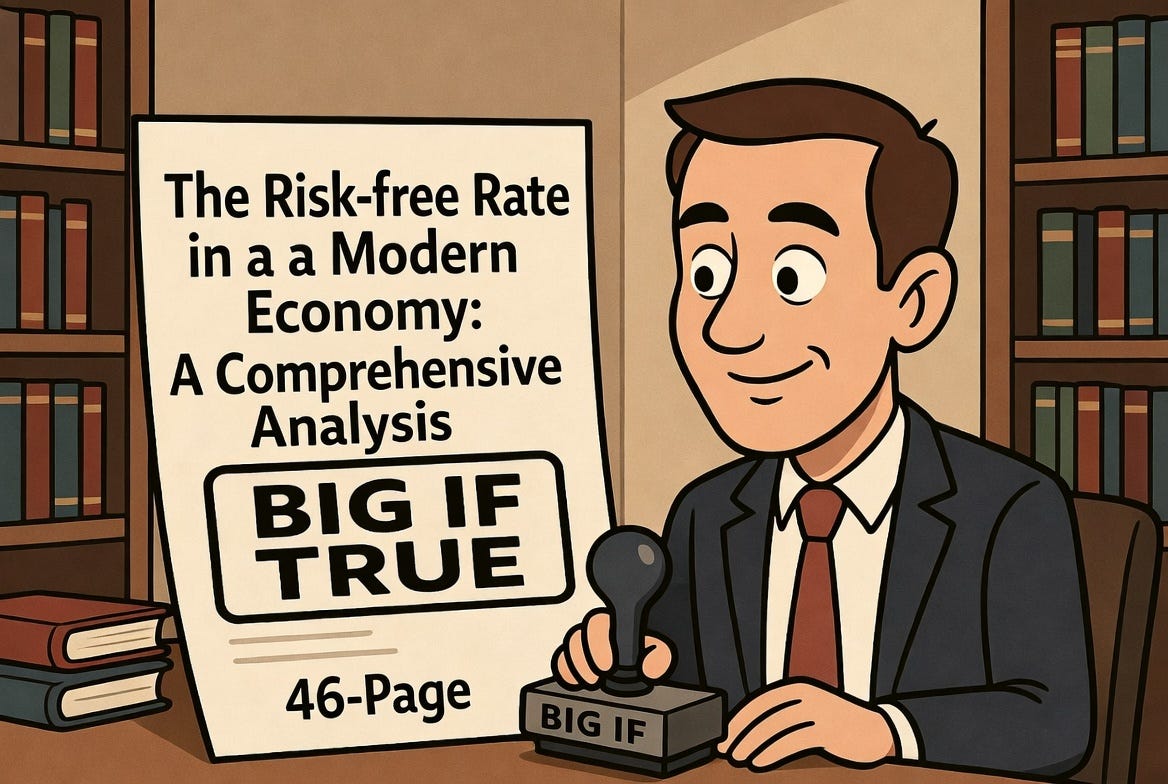
On June 2, Tyler Cowen gave a forty-six-page NBER paper a three-word review, and honestly it might be the most Tyler he has ever been. Luckily I was not drinking coffee at that moment else I might have choked on it!
The paper asks whether you can roll government debt forever. Cowen’s post reproduces two paragraphs of the abstract and links the thing — and then, for original commentary, offers exactly three words: “Big if true.”
That’s the whole review. No gloss, no “here’s why this matters” — he trusted you to do the work yourself. So let me do the disrespectful thing and do the work out loud, partly out of affection for the bit and partly because the gap between “big” and “if true” is where the entire argument lives. Tyler left it sitting there on purpose. So did the paper’s author.
The paper is by Stavros Panageas, one of the serious asset-pricing theorists working today; the acknowledgments run through Lars Peter Hansen, Ravi Bansal, Martin Lettau. When someone at that level writes a paper whose corollary is “maybe you can roll government debt forever,” it’s worth slowing down.
Here is the whole thing under the jargon.
Everything turns on a single comparison: is the risk-adjusted growth rate of the economy below the risk-free interest rate, or above it? By “risk-adjusted” I mean growth as the market prices it — the economy’s actual growth rate, marked down by a premium for the fact that growth tends to disappoint exactly when bad times make a dollar most precious. If that risk-adjusted rate is below the risk-free interest rate, the present value of the entire economy is finite — asset prices reflect their dividends, debt has to be serviced by surpluses eventually, and there are no bubbles on assets in positive supply. This is the world textbooks assume. If it’s above, the present value of the economy is infinite (this is just the Gordon-growth fact that discounting a cash flow at a slower rate than it grows gives you an infinite sum), and all of that breaks: debt can then be rolled over forever without ever running a primary surplus, and the rollover need not be a Ponzi scheme — it can be a stable equilibrium.
Beneath a surprisingly large part of the fight between deficit hawks and their opponents lies the sign of that one number. It isn’t the whole war — there’s inflation, real resources, who holds the debt, what it does to capital — but it’s a bigger front than either side tends to admit. And most of the combatants don’t know it’s the front they’re on.
Now, the tempting argument — the one Panageas sets out to kill — goes like this. The present value of the economy must be finite, because look around: there are finitely-priced assets, like land, that don’t depreciate and whose cash flows track aggregate output over the long run. Land has a price. The price is finite. Land’s rents move with the economy. So the economy’s present value must be finite too.
This feels airtight. It feels like an accounting identity. And it is wrong.

This is, I’ll note, exactly the failure mode I keep circling in these posts: someone spots a quantity that looks conserved, stops asking where it actually went, and builds a cathedral on the unexamined intuition. The land argument smuggles in a conservation law that isn’t there. Cointegration — the technical name for “these two things share a long-run trend” — means the two series move together. It does not mean they have the same present value. Panageas shows that two cash-flow streams can be cointegrated, can look perfectly correlated over any long horizon you like, and yet one can have a finite present value while the other’s runs to infinity. Comovement is not a price ceiling.
And there’s a clean way to see that the land argument was never as tight as it looked. Land doesn’t depreciate, but capital does — and a depreciating asset gets discounted at the interest rate plus the depreciation rate, at r + δ rather than r. So you can have a world where capital is finitely valued, its profits growing at rate g but discounted at the faster r + δ, while the aggregate economy it sits inside has infinite present value, those same goods growing at g but discounted at only r. Finite asset, infinite economy, no contradiction. You just had to pick the right asset to see the intuition drip.
So if the high-level theoretical argument doesn’t work, what does? Here is where the paper earns the word “big.”
You measure it. Directly.
The ideal data would be a security that pays off the aggregate endowment itself, so you could read its yield and see whether the market discounts the economy’s growth at a positive or negative rate. Those securities don’t trade in the United States and never have. But — and this is the kind of thing that makes empirical finance occasionally feel like archaeology — France came close. On June 1, 1956, the French government made a single fifteen-year bond issue whose coupon rose with the index of industrial production. The bonds then traded on the Paris exchange through 1971, leaving behind a long series of market prices. Industrial production isn’t GDP, but over the period the two track each other almost exactly, and that price series is enough to back out the quantity we want.
Here is what the price series says. Backed out of it, the implied yield on a claim to aggregate growth is negative — which is the whole ballgame, because a negative growth-strip yield means the risk-adjusted growth rate sits above the risk-free rate. Put in numbers: Panageas estimates the risk-adjusted growth rate at about 3.26 percent against a real risk-free rate of roughly 2.19 percent, a gap of a bit over a point, and he argues that gap is if anything conservative. Note the object that’s negative: it’s the inferred yield on a growth claim, not the ordinary yield-to-maturity on the French bonds themselves. This isn’t a story about a bond that traded at a negative rate. It’s a story about what the bond’s price reveals when you ask it the right question.
Sit with how unusual that kind of evidence is. Most of the r-versus-g literature observes realized r minus g — what the safe rate and growth actually printed — and then argues about what the risk adjustment should be, with that adjustment buried inside a model or inferred sideways from other assets. (Blanchard’s 2019 presidential address does marshal historical evidence on how often safe rates sit below growth; the risk-adjusted piece is the part that stays theoretical.) Panageas found a security whose price carries information about the risk-adjusted growth rate directly. He didn’t calibrate a macroeconomic model; he read the quantity off a market price. He found a thermometer that history happened to leave in a drawer. Now, even a thermometer needs calibrating — his reading comes through a bond-pricing formula, assumptions about volatility and interest rates, an imputed production series, and a nonlinear fit — so this is not quite reading a number off a dial. But it is a different and rarer kind of claim than one more calibrated model, because the market price is doing work the model usually has to do alone.
And here’s the part the abstract buries, which I think is the most interesting thing in the paper. What breaks the “finite” intuition isn’t anything exotic. No unbounded prices of risk, no fat tails, no infinite variance. The thing that does it is nonlinearity — specifically, nonlinear mean reversion in the cointegrating relationship. Keep the adjustment linear and the two strip yields stay equal and the intuition survives. Let the adjustment be nonlinear, even modestly, and the finiteness condition silently fails.
Here is the mechanism in one breath. The two yields differ only if a particular long-run average refuses to settle down, and whether it settles depends on the gap between the two cash flows reverting fast enough to a stable level. The trap is that “fast enough” has two different meanings. The mean reversion can be plenty strong where you observe the gap, so it looks tame and well-behaved in the data — but asset prices don’t live in the real-world measure, they live in the risk-adjusted one, and the same reversion that tames the gap in the data can be too weak to tame it under the measure that actually sets prices. There, the gap wanders off, the long-run average blows up, and the two yields come apart. Linear adjustment forces “tame in the data” and “tame under pricing” to be the same condition. Nonlinear adjustment lets them split. That split is the whole result.
I’m going to write a whole separate post about this, because it’s a cousin of a warning I’ve been sounding from the physics side. The Schrödinger evolution of a quantum state is exactly linear — superpose two solutions and you get another solution. And yet the probabilities you actually observe are quadratic in the amplitudes, the update when a measurement lands is not linear at all, and the effective equations governing macroscopic variables are routinely nonlinear. Linearity at the bottom layer does not buy you linear behavior in the thing you actually see. The finance case rhymes with this rather than repeating it: the economy looks tidy, the long-run relationship looks linear, and then the one term everybody wanted to drop — the nonlinear adjustment — turns out to be carrying the entire result.
The paper’s own history tells you something, too. It has worn three titles. It started as “Of Trees and Beanstalks: A Paradox of Co-integration and the Sharpe Ratio of Growth-Indexed Bonds” — a riddle about an anomaly, trees being the finite things and beanstalks the ones that climb to the sky. Then it became, more soberly, “Growth-Indexed Securities” — a paper about a data source. Now it’s “The Risk-free Rate and the Risk-adjusted Growth Rate” — a paper that has figured out it’s about the price of the whole economy. You are watching a researcher discover, across three filenames, that the strange instrument in his hand is a thermometer for the one quantity nobody could otherwise measure. I have spent thirty years pricing things for a living, and that is exactly how it goes: you sit down to study some peculiar little security and look up to find you’ve measured something fundamental.
The revision history carries a second signal. An earlier version put the comparison between risk-adjusted growth and the interest rate on the borderline of zero — roughly a tie, maybe a hair above. The current version drops the hedge: the risk-adjusted rate is above the interest rate, full stop. Ordinarily a claim getting more categorical between drafts is a reason for suspicion, not applause — bolder prose is not bolder evidence. But here the estimate itself moved in the right direction, and the growth premium came out roughly stable when the sample was split into subperiods, which is the kind of thing that earns a little extra confidence. The wording got bolder because the measurement did.
So what do we do with this?
Less than the excitable will want — and here Panageas is more disciplined than his louder readers will be. The paper is studded with sentences that begin “the paper does not claim.” It does not claim debt can definitely be rolled forever. It does not claim positive-supply assets definitely contain bubbles. It claims something narrower and harder to dismiss: you cannot rule those things out by waving at the finite value of land. The door you thought was bolted is merely closed.
Because here is the catch the optimists skip. An infinite present value today is a statement about a measure under today’s regime. Risk prices move. Interest rates move. The reading taken in France between 1956 and 1971 is not welded to all times and all places. “The risk-adjusted growth rate exceeds the risk-free rate” is not a conservation law; it is a measurement, and measurements are contingent on the regime that produced them. The binding constraint on rolling debt forever is the persistence of that inequality — and whether it persists is an empirical question, not a moral one.
Which is the part I find I cannot let go of, because I have watched the alternative for thirty years. Debt sustainability gets argued as a morality play: thrift is virtue, borrowing is sin, the prudent nation balances its books. But a practitioner who prices long-dated claims for a living develops an allergy to the phrase “obviously finite,” because the long end is precisely where “obvious” dies and the real work begins. The finiteness of the economy’s present value was never a moral fact about national character. It was always a measurement nobody in the room wanted to take, because taking it is hard and moralizing is free.
So: big if true. The precision of the review is the point. Big, because it takes a hidden assumption sitting underneath one of our largest fiscal arguments — that the economy has a finite price — and turns it into a quantity you can, at least in principle, go out and measure. If true, because the measurement comes from one historical instrument, one postwar market, and an extrapolation to infinite horizons that remains contestable. Tyler quarantined all the doubt into two letters and trusted you to feel their weight. Panageas spent forty-six pages doing the same — the whole paper is an exercise in living honestly inside that “if.”
That’s what a good argument looks like. Not one that demands your assent, but one you could actually lose to the evidence. We should want a great many more of them — and if you like watching a cherished story meet a measurement that doesn’t care about it, that happens to be the move I spend a whole book making below.
If you found this worthwhile, you might like my book, The Science of Free Will — which asks an equally uncomfortable question about an equally cherished story.
And if you’re new here: I write a lot about the paradox of India (whole series here), and about Britain’s long institutional decline, which I first saw coming in 1979.