ARGH!
America Remains Great, Halfwits!

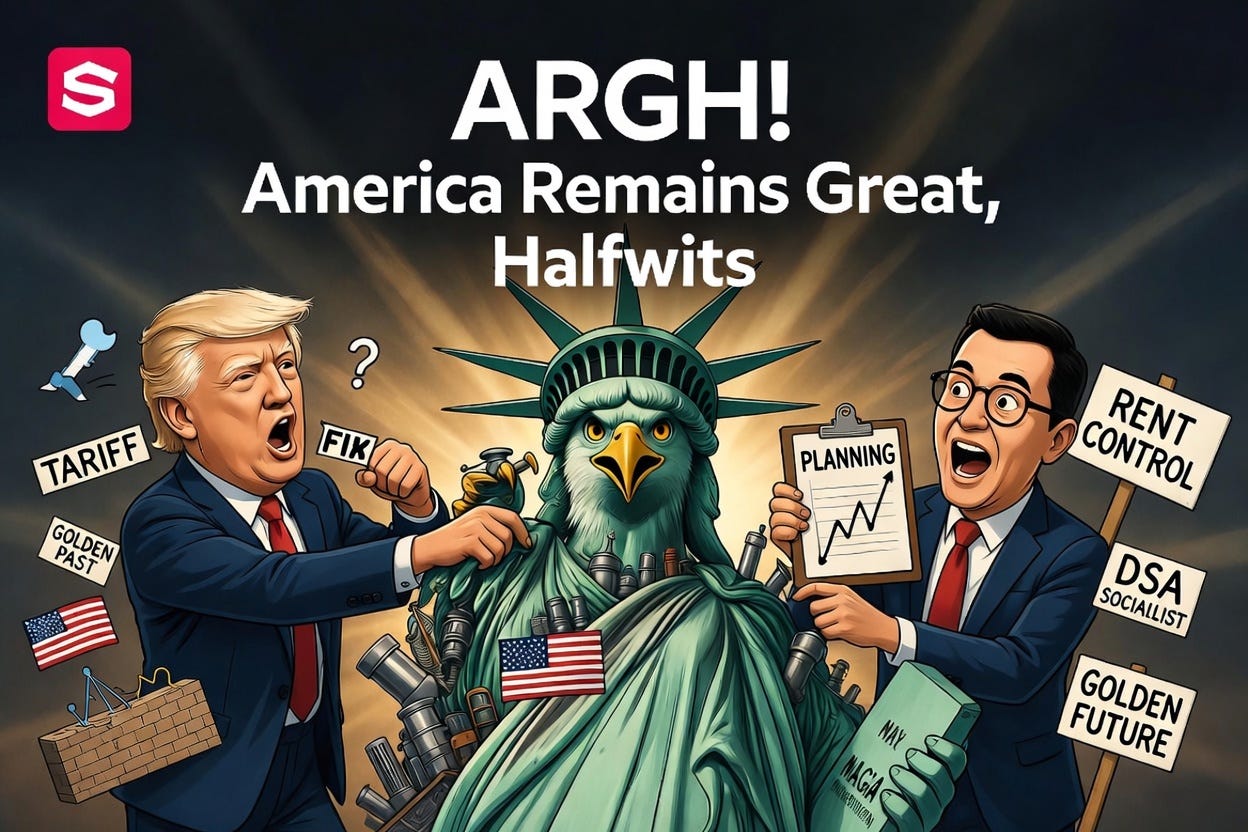
I grew up in a country that decided, as a matter of high-minded national policy, that prosperity was vulgar.
This is not a figure of speech. From the 1950s to 1991, India ran what its critics came to call the License-Permit Raj — a system in which you needed a government permit to build a factory, expand a factory, import a machine for the factory, and then, once the factory existed, government permission to shed workers or close the thing. (Read that last part twice. In any sizable establishment — broadly, a hundred workers or more — the pathology wasn’t “you may not hire.” It was “hire, and then good luck ever adjusting” — economic flypaper.) The result was what the economist Raj Krishna in 1978 dubbed the “Hindu rate of growth”: an economy that grew at roughly 3.5% a year while its population grew at over 2%, which is to say, an economy that mostly stood still while telling itself it was on a journey. While India crawled, the Asian tigers ran — Singapore, South Korea, and Taiwan all compounding at around 9% a year over the same stretch. Not because they were laissez-faire fantasies; they ran plenty of industrial policy. The difference was that they forced their firms to face the world and compete, while India sheltered its firms from reality and called the shelter a plan. The nation that gave the world the zero spent four decades demonstrating what one looks like at national scale.
I lived in the aftermath of that. I watched, later, as the 1991 reforms — forced, not chosen; India liberalized because it was hours from defaulting and the IMF had it by the throat — unwound the machine and the economy finally began to grow the way an economy of a billion clever people always should have. Daron Acemoglu and James Robinson wrote a whole book about why some nations stay poor on purpose (Why Nations Fail; Acemoglu, Robinson, and Simon Johnson shared the 2024 economics Nobel for the underlying work on institutions and prosperity), and India across those four decades is very nearly the textbook case. The aftereffects will be felt for a century. The reforms are thirty-four years old and the country is still digging out — though “digging out” undersells the turn. The economy that had crawled at the Hindu rate surged after reform: 7.5% growth in 1994–97, above 9% in the 2005–08 boom, around 8% across the high-growth stretch after 2003; per capita income has since climbed past $2,600, many multiples of its early-1990s level. (The honest caveat, which I’ll make before a critic does: growth had already ticked up to ~5.8% in the 1980s — but on borrowed money, which is precisely why it ended in the 1991 near-default crisis that forced the reforms. The spree was the disease’s last fever, not its cure.) Four decades of standing still, then a sprint the moment the machine came off. That is the whole argument in one country’s national accounts.
So when I tell you I am not a socialist, understand that this is not a political preference. It is an immune response.
In the old days, before we had clean attenuated vaccines, you protected a child against smallpox by deliberately giving them a small live dose of the real thing — variolation. If it didn’t kill you, you never got smallpox. That’s me. I was variolated. I took the live virus of actual, functioning, on-the-ground socialism as a child, and the antibodies never went away. I cannot get the disease. I have tried to be fair to it, the way you try to be fair to a thing that has demonstrably tried to kill you, and I keep arriving at the same place: it does not work, it has never worked, and the people who insist it would work this time, with the right people in charge are describing a chemistry experiment that has been run several hundred times and always produces the same precipitate.
I bring all this up because America is currently being shouted at, from both ends of its political spectrum, by people who have never been variolated against anything.
This is a piece about those people. Both kinds. And the thing I most want you to take away is that they are, underneath the costumes, the same people making the same mistake.
The mistake, stated once, cleanly
Here is the mistake.
The United States is a working system. Not a perfect one — there are no perfect ones, and anyone who tells you they’ve found one is selling either a religion or a revolution, which historically have a way of becoming the same product. But a working one: a machine that has, for two and a half centuries, converted human beings of every conceivable origin into the largest and most innovative economy in the history of the species — and one of the most productive — and done it while remaining free enough that the people inside it can stand on a soapbox and call it a hellscape without being sent anywhere unpleasant for saying so.
The mistake — and it is bipartisan, it is the great unifying stupidity of our moment — is to look at a working system, notice that it is not an idealized system, and conclude that it should be torn down and rebuilt according to a theory.
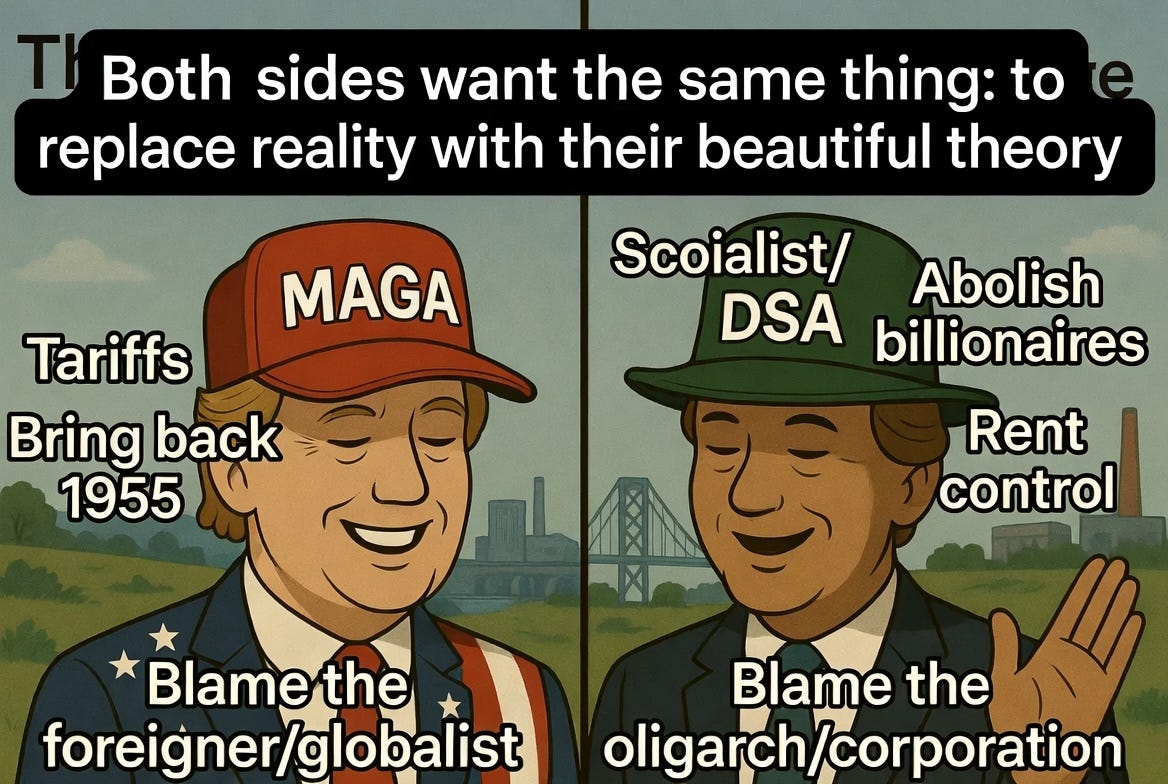
The MAGA right has a theory. The theory is that there was a golden past — roughly 1955, soft-focus, the factories humming, the borders sealed, the trade balanced, the men employed and the women home — and that this past was stolen by foreigners and globalists and that we can tariff and deport our way back to it.
The socialist left has a theory. The theory is that there is a golden future — fully planned, fully equal, the rents frozen and the groceries municipal and the billionaires abolished — and that this future is being withheld from us by oligarchs and corporations and that we can tax and decree our way forward to it.
Look at those two sentences. Look at them. One worships a past that never existed; the other worships a future that has never once arrived. One blames the foreigner and the globalist; the other blames the oligarch and the corporation. Different villains — but watch what happens when the policy actually touches a foreigner. The right won’t trade with him because he’s foreign: he talks funny, he works cheap, he isn’t us. The left won’t trade with him either, only the left does it while professing to love him — trading with him is “exploitation,” the factory must be repatriated, the supply chain brought home. One bars the door out of contempt and the other bars the same door out of solidarity, and the foreigner, standing on the far side of an identical closed border, is invited to admire the difference in their reasoning — the difference that somehow justifies the exact same result.
And here is where I stop being polite, because this is the part that actually offends me. Who, exactly, are these people? In a society that calls itself free, who are you — tariff-writer, supply-chain-repatriator, either one of you — to stand between me and a man in Shenzhen and forbid the two of us from voluntarily exchanging goods to our mutual benefit? What business of yours is it? Now, there is a respectable answer: that my trade with Shenzhen has third effects — a laid-off worker in Ohio, a strategic dependency, a cost borne by someone who never sat at the table. Fine. But notice where that puts the burden. It is on you, the one reaching for the veto, to make the affirmative case that the third-party harm is real and large and not merely asserted — not on me to justify a peaceful exchange that is, on its face, nobody’s business but mine and his. And if you can’t carry that burden, then the question stands: if you may veto a voluntary trade between two consenting people, may I veto yours? Because if I may, then no one can transact and the word “free” is a fraud; and if I may not, if the veto runs only one direction, then you are not my fellow citizen in a free country. You are my sovereign, and I am your subject, and we should at least have the decency to call it what it is. The foreigner and I have the same two-word reply to that arrangement, and it translates cleanly into every language on earth, and it is not thank you.
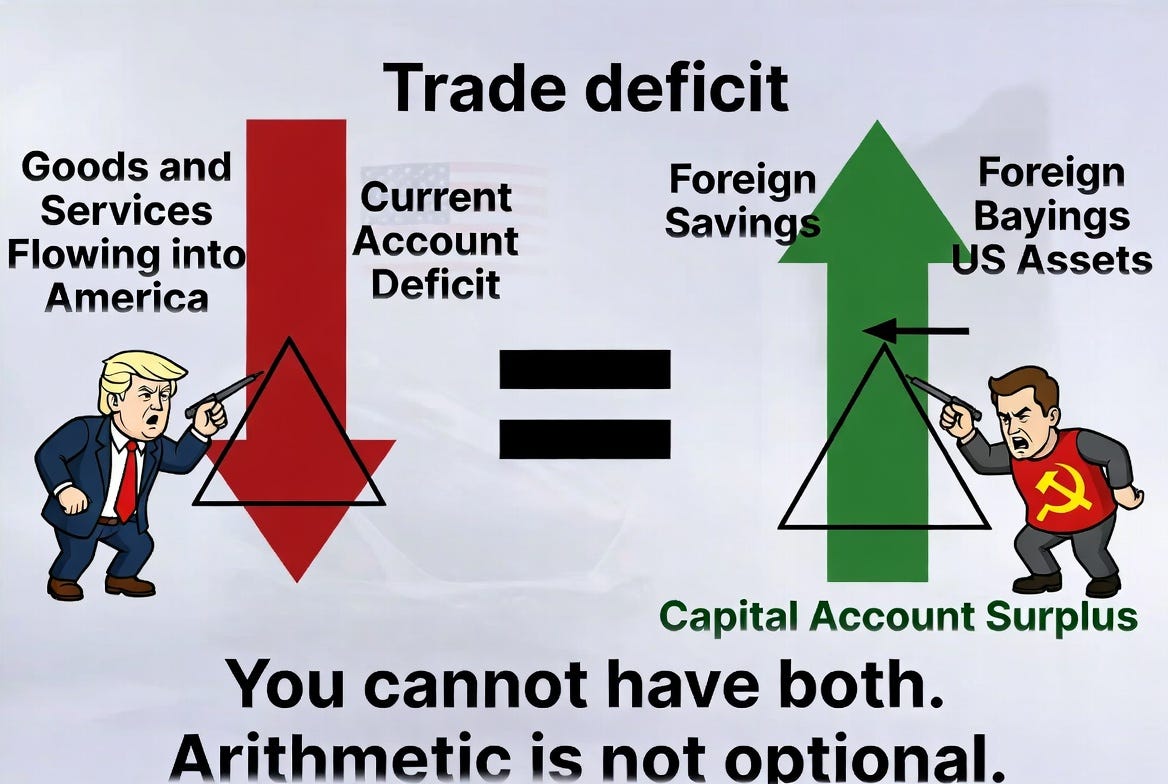
And then — because the rage isn’t even the embarrassing part — there’s the arithmetic. Both factions want the trade deficit abolished. Both factions also want the world to keep pouring money into the country: into Treasuries, into equities, into the factories they claim to be defending. Here is the problem, and it is not an opinion, it is an accounting identity: those are the same thing with the sign reversed. A current-account deficit is, on net and by construction, mirrored by a capital-and-financial-account surplus — foreigners sending you goods and services now, and the balancing entry is their savings buying up claims on America. (Yes, the current account is broader than the trade balance — it folds in services and investment income too — but the identity holds all the same.) You cannot, on net, both ship the world more goods than it ships you and be the world’s net destination for its savings; the trade surplus you say you want would, by the same identity, make you a net exporter of capital, not the recipient of it. MAGA wants to kill the trade deficit while the world still finances American consumption on terms almost any chronic debtor in history would envy. The left wants to reshore the factories while foreign savings funds the federal deficit it depends on. Both are demanding the two halves of an identity and disowning the equals sign between them. There is an honest way to shrink the deficit — consume less and save more, at home, as a nation — but neither faction will say that out loud, because “spend less” wins no votes, so they reach for tariffs and decrees that fight the identity by fiat instead of changing the saving that drives it. It is the economic equivalent of insisting on a triangle with four sides, then blaming China when you can’t draw it.

And there’s a third freedom they’re both busy strangling, and it’s the one that should be hardest to get wrong, because it is the single most distinctive thing about this country. Almost every free nation on earth protects speech. Only America makes censoring it nearly impossible. That is not a small distinction; it is the whole difference between a right and a permission. The European Convention, the Canadian Charter, the German Basic Law — all of them guarantee free expression and then attach a carve-out, for “hate speech,” for “public order,” for “dignity,” and a carve-out is just a lever the government keeps within reach for the day it decides your speech qualifies. The First Amendment keeps no lever. Congress shall make no law is not a balancing test; it is a prohibition on the state itself. This is why the United Kingdom arrests people over tweets, why Germany sends police to homes over online insults, why Canada convenes tribunals over the wrong opinions — and these are not tyrannies, that is precisely the point. They are free countries that kept the lever. America is the one major country that constitutionally smashed it.
And both sides want it back. The right spent a decade as self-appointed free-speech absolutists and now pulls books from libraries, legislates against teaching the history it finds uncomfortable, menaces broadcasters over coverage it dislikes, and would jail you for burning a flag. The left built the speech-policing machinery on the campus and inside the platforms, coined the slogan “hate speech is not free speech” — which is verbatim the European carve-out the First Amendment exists to forbid — and leaned on private companies to throttle views it deemed dangerous. Each faction is utterly convinced it is the defender of speech while it strangles the speech it hates. And neither will say the actual principle aloud, because the principle is unbearable to both: free speech is only ever tested by speech you find vile. The speech you like was never in danger. The First Amendment is for the Nazi in Skokie, the flag-burner, the campus crank, the conspiracy peddler — and the moment either tribe gets the power, it discovers an emergency exception for exactly the speech that offends it, which is the only speech the Amendment was ever about. (Yes, even America draws lines — incitement, true threats, defamation, obscenity, and a few other narrow categories. But those are historically defined exceptions tied to concrete legal harms, not licenses to ban an opinion because the state finds it hateful or false. The gap between “no viewpoint may be banned” and “offensive viewpoints may be banned” is not a difference of degree. It is the entire ballgame, and America is the only major country standing on the right side of it.) An immigrant from a country with the lever does not experience this as a culture-war token. He experiences it as the reason he can publish a post calling the mayor a halfwit and not receive a visit. He knows what the lever is for. That is why it is so obscene to watch native-born members of both parties reach for it as though it were a normal instrument of government.
Strip away the costumes and what’s left is identical: a theory that has never once survived contact with reality, and a serene conviction that the problem is other people — that if we could just remove the right ones and install the right plan, the heavens would open.
This is the same person. He has simply bought two different hats.
What the immigrant knows that the theorist does not
Now. Here is the part that matters, and it is the reason I, specifically, get to write this.
All of which raises the obvious question: if the freedoms are this basic and the arithmetic this elementary, why do so many people get it wrong? And the answer points straight at the one group nobody thinks to ask.
The point of an immigrant is not that he is virtuous. The point of an immigrant is that he is working from data and not from theory.
The native-born American radical — of either flavor — has only ever lived in the working system. He has never seen the alternative run to completion. He can therefore afford to romanticize it, because romanticizing a thing you’ve never experienced is the cheapest hobby on earth. The MAGA voter mourning the lost factory town has never had to actually live in an autarky, with the empty shelves and the ten-year wait for a telephone line that economic nationalism reliably produces. The DSA member dreaming of the planned economy has never had to actually queue for bread under one. They are both, in the most precise sense, tourists of catastrophe. They’ve seen the postcards. They’ve never been.
The immigrant has been. That’s the whole thing. That’s the entire value proposition.
When I, or my fellow refugees from various failed utopias, choose to come to the United States, we are not voting for an abstraction. We are voting with our feet, having personally inspected the alternatives, against the very theories the native-born radicals find so seductive. We came here because the planned economy didn’t work, because the strongman didn’t deliver, because the closed border made everyone poor. We are, as a population, the single largest body of empirical evidence on the planet that the working system beats the theory. We are the experiment’s control group, and we got on a plane.
And — this is the part the nativists in particular cannot metabolize — the data on us is overwhelming. We come, and we behave better than the people already here.
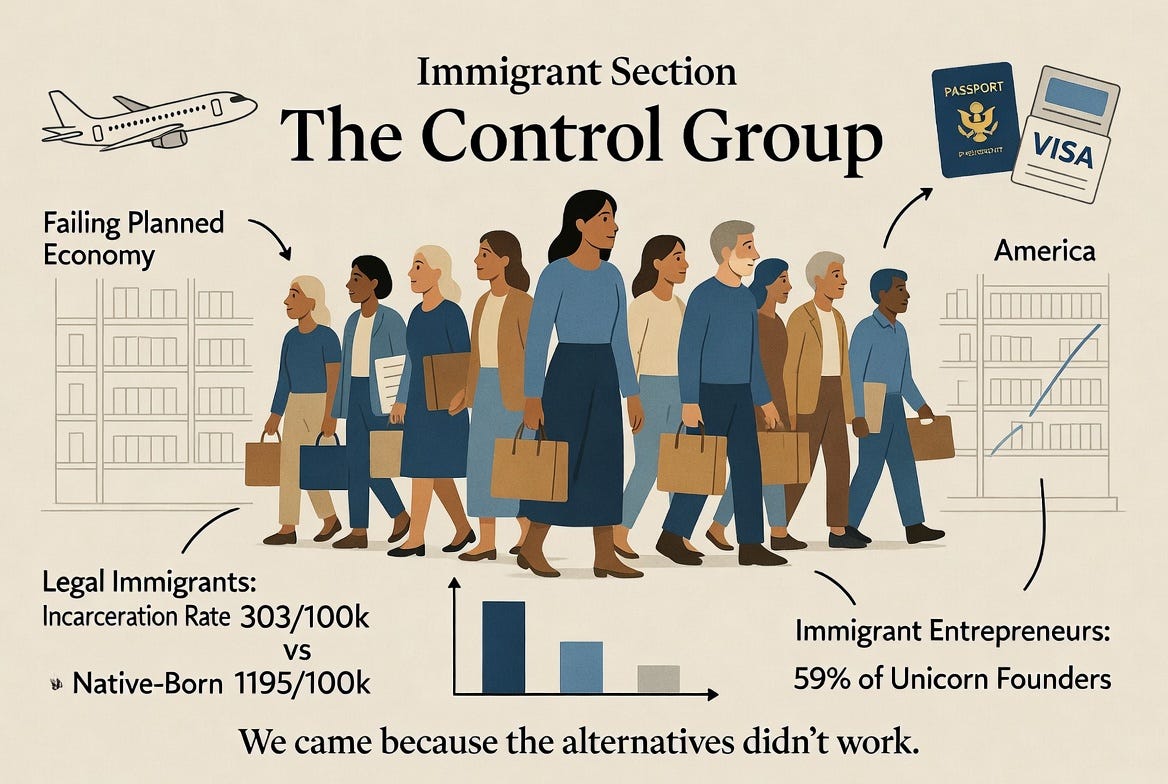
Take incarceration, since the MAGA right has made crime the centerpiece of an entire political program. The single most thorough and current analysis we have — the Cato Institute’s March 2026 study of the 2024 American Community Survey — found that the incarceration rate for native-born Americans was 1,195 per 100,000. For illegal immigrants, it was 674. For legal immigrants, it was 303. Read that again slowly, because it is the sort of number that should end a debate and somehow never does: a legal immigrant is about 75% less likely to be sitting in a prison cell than a native-born American, and even an illegal immigrant is meaningfully less likely than the native. The thing the entire restrictionist program is organized around fearing is, statistically, a thing native-born Americans should fear about themselves.
Take the economy, since the socialist left has decided that capitalism is a machine for crushing the vulnerable. As of 2026, immigrants had founded or co-founded 59% — 455 of 775 — of America’s privately held billion-dollar startups, up from 55% in the prior reports. Nearly half the Fortune 500 was founded by immigrants or their children — a figure that leans on counting the second generation and that skeptics at the Center for Immigration Studies have contested on methodology. Fine; throw it out and keep only the unicorn number, where the founders are themselves the immigrants. It’s still a majority. The point survives a hostile audit, which is the only kind worth making. The country at the top of that founder list, incidentally, was India — 96 unicorns, ahead of every other nation — the same India that spent forty years proving the other system doesn’t work, exporting its most capable people to go prove it somewhere that lets them.
Now, the sharp objection — and it comes from the left, which is the half of the room that actually reads the methodology sections. “This is just selection,” they’ll say. “Immigrants aren’t better-behaved or more entrepreneurial because immigration ennobles them. They’re filtered. You screen for ambition and a clean record at the visa office and self-select for risk-tolerance before anyone boards a plane. The data say nothing about inoculation. They say something about the sieve.”
Yes. Exactly. Thank you. That is the mechanism, and naming it doesn’t weaken the argument — it is the argument, stated in the language of econometrics instead of immunology. Of course it’s selection. The whole point is what the cohort selected on. These are, by construction, the people who looked at the available systems — the planned one, the strongman’s one, the autarkic one, and the messy working one — and chose the working one at real personal cost, with their feet, against the romance. “Selection effect” and “revealed preference at scale” are the same fact wearing two lab coats. The leftist thinks he’s identified a confound. He’s identified the independent variable. The immigrant cohort is precisely the natural experiment in which people who have seen the alternatives sort themselves toward the working system — which is why their behavior, once here, looks the way it does, and why the native-born theorist who has selected on nothing but a seminar reading list is the worse bet.
So here is the immigrant, holding the data. Lower incarceration. Higher top-end entrepreneurship. A revealed, plane-ticket-purchasing preference for the working system over every theory on offer. And here is the native-born radical, holding the theory, explaining to the immigrant that the system is a fraud and the answer is the very arrangement the immigrant crossed an ocean to escape.
You can perhaps see why some of us find the lecture a little rich.
The hinge: but Mamdani is an immigrant
And now we arrive at the objection that is supposed to detonate this entire essay, and which instead — if you follow it carefully — turns out to be the load-bearing beam.
“But Samir,” you say, “the current mayor of New York City is himself an immigrant. Zohran Mamdani was born in Kampala, Uganda. He’s a democratic socialist. He won. So much for your theory that immigrants are inoculated against socialism. Your control group voted for the disease.”
Good. Excellent. Let’s take it seriously, because it is the most interesting thing in the room.
The error in your objection is the error in this entire national argument, and it’s worth slowing down for. It was never the passport that inoculates you. It was the disease.
Variolation only works if you take the live virus. You have to actually have the smallpox, in a small and survivable dose, for the antibodies to form. A child who grows up reading about smallpox in a beautifully appointed seminar room, who studies the epidemiology and writes a moving senior thesis on the structural injustice of the disease, does not thereby acquire immunity. He acquires opinions about the disease. These are not the same thing. One is built from antibodies; the other is built from footnotes.
Zohran Mamdani holds a passport stamped immigrant. But consider, with genuine care, the life. His father is Mahmood Mamdani, a chaired professor at Columbia, one of the most celebrated postcolonial theorists alive. His mother is Mira Nair, the internationally acclaimed filmmaker. He grew up between Kampala and the Upper West Side of Manhattan, the son of that household. He attended the elite Bronx School of Science and then Bowdoin College. This is not the biography of someone who fled a planned economy with two suitcases and a medical degree the new country wouldn’t recognize. This is the biography of the global academic aristocracy — the single demographic on earth most marinated in the theory of socialism and most insulated from its practice.
He didn’t immigrate from the disease. He immigrated into the faculty lounge. He is, in the precise technical sense I’ve been building this whole essay around, unvariolated. He has the elite seminar’s complete theory of the smallpox and not one antibody in his blood. He is the living, governing proof of my actual thesis, which was never “immigrants are magically wise” — that would be its own dumb romanticism, and I have no interest in trading the nativist’s fairy tale for a flattering one about my own kind. My thesis was always narrower and harder: lived experience of the failed system inoculates you against it, and nothing else does. Not the passport. Not the suffering of your ancestors. Not your sincerity. The disease, or nothing.
This is why the children of Cuban exiles in Miami vote the way they do and the children of Cuban theory in the academy vote the opposite way, and why this surprises only people who think the relevant variable is ethnicity rather than memory. It’s why my own inoculation is specific and personal and non-transferable: I cannot give it to my American-born children by telling them stories, any more than you can vaccinate a child by reading him the label. The antibodies don’t cross the placenta. Each generation has to either catch the live virus or, far better, be governed by people who did and who built the institutions accordingly.
Mamdani caught the footnotes. Now eight and a half million people get to find out the difference, in real time, with their rent and their groceries and their police department as the assay.
I would genuinely rather they didn’t have to. I lived downstream of that experiment once already.
A word to each idiot, in turn
Let me be even-handed about the contempt, because both of these factions have earned it honestly and it would be unfair to slight either.
To the MAGA economic nationalist: You have decided that the path to American greatness is to make Americans poorer on purpose, via a tax you’ve been told isn’t a tax. A tariff is a tax. It is paid by the importer, who is American, and passed to the consumer, who is American, and the whole exercise is a transfer from the broad American public to a narrow protected industry that has successfully lobbied to be spared from having to be good at its job. This is not a controversial finding. It is one of the few things in economics on which essentially every economist who has ever lived agrees, from Adam Smith forward, which is a sentence I do not get to write often. You have looked at the single most successful wealth-generating arrangement in human history — open, dynamic, immigrant-fueled American capitalism — and concluded that what it really needs is the economic policy of 1930 and the demographic anxiety of 1924. You want to wall off the country that the Why Nations Fail literature identifies as history’s great winner because it stayed open, and you want to do it in the name of winning. You have mistaken the lock on the door for the engine of the house.
To the DSA socialist: You have looked at the same arrangement — the one that took my variolated, capable, formerly-poor immigrant cohort and let us build companies and pay for the schools your program depends on — and concluded that what it really needs is the economic model of the country I left. You want rent control, which 95% of a University of Chicago expert panel agree reduces the supply and quality of housing — a near-unanimity rivaling the tariff consensus — and you have decided that the lesson of every place that’s tried comprehensive planning is that they simply lacked your sincerity. They didn’t. East Germany was sincere. Venezuela was sincere — it had the largest oil reserves on the planet and the most fashionable economic theories in the faculty lounge, and it engineered mass hunger and emptied its own supermarkets. Maduro meant well, if you ask the right professor. The graveyards of the twentieth century are landscaped with good intentions and the people they starved. You are not the first to be sincere. You are merely the latest to mistake sincerity for a mechanism.
And to both of you, the thing I most want to say:
You are surrounded by people who fled the exact experiment you are proposing to run. We are right here. We came thousands of miles and filled out your absurd immigration paperwork specifically to get away from your big idea. We are the most expensive focus group in the history of the world, assembled at our own cost, and we are unanimous. And you will not ask us a single question, because the answer is inconvenient to a theory you find more beautiful than the data.
That is the part that makes me want to put my head through a wall. Not that you’re wrong. People are wrong all the time; being wrong is the human condition and I have been wrong about plenty. It’s the incuriosity. It’s the serene confidence of a man who has never run the experiment lecturing the people who survived it about what the results will be.
America Remains Great, Halfwits
So, the title.
America remains great. Not perfect — I’ve said this enough times that you’ll believe I mean it — but great in the only sense that has ever mattered: it is the place that the rest of the world’s most capable and determined people are still, despite everything, trying to get into. Revealed preference is the only honest poll. Nobody is risking their life on a raft to reach the worker’s paradise. Nobody ever did. The boats have always pointed one direction, and it is the direction of the working system, and it has been pointing that way for two hundred years through every fashion of theory that has risen up to declare the system a fraud.
The halfwits, left and right, are people who have inherited the single greatest going concern in human history — the freedom to trade with whom you please, to reckon with the numbers honestly, to say the unsayable without a knock at the door — and would like to torch it because it fails to match a picture in their heads, a picture, in both cases, of a place that has never existed, drawn by someone who has never had to live there.
I have lived there. I have the antibodies to prove it. And the message from those of us who took the live virus and survived, to everyone currently demanding we all take a fresh dose for the principle of the thing, is short and it is heartfelt:
We’ve seen this one. It doesn’t end the way you think. America remains great. Stop trying to fix it with the thing we ran away from.
ARGH.
If you found this worth your time, you may enjoy my book The Science of Free Will, which asks an equally uncomfortable question about an equally cherished story.
For the long version of the India argument — what the License Raj actually did and how the country is clawing back — start with The Paradox of India, or browse the whole series.
And for the same disease in a different country, see Albion — Britain’s institutional decline, by someone who first saw the place in 1979.
Terrific essay, Samir.
What resonated most with me was your argument that prosperity emerges from human ingenuity and that institutions largely determine whether that ingenuity is allowed to operate freely or is obstructed.
I also appreciated your framing of markets and entrepreneurship as systems that force continual feedback from reality. Political systems can postpone accountability for long periods of time. Markets and arithmetic eventually refuse to cooperate.
The perspective of someone who has actually lived inside the alternative system gives this piece a credibility that is difficult to replicate through theory alone.
A brutally honest and blunt explanation of the forces at play. Well done!
On tariffs, these have been used as a weapon to gain concessions from other countries. Slapping tariffs on many goods allowed the Americans to negotiate lower tariffs from other countries. Lower your tariffs and we’ll lower ours. Its about negotiation leverage to obtain a fair playing field. A fair playing field in turn allows you to do business with who you wish, the very system you said you crave.
On the left vs right though, your thesis has one major flaw. The right is trying to impose various things, but it is those things that it craves, and pretty much only those things. The left however, craves power. They openly speak about packing the Court, abolishing the border (to let in illegal immigrants they believe will vote for them), allowing illegal immigrants to vote, nuking the filibuster, adding two more states that will be reliably blue and more. They want to win the next election and then use it to ensure that they can never lose an election again. I do not see such speech coming from the right, nor have extremists in their party been winning primaries. Mamdani got three elected in New York alone, and with no one running against them, they will automatically be in Congress. There are a dozen more spread across the US, some of whom do not get that automatic pass. But the most visible one is in Maine where a man with the longest list of disqualifying behavior I’ve ever seen in a candidate, nonetheless won the primary and is leading in the poles for a Senate seat.
Danger. Loud, clear, ugly, and on the Left.