What is mass?
Exploring Einstein's elegant insight that transformed our understanding of mass and spacetime

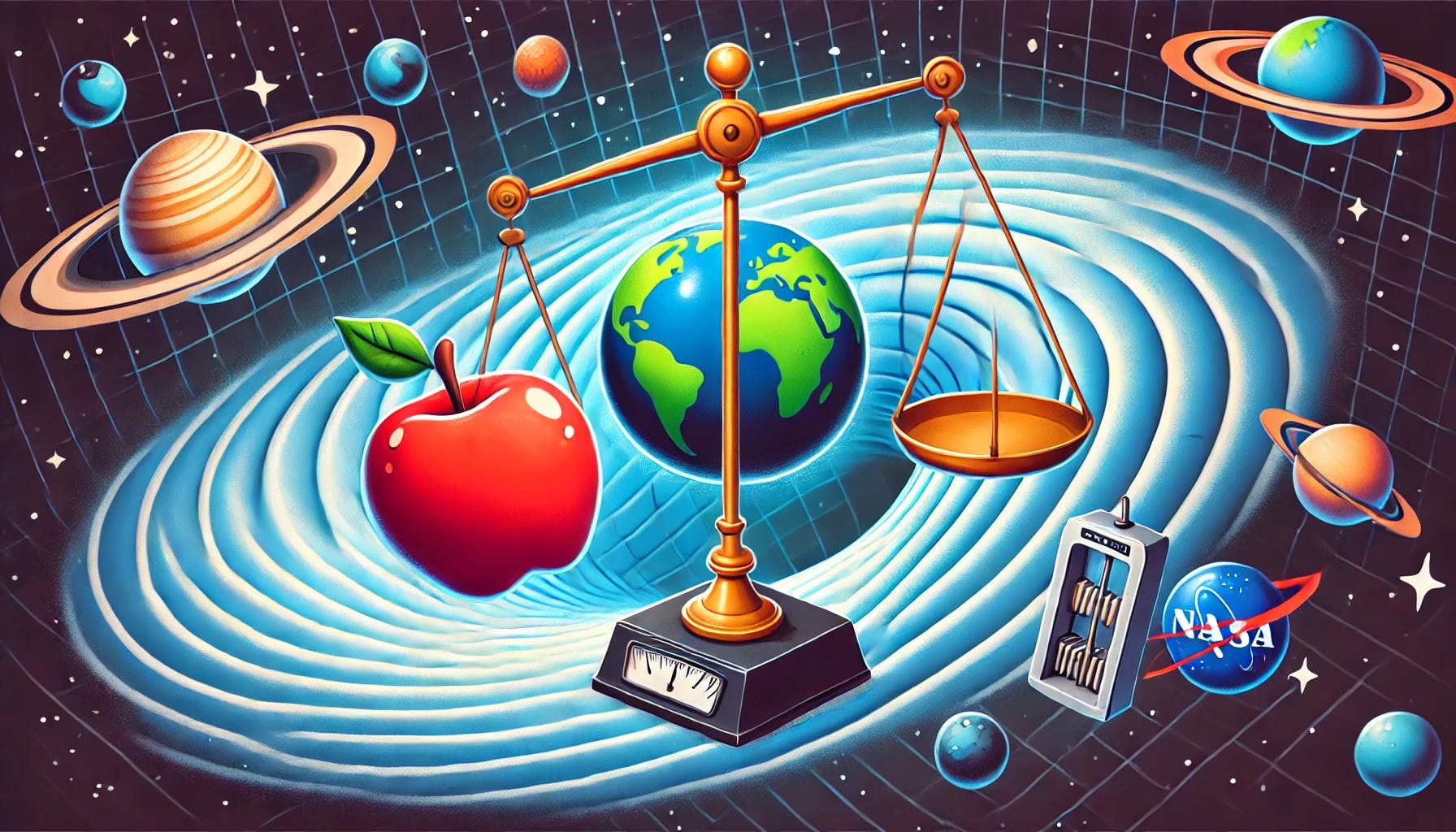
What Is Mass?
Mass can seem like a simple idea: it’s “how much stuff” something has. This is encoded in the famous equation of Newton's second law, F = m a, where F is the force, m is the “mass” and a is the acceleration. The mass in this case is called “inertial” mass. Inertia means how much a body “resists” being made to change its state of motion. So if you look at this differently, a = F/m, which means that if you double the mass, to get the same acceleration you also have to double the force. Usually, on earth, when we do any kind of experiment, there is friction. So part of what we feel when we push on something is the force required to overcome friction. But even after you overcome the friction, there is a “resistance” to a change in motion left over, so to speak, and that resistance is the "inertial mass" of the object you are pushing on.
On the other hand, there’s gravitational mass, which tells you how strongly an object feels gravity’s tug. This is most simply encoded in Newton's law of gravitation, where F = G M m / r^2. M and m are the masses of the two objects that are attracting each other (gravity always attracts as far as we know--there is no sci-fi style anti-gravity), r is the distance between M and m and F is again the force felt by each of the two objects (F is the same for each object: the earth attracts the moon as much as the moon attracts the earth). So if you double the distance, you cut the force felt by M and m by1/2^2=1/4; if you quadruple the distance, you cut the force by 1/4^2 = 1/16 and so on.
Oddly enough, experiments show that these two notions—gravitational and inertial—line up perfectly. Precisely. No matter how many times we measure or how elaborate the test, we get the same number for an object’s “resistance to acceleration” and “amount of gravitational attraction.”
Is This Coincidence or Cosmic Law?
Why should gravity care about how resistant an object is to being shoved around? Why would nature link two seemingly separate concepts? One might imagine a universe where gravitational attraction and inertia aren’t the same property. Instead, we live in a universe that insists they match.
Einstein placed this coincidence at the heart of his theory of General Relativity. He saw an exact correspondence between acceleration and gravity, as if gravity were not a force in the traditional sense, but a bending of spacetime itself. When you stand in an elevator that’s accelerating upward, you feel a pull that’s experimentally indistinguishable from standing still on Earth’s surface. The reason the mathematics works so beautifully? Gravitational mass and inertial mass are equal.
Deeper Implications
But do we have any reason to expect this equivalence? One might suspect it reveals something fundamental about spacetime. Experiments like the Eötvös experiment (https://en.wikipedia.org/wiki/Eötvös_experiment) show that the gravitational and inertial masses coincide to extraordinary precision, leaving little room for them to deviate.
Some physicists believe it suggests gravity is not just another force but an outgrowth of geometry: when you’re free-falling, you’re simply following the “natural” path in spacetime. There’s no extra force acting on you; it’s just spacetime letting you coast along.
Others look to quantum field theory and the Higgs mechanism. The Higgs field bestows “rest mass” on particles, but that’s not the full story of why gravitational and inertial mass match. For a deep dive, see this beautiful explanation from Matt Strassler: https://profmattstrassler.com/articles-and-posts/particle-physics-basics/how-the-higgs-field-works-with-math/. However even with the Higgs, the equivalence principle remains something we test to see if any hairline cracks emerge. So far, no cracks.
What It Tells Us About Our Universe
For starters, it signals a certain elegance. It also hints that reality might be knitted together by geometric structures more unified than we usually imagine. When two seemingly independent concepts fuse so seamlessly, it makes us suspect that we’re missing the deeper blueprint.
This equivalence might even nudge us to think differently about forces: maybe gravity stands apart from electromagnetism, the strong force, and the weak force. Instead of “pulling” on you in the usual sense, it’s geometry warping your local patch of spacetime.
Or it may just be a cosmic “happy accident,” albeit one so consistent that we’ve built an entire physical theory around it. Here’s the tricky question: if tomorrow we discovered the two masses differ beyond the fifteenth decimal place, would our entire framework wobble? Probably. But there’s no evidence of that.
In Short
1. Inertial mass: how stubbornly an object resists changes in velocity.
2. Gravitational mass: how strongly an object feels and exerts gravitational pull.
3. Equivalence: they match so closely that experiments haven’t yet found a difference.
4. Why?: Possibly because our universe is shaped in such a way that gravity isn’t an ordinary force but a feature of curved spacetime.
We might shrug at first—“mass is mass.” But that’s the crazy thing: a fundamental principle can hide in plain sight. It’s like discovering that a key fits perfectly in two different locks. Coincidence, or sign of a deeper design? In physics, that question keeps fueling exploration.
If you picture yourself in free fall, you’re essentially weightless. In the same moment, the elevator around you could be accelerating in outer space to mimic gravity. Somehow, inertial and gravitational mass conspire to make these experiences indistinguishable. Why? Figure it out and a Nobel Prize awaits you!
Check out my recently released book, The Science of Free Will: How Determinism Affects Everything from the Future of AI to Traffic to God to Bees, https://amzn.to/4aMQJD1.