
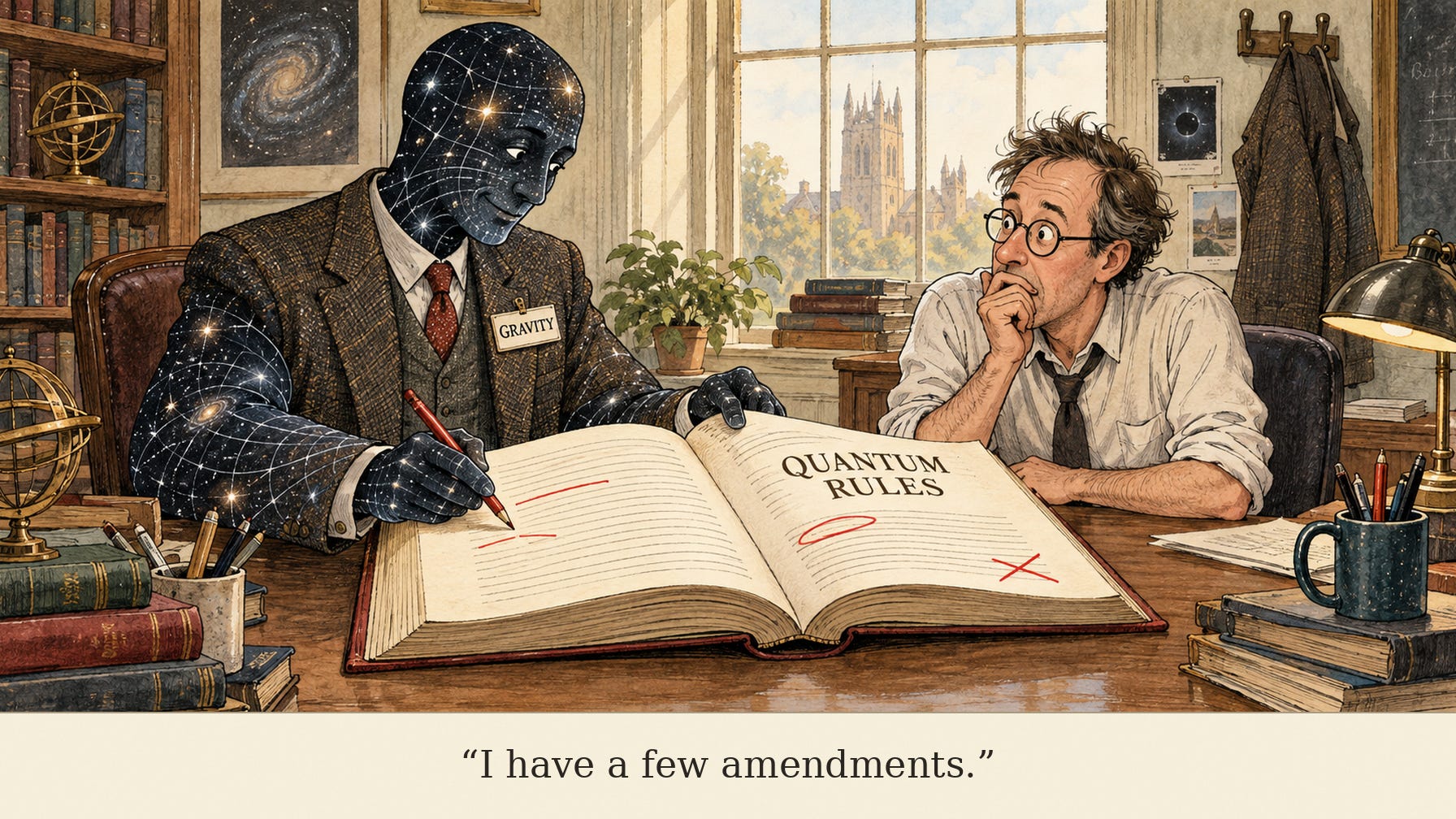
On March 16, 2026, I co-hosted a podcast episode with Eric Jennings of the World XP Podcast, where we sat down with two of my oldest friends from graduate school to talk through their new book. Djordje helped get me through graduate school, and I owe him for it. That explains why I read the book closely. It does not settle whether the physics is right.
So let me tell you what interests me, where I think the idea is strong, and where it is still a research program rather than a settled result.
The book is The Weight of Quantum: Quantum Theory and the Structure of Physics (CRC Press), written for the centenary of quantum mechanics. Its central proposal is easy to state and hard to stop thinking about. Physics rests on two theories that have never been fitted together: quantum mechanics, which governs atoms and particles, and Einstein’s general relativity, which governs gravity, planets, and the cosmos. For a hundred years we have tried to make gravity obey the rules of quantum mechanics. Hübsch and Minic ask whether we have it backwards: whether gravity should instead change the rules of quantum mechanics itself.
The idea
Einstein taught us that spacetime, the combined fabric of space and time, is not an immovable stage. Matter changes its geometry, and that geometry changes how matter moves: a heavy object bends the fabric around it, and other objects roll along the bend. The geometry of spacetime went from being fixed background to being a player that moves and responds. Hübsch and Minic want to apply the same lesson to quantum theory.
Quantum mechanics has its own geometry, and it takes two ideas to see it. The first is the rule. Quantum mechanics describes a system by a wave function, a list of amplitudes, one for each thing that could happen. An amplitude is a number attached to a possible outcome; it is not yet a probability, and it can be negative, which is why two amplitudes can cancel, and cancellation is what interference is. The Born rule, written down by Max Born in 1926, says that the probability of an outcome is the squared magnitude of its amplitude: multiply the number by itself, which also erases any minus sign. That is the rule that turns the mathematics into odds, and every prediction quantum mechanics has ever made passes through it. The second idea is the map. A state is a complete description of the system, such as which way an electron’s spin, a tiny built-in magnetic axis like a bar magnet’s north–south line, points. Picture every state the system could be in as a point on a map, where distance is about to mean something physical. The map has a shape, and the shape is curved. (Physicists: complex projective space with the Fubini–Study metric. Everyone else: skip this.) Even the humble electron spin, the simplest quantum system there is, has a map you can draw: every possible spin state is a point on the surface of a globe, with spin-up and spin-down, the only two answers a measurement along a chosen axis can give, at the poles. Now the link, which is the point of the whole book. The Born rule is at bottom a distance rule: how far apart two states sit on this curved map is exactly what sets the odds of finding the system in one when you prepared it in the other. The rule and the geometry are one object. The geometry is not flat, and it is not new. It has been part of quantum mechanics from the start.
The point is that in standard quantum theory this geometry is prescribed and fixed. It does not respond to anything. It is the immovable stage.
Hübsch and Minic’s proposal is that it should become dynamical: that the geometry governing quantum probabilities should itself participate in the physics, the way spacetime geometry does in general relativity. In ordinary quantum mechanics the odds shift from moment to moment, but the recipe that turns amplitudes into odds never does. The claim here is deeper: the recipe itself shifts, and what shifts it is gravity. Why gravity? Because gravity is the one force we already know bends a geometry. The bet is that it bends this one too.
The Einstein analogy motivates the idea; it does not prove it. That is the line between an interesting hypothesis and an established result, and this book lives on the hypothesis side of it.
The book organizes all of this around a “cube of physics”, a map with three axes, one for each of the three numbers that set how strong each effect is: relativistic effects (the knob is 1/c, the inverse of the speed of light, because relativity’s effects vanish when light is infinitely fast, and 1/c is zero exactly then), gravity (Newton’s G), and quantum effects (Planck’s h). Each corner is a theory. Classical mechanics, Newton’s everyday physics, sits at the origin, where all three knobs are off. Turn on relativity and you get special relativity; gravity, Newton’s; both, general relativity; quantum effects, quantum mechanics; quantum effects with relativity, quantum field theory, the framework behind particle physics. Two corners remain unfilled: quantum gravity with relativity switched off (Gh) and the full relativistic quantum gravity (cGh), the letters naming which knobs are on. The cube is a good organizing device, and it is only that, a map of where the theories live. The argument that the Born rule must change has to come from physics.
The experiment
The reason to take any of this seriously is that it points to a concrete experiment. It is the strongest part of the story, so it comes before the speculative scaffolding.
In the standard double-slit experiment, a particle fired at a barrier with two slits produces an interference pattern on the detector: bright and dark stripes where the waves reinforce or cancel. The stripes appear even when the particles are fired one at a time, which means each one somehow passes through both slits at once, as a spread-out wave would. Now add a third slit, and call the three slits A, B, and C. Standard quantum mechanics makes a sharp prediction, first spelled out by Rafael Sorkin in 1994: in the ideal case, the three-slit pattern is completely determined by the two-slit and single-slit patterns. Whatever you see with three slits, you could have predicted from the one-slit and two-slit stripes alone; nothing appears that needs all three slits at once. The reason traces directly to the Born rule. Probability is a squared magnitude, and if you square a sum of three amplitudes you get each one times itself and each pair multiplied together, never a term with all three at once. Pairs are all the rule can make. Subtract everything the single-slit and two-slit patterns can account for, and the standard rule says nothing is left. Formally, the quantity

where P_ABC is the pattern with all three slits open, P_AB the pattern with only A and B open, P_A with only A, and so on, is zero in standard quantum mechanics (once stray noise in a real apparatus is subtracted). If the Born rule is instead dynamical, I₃ can be nonzero: a signal standard quantum mechanics forbids.
The experiment, developed with colleagues including Andrew Geraci at Northwestern and described in arXiv:2303.15645 (Berglund, Geraci, Hübsch, Mattingly, Minic), proposes to look for this with nanoparticles instead of light: objects “composed of millions of atoms,” in the book’s phrase, yet still capable of quantum interference. The particles fall through a diffraction grating, which is a screen with many fine slits, except that here there is no solid screen: crossed laser beams form a fixed pattern of bright and dark stripes that acts on the particles as the slits would, and the particles land on a detector below, where the pattern is recorded. A grating is many slits at once, so any three-way interference would show up in its pattern too. The experimenters measure that pattern precisely. It is a fractal-like structure called the Talbot carpet: at a certain distance past the grating the particles reproduce the grating’s stripe pattern exactly, and at a half, a third, a quarter of that distance, smaller and more finely spaced copies appear. The book’s claim is that a dynamical Born rule would destroy those fractional copies, while stray disturbances such as gas molecules, heat, or vibration “would influence and distort, but not destroy” them. The fractional copies are the most delicate part of the pattern, built from waves from many slits adding up in exactly the way the standard rule prescribes, so a change to the rule would hit them first, while noise blurs the whole carpet without erasing its structure. That, at least, is the claim.
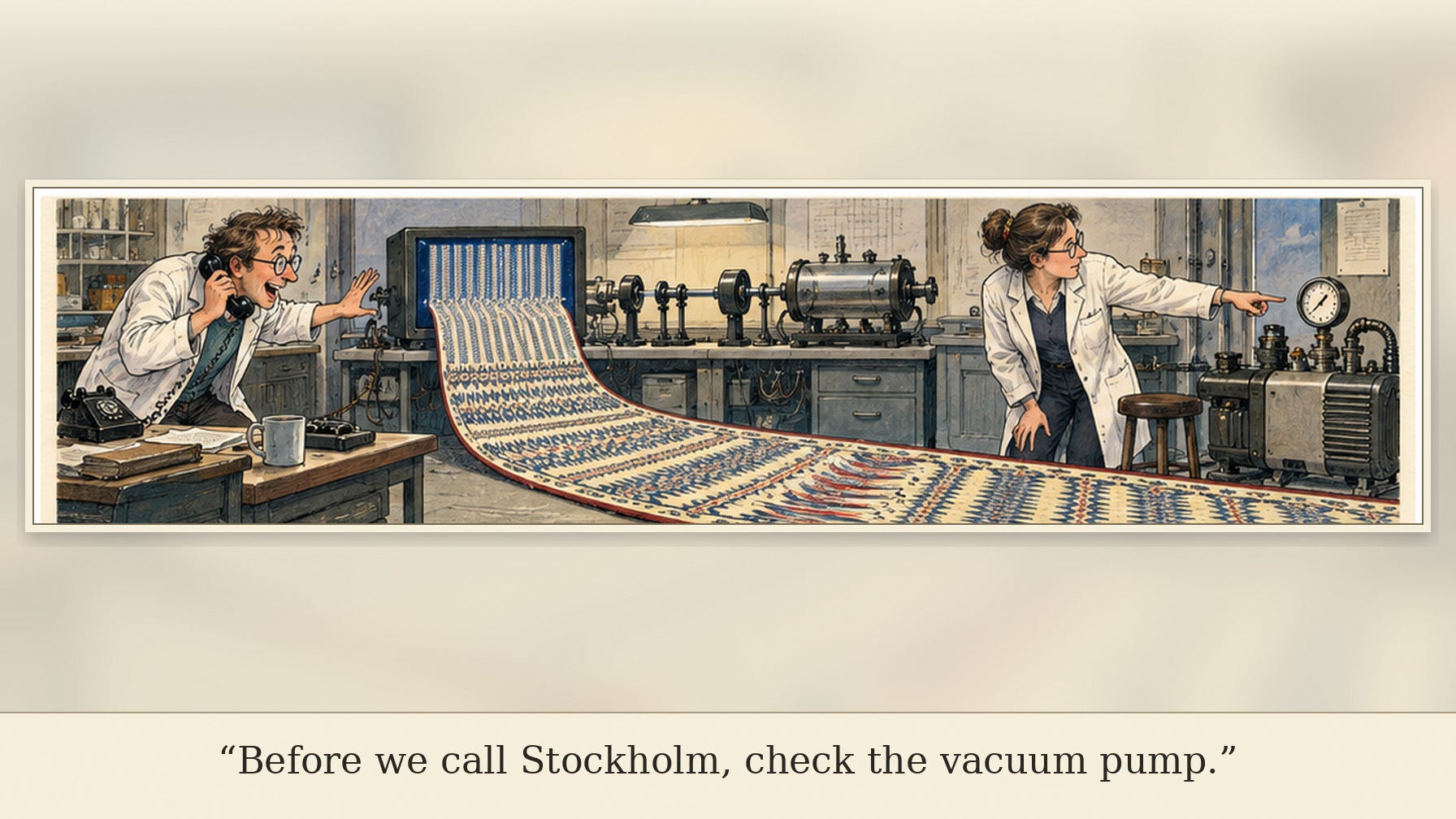
This is clever, and it is the right kind of ambition: a tabletop test of whether quantum probability itself bends. What such a test can and cannot show is where enthusiasm tends to outrun the physics, so three cautions.
First, an apparent three-slit residual is not automatically a Born-rule violation. Closing a slit does more than remove one route: the edges of the remaining slits scatter the wave slightly differently, so the setups being compared are not strictly the same experiment, and that alone can produce a nonzero-looking I₃ without any change to the underlying rule. Disentangling a true violation from this is subtle experimental work.
Second, and more important: the program does not yet predict how big the effect should be. Rather than compute the effect from the full theory, the published Talbot analysis inserts an adjustable knob for how much the Born rule bends and shows what the pattern looks like at a knob setting chosen for illustration. The theory does discuss rough sizes for the effect, so the right complaint is “no definite number” rather than “no number”: it does not yet predict a definite signal with a definite dependence on the things an experimenter controls: the mass, the gravitational environment, how long the particles are in flight, the geometry of the apparatus. Until it does, a dramatic change in a delicate pattern is suggestive and no more, because every mundane effect that could mimic it has to be ruled out first.
Third, falsifiability, whether any experiment could prove the idea wrong. A null result, seeing nothing unusual, can exclude specified ranges of the effect; it cannot exclude a program that lets the effect shrink without limit. And a confirmed departure from standard quantum predictions, which would be one of the most important results in the history of physics, would establish that the standard quantum description fails under the tested conditions, and no more. Whether the failure lies in the probability rule, whether that rule is dynamical, and whether gravity is what moves it would each need their own evidence, as would the larger theory this proposal sits inside (the authors call it metastring theory), its dark matter proposal, and its account of how a single definite result appears when a quantum system is observed, the last two of which this essay comes to below.
None of this is a reason not to do the experiment. It is a reason to be exact about what the experiment would mean.
Spacetime may have “atoms” too
Matter has atoms, and the smallest units of matter, electrons and the quarks inside protons and neutrons, are indistinguishable. Every electron is identical to every other; swap two and nothing changes. This is a deep fact about quantum field theory, not a limitation of our instruments: it is not that we lack tools fine enough to tell them apart. Nature itself keeps no record of which is which.
Hübsch and Minic propose that spacetime also has fundamental constituents (they borrow the ancient Greek word ameres, “partless”), but that these would obey a different kind of quantum statistics from ordinary matter. Quantum statistics, in this sense, is the rulebook for what happens when two identical constituents trade places; for ordinary matter the trade leaves the physical situation exactly as it was. The book associates spacetime’s constituents with what is sometimes called infinite statistics, in which exchanging two of them need not return the same physical state (the name is technical; what matters is that the swap rule differs), a point I come back to in a moment. This proposed difference in statistics is what they tie to higher-order interference, the three-way signal of the experiment above. The book asserts the link; it does not derive it for the reader, and the experiment is meant to decide.
Now the subtlety I promised, which the popular version of this story usually gets wrong, and which I nearly got wrong myself. It is tempting to say “every location in spacetime is distinct, so swap two and the physics changes, and that is where the new interference comes from.” That is not right, and it proves too much: if it were right, any two different particles would show the new interference, and they do not. Distinguishable systems are perfectly well described by ordinary quantum mechanics with the ordinary squared-amplitude Born rule: two particles of different mass are distinguishable, and their physics is completely standard. Attaching labels to things does not, by itself, generate a three-way term. Infinite statistics is meant to be a third thing, neither interchangeable like electrons nor merely labelled like marbles of different colours, and what follows from it is the part the book asserts. So the higher-order interference rests on their proposed connection to a new statistics of spacetime; it does not follow from distinguishability alone. The book also uses the same swap rule to explain why spacetime, though built from pieces, looks smooth and continuous to us. That too is a proposal, awaiting the same test.
Stated that way, the idea loses none of its interest. It puts the discovery where it would be: in the proposed statistics, and in whether nature honors it.
The payoffs, as postdictions
If the framework is right, its reach extends well beyond the interference experiment. The book is careful to call most of these results postdictions, explanations of numbers we already know, and I keep that word, because it is the honest one. Explaining existing data is a real achievement; the question is always how much freedom the explanation had.
The headline is the cosmological constant: empty space itself carries a little energy, the “dark energy” that makes the universe’s expansion speed up, and it is famously far less than the naive estimate. Quantum theory says empty space is never truly empty; it jitters. Add up that jitter down to the smallest length the theory allows and you get an answer too big by a factor of one followed by 120 zeros, which is why it is often called the worst estimate in physics. (The absurd number is a rough estimate; our best theory of particles makes no firm prediction here.) The book’s proposal turns on lengths. An energy density has a length attached, roughly the wavelength of the jitter that would produce it, and thinner energy means a longer wave. The book proposes that the vacuum energy’s length is the geometric mean, the square root of the product, of the two most extreme lengths in physics: the Planck length, the tiniest length at which gravity and quantum effects both matter, and the cosmological horizon, roughly the size of the observable universe. The horizon is about one followed by sixty zeros Planck lengths, so the halfway point, on a scale of ratios, is one followed by thirty zeros; energy density falls as the fourth power of length, and thirty times four is where the 120 zeros go. Call it seesaw logic: put one known scale at the tiny end and one at the huge end, and the quantity you want sits at the balance point. The same seesaw, used again, is made to account for the mass of the Higgs, the particle that gives others their mass, and the masses of the quarks and leptons, the family that includes the electron and the neutrino, with predictions for the neutrino masses, which remain to be measured.
My one reservation is the question I would put to the authors directly. When a framework reproduces a dozen known scales from a couple of fundamental inputs, the achievement is real only to the extent that the scale assignments were not quietly chosen to land on the right answers. What I would want, and what Figure 12.1 in the book gestures toward without providing, is an explicit table: which quantities are inputs, which known quantities are reproduced, and which are new. That accounting is the difference between a compelling structural insight and a curve fit, a formula tuned after the fact to hit the numbers, and it is the fair thing to ask of any framework this ambitious, including one written by friends.
The framework also produces dark matter candidates, dark matter being the invisible matter astronomers infer from how galaxies move. The framework holds that our spacetime has a hidden twin, a second copy of space with its own positions, shadowing ours, which the authors call dual spacetime; every visible particle would have a partner living there, invisible to us and correlated with its visible twin. Those partners might turn out to be “fuzzy”: every particle has a wave-like size, its de Broglie wavelength, and here it would be the size of a galaxy, so the dark matter would be smeared out rather than clumpy.
Measurement, and where I’d push back
The book connects its proposal to the measurement problem, which is this: quantum theory describes a system as a blend of possibilities, yet every measurement yields one definite result, and the theory does not say how the blend becomes one. This is where I’d urge the most caution, including about my own enthusiasm.
First, a fairness point. It is common to say quantum mechanics “requires” splitting the world into a quantum system and a classical, meaning everyday and non-quantum, measuring apparatus. That describes the textbook Copenhagen picture, from Bohr’s circle, one framing among several. Everett’s many-worlds, in which every outcome happens in its own branch, and pilot-wave theories, in which particles always have definite positions steered by the wave, both discussed in the book, give the whole universe a single wave function, apparatus included, without any fundamental classical domain. So the target is Copenhagen’s divide, not quantum mechanics writ large, and the famous “shut up and calculate” line so often pinned on Copenhagen is, by the way, the physicist David Mermin’s, from 1989, not Bohr’s or Feynman’s; the misattribution is common.
Now the substance. The book proposes that treating the twin spacetime as unobserved background and averaging over everything it might be doing (integrating over it, in the mathematics) yields classical behavior, and it presents this as a route to dissolving the measurement problem. I think this is an attractive idea, but I do not think the book establishes it, and here I part company with the strong version of the claim.
The reason is a distinction that matters. In ordinary quantum mechanics, averaging over an unobserved environment, which physicists call decoherence, can drive the interference between alternatives to nearly zero: like a pure note played into a noisy room, the surroundings scramble the delicate wave pattern so fast that the stripes wash out. That is real and important. But it does not, by itself, select one actual outcome from among the alternatives: it kills the alternatives’ ability to interfere without explaining the definiteness of what you in fact observe. A real solution to measurement has to supply that extra step, and averaging over hidden coordinates does not automatically supply it. So I would separate four different tasks that are easy to blur together: recovering the ordinary Born probabilities, explaining why the world settles on positions rather than, say, speeds, when quantum theory allows either menu and something has to pick (physicists call this the choice of basis), suppressing observable interference, and accounting for definite records. These are related, but they are not one calculation, and the book does not complete them.
For the same reason I would not say, as I was tempted to, that quantum mechanics “derives” from the fact that position and its dual-spacetime partner do not commute: measure one and then the other and you get a different answer from the reverse order, as already happens with position and momentum in ordinary quantum mechanics, where it is the root of the uncertainty principle. That non-commutativity is one structural ingredient. The book’s own account also invokes a smallest possible length and a shortest possible tick of time, Lorentz symmetry (relativity’s rule that the laws look the same to every observer moving at steady speed), and assumptions about probability and evolution. Collapsing all of that into “the coordinates don’t commute, therefore the Born rule” would skip precisely the steps most in need of scrutiny.
The fair formulation is this: the authors propose that a single deeper structure could underlie both quantum probability and the emergence of classical measurement records. That connection is one of the most attractive parts of the program. The account given here does not solve the measurement problem, and, to their credit, the book’s own coda lists exactly these mechanisms, the measurement problem illuminated by spacetime itself picking the menu of alternatives, and classical dynamics emerging “after integrating over the dual spacetime,” and calls the lot “extremely (!) speculative at the moment,” exclamation mark theirs.
Why I read it, and why you might
Every major theory in physics began as a work in progress. Newton had no account of what gravity is. General relativity is sometimes described as untested for decades; in fact it explained a slow drift in the orientation of Mercury’s orbit that Newton’s theory could not fully account for, quantitatively, in 1915, and the tests only grew more demanding from there. The pattern is a good idea sharpened against data over time.
That is the right frame for this book. I do not think its chapters establish that quantum theory must be generalized this way, or that this is the right generalization. The book’s recurring move is to go from an appealing analogy, or a wish for neatness, to a physical conclusion. That generates hypotheses; on its own it neither rules out the alternatives nor delivers a finished theory connected to data. The authors know this and mostly say so; the book’s foreword warns against overselling, and I have tried to honor that warning.
What draws me is the question. We usually ask how gravity can be made to obey quantum mechanics. Hübsch and Minic ask whether we have been protecting the wrong assumption: whether the fixed rule for quantum probability is the thing that has to give. That is an ambitious and clarifying question, and the proposed experiments give us a way to confront it instead of arguing about it.
I wrote a book about free will, The Science of Free Will, whose central argument is that everything, all the way up, is quantum mechanical, and that the classical world is an approximation rather than a foundation. So I have a personal stake in any program that takes “it’s quantum all the way down” seriously and tries to make it pay its way experimentally. That stake is why I am interested.
My friendship with the authors makes me hope they are right. It does not make them right. Nature gets the deciding vote, and this is a proposal that intends to let nature cast it.
Tristan Hübsch and Djordje Minic’s book, The Weight of Quantum, is published by CRC Press. The podcast conversation with Eric Jennings is on YouTube. The triple-interference and nonlinear Talbot proposal is arXiv:2303.15645 (Berglund, Geraci, Hübsch, Mattingly, Minic), Classical and Quantum Gravity 40, 155008 (2023); the nanoparticle version is described in the book’s coda and in Hübsch and Minic, arXiv:2604.19418, April 2026. My book, The Science of Free Will, is on Amazon.
https://youtu.be/3HRDwheN4KQ