

In 1993 Silas Beane and I published a short paper in Physics Letters B with an unfashionable thesis: you cannot learn physics from unitarity alone.
Unitarity is the requirement that probabilities add up to one. It is an axiom, and axioms constrain without predicting. Several groups at the time were taking the low-energy theory of W boson scattering, imposing unitarity on it by a standard mathematical trick, and watching a new heavy particle fall out — a vector resonance. A resonance is a particle too short-lived to travel anywhere: the colliding pair forms it for an instant and it falls apart again, so it never reaches a detector and announces itself only as a bump in the collision rate at one particular energy. Vector means it carries one unit of spin. This one would be the electroweak counterpart of the rho meson, which does the same job in the physics of pions. Conclusions followed, among them a bound that excluded a hypothetical fourth family of matter particles.
We argued that the resonance was an artifact of the method. An effective theory is a description that deliberately covers only part of the range: you write down the physics that matters at low energy, put in by hand whatever heavy particles you believe exist, and accept that the description fails above some scale. Impose unitarity on such a theory and what comes back is the heavy physics you put in when you built it. Our construction found exactly one pole — a pole being the mathematical signature of a particle, a place where the formula blows up because a real object is sitting there — and that pole was the Higgs, which was the particle we had assumed. The paper’s closing verdict: one gets out essentially what one puts in.
That paper made an assumption of its own, and so did every paper it argued with. All of them treated the scattering as exactly elastic — two particles in, two particles out, nothing lost along the way. Everyone knew this was an approximation. Nobody had computed the leading correction, so the assumption stayed, and the field spent three decades building machinery on top of it.
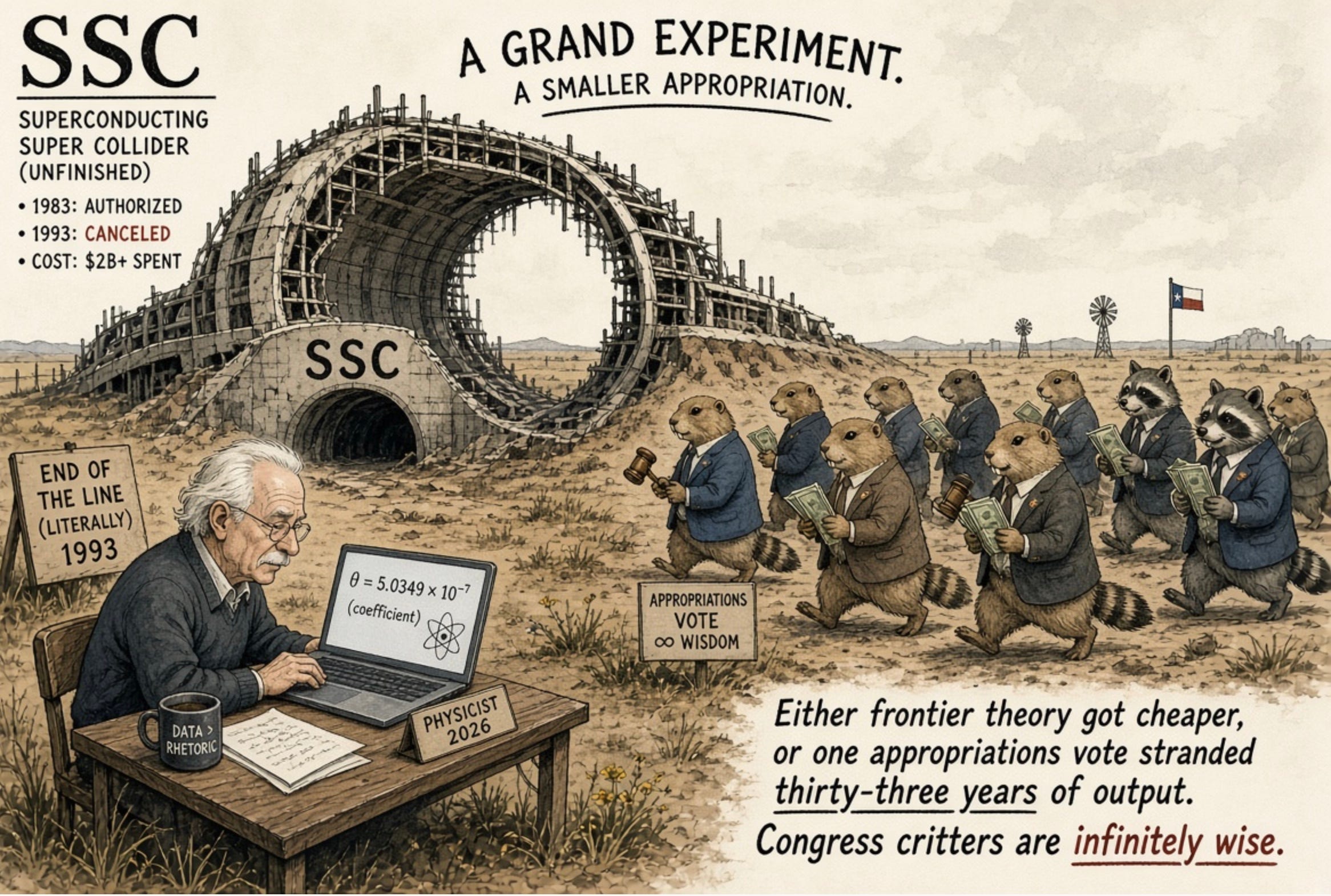
Then Congress cancelled the Superconducting Super Collider, I ended up in Connecticut to run money, and thirty-three years passed.
Physics Letters B has now published “Leading four-Goldstone inelasticity in custodial partial waves”, which computes the leading correction to that approximation. What comes out the far end is a better approximation, with its own higher-order terms still sitting there uncomputed. Same journal, same collision, and the same p-wave that the 1993 argument was about — the p-wave being the family of collisions in which the outgoing pair carries one unit of rotation, the channel where a vector resonance would live. The 1993 paper said the elastic unitarity condition carries no predictive power. This one asks a narrower question. Unitarity stays exact; exact elasticity does not, because some probability can leave the two-particle channel for four-particle states. The paper prices that leak in that p-wave. The price is a coefficient, 0.00000050349, which multiplies the fourth power of the collision energy — so what it comes to depends on where you look.
What follows explains what that number is, why it took three decades to get, and why a journal that published the discovery of the Higgs boson thinks a very small number from a guy listing his affiliation as VS Asset Management, LLC is worth publishing.
Five equations below stand on their own. Each has a paragraph before it telling you what to expect and a paragraph after it telling you what changed. If symbols put you off, skip the displayed line and read the paragraphs. The argument does not hide inside the notation.
The particle that used to be a symmetry
Put a marble at the center of a wine bottle’s punt — the dimple pushed up into the base. The situation is perfectly symmetric: every direction looks the same to the marble. It is also unstable. The marble rolls down and comes to rest somewhere in the circular trough around the dimple.
The whole trough sits at one height. Every position on that circle is exactly as low as every other, and the marble slides between them without ever climbing. This is worth being fussy about, because two nearby pictures give completely different physics. A bowl with a single lowest point would leave the marble one place to sit and nothing to do. A ring of separate dips with humps between them would leave it a handful of places to sit and a hill to climb between any two. What the wine bottle has is a continuous circle of equally low positions, and that continuity is what everything below depends on.
The law was symmetric. The outcome is not. The marble now sits at one particular spot on that flat circle at the bottom, and it had to choose. Physicists call this spontaneous symmetry breaking, and it is the single most productive idea in the field.
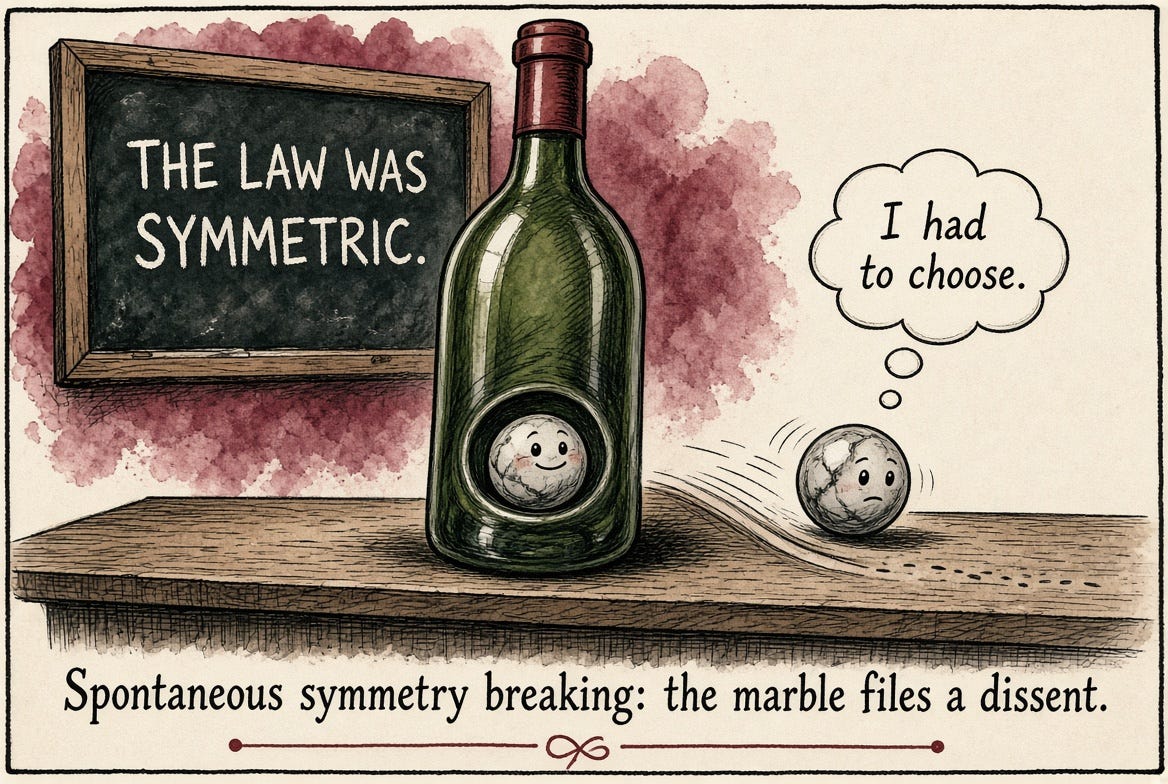
Now ask what it costs to move the marble. Pushing it up the wall costs energy: that direction has a stiffness to it, and in quantum field theory a stiff direction becomes a massive particle. Sliding it around the trough costs nothing at all, because every point in the trough is equivalent. A direction you can move along for free is called a flat direction, and in quantum field theory a flat direction becomes a massless particle.
That massless particle is a Goldstone boson. Jeffrey Goldstone conjectured the general statement in 1961 and proved it with Abdus Salam and Steven Weinberg the following year: break a continuous symmetry and you get one massless particle for every direction you can move without paying. The particle is the symmetry, still present, now expressed as a ripple that costs nothing to make.
The electroweak version has three flat directions of this kind, so it should have three massless Goldstone bosons. We do not see three massless particles. We see the W+, the W-, and the Z, all of them heavy — around 85 to 100 times the mass of a proton.
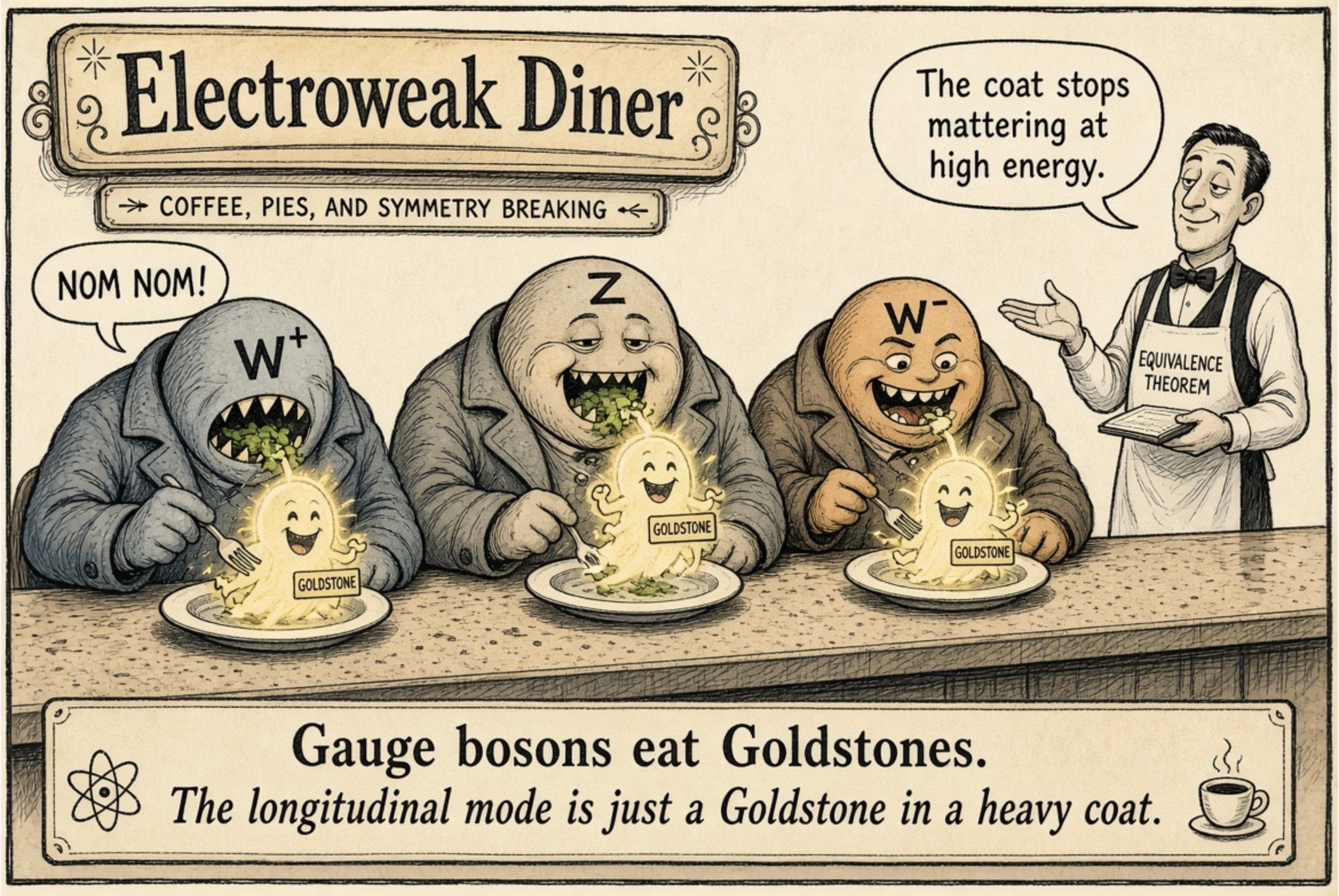
The three Goldstones did not vanish. Counting polarization states shows where they went. A polarization is the direction a particle’s field oscillates as it travels. A massless particle of spin one, the photon, has two, both across its line of flight, the way a light wave wags side to side. A massive particle of spin one has three: those two, plus one oscillating back and forth along the line of flight, called longitudinal. The difference is mass itself. A massive particle can be brought to rest, and a particle at rest has no direction of travel to single out, so all three directions are open to it. A massless particle never stops moving, and the two directions across its path are all it gets.
The W+, the W-, and the Z are massive spin-one particles, so each carries one polarization state that a massless particle cannot have. That is three extra states, and three Goldstone bosons that should have been there and are not. They are the same three objects: the longitudinal state of each heavy boson is one of the missing Goldstones. The standard phrase is that the gauge boson eats the Goldstone, a gauge boson being the general name for a force carrier: the photon for electromagnetism, gluons for the strong interaction, the W and Z for the weak one. Three Goldstones, three gauge bosons, three meals.
So the longitudinal polarization of a W boson is a Goldstone boson wearing a heavy coat. At energies far above the W mass, the coat stops mattering: amplitudes involving a longitudinal W approach the corresponding Goldstone amplitudes, up to corrections that shrink as mW/E. This is the equivalence theorem, and it converts a difficult problem about massive spin-one particles into a tractable problem about massless scalars with one parameter, v = 246 GeV, which sets the scale of the whole business. (A scalar has spin zero: no sense of direction at all, looking the same however you turn it, where the vector mentioned earlier carries one unit.) A GeV is roughly the mass of a proton, so v is about 260 proton masses, and a TeV is a thousand GeV.
The reason anyone cares involves one more piece of vocabulary. The amplitude is the complex quantity a quantum theory computes for a process. Take its squared magnitude, apply the appropriate normalization and phase-space factors, and you get an observable rate. Everything below is about one amplitude, for two Goldstones going in and something coming out.
At leading order in the low-energy expansion, that amplitude grows as E2/v2, without limit. Its squared magnitude grows faster still, and extrapolated far enough the corresponding partial wave would exceed the bound that probability conservation places on it. A partial wave is the amplitude sorted by how much rotation the outgoing pair carries away: an s-wave for none, the p-wave of the opening pages for one unit, a d-wave for two, and so on up. The sorting is worth doing because probability conservation constrains each wave on its own, so a theory can be in trouble in one of them while the others are perfectly well behaved. Nature does not break that bound. The approximation does. The runaway growth is the approximation announcing its own expiration date, somewhere around a TeV. Past that point, physics the approximation does not contain is carrying the amplitude. In the Standard Model the Higgs boson does the carrying. If the Higgs sector has more structure than we think, something else does. Every question about what electroweak symmetry breaking really is comes down to what takes over and how.
Reading the shadow
To make progress you need a way to measure the total probability that anything happened in a collision — every possible outcome, summed. Catching every fragment in every direction is hopeless. There is a much better instrument.
Send a beam through a target and look only at the beam that comes out the far side, undeflected. Some of it is missing. Everything that scattered, absorbed, or transformed left a hole in the forward beam, and the size of that hole encodes the total. You never have to see the scattered particles at all. You read the shadow.
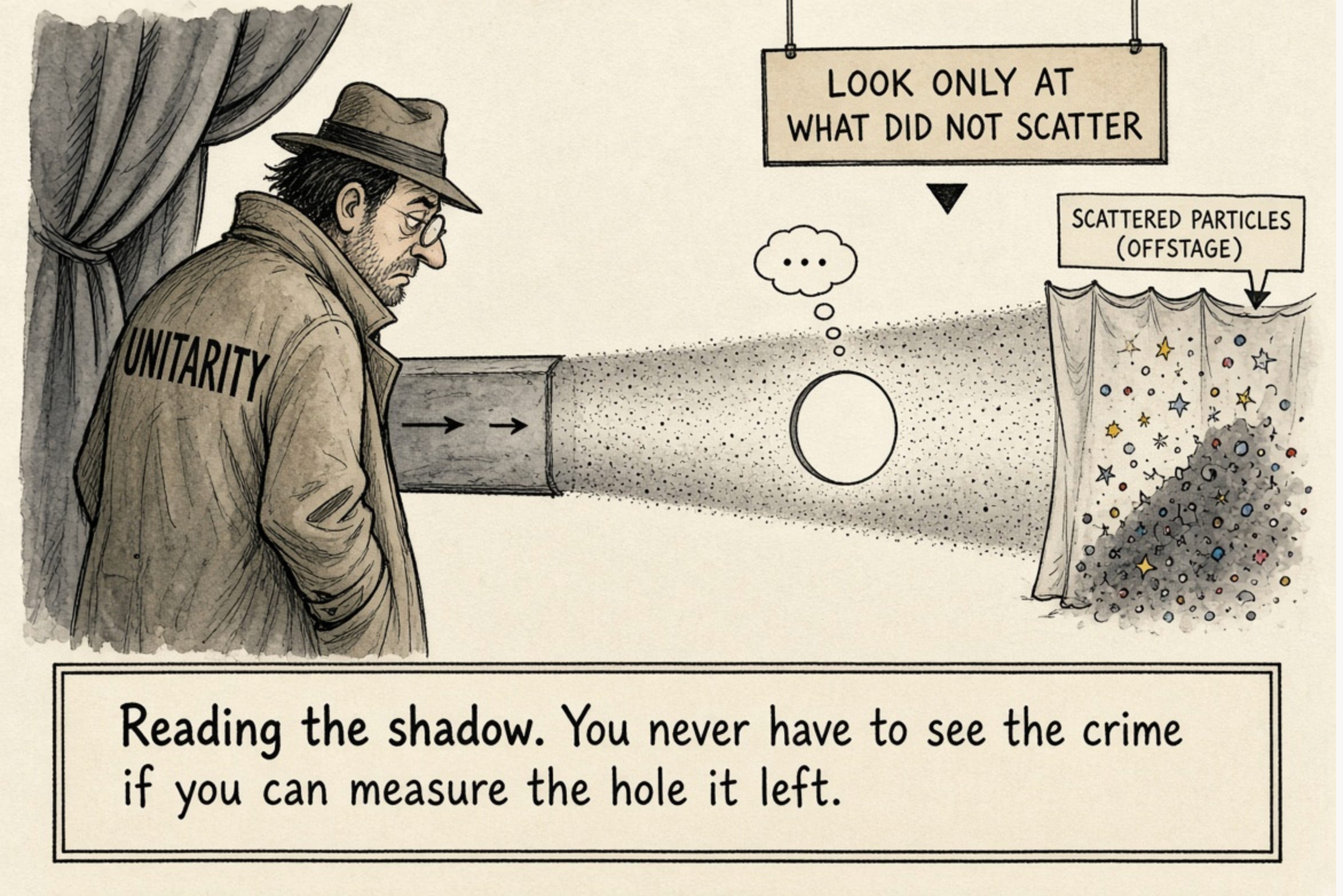
This is how attenuation imaging works, and it is also one of the deepest statements in quantum mechanics. It is called the optical theorem, and it follows from nothing more than conservation of probability. Written for a single spin channel of a scattering amplitude a:

The left side is the shadow. Amplitudes are complex numbers, carrying a size and a phase, and the imaginary part is the piece that survives when you ask what was lost from the forward beam. The right side sums the ways the collision can end. Written like this, it counts only outcomes with two particles coming out. Two in, two out.
That is the assumption. Unitarity itself never fails; it is exact, and it is the reason the equation holds at all. What fails is exact elasticity — the extra assumption that nothing but two-particle states appears on the right. Full unitarity adds a positive term for every inelastic outcome. Physicists package the same information into an elasticity parameter η: setting η to one says the circuit is closed and nothing leaks.
Two particles can become four, and once they can, the circuit is open. In a theory of massive particles there would be a threshold: a minimum collision energy needed to pay for four rest masses, below which the channel is shut and the elastic description is exact. Goldstones are massless. There is nothing to pay for, and no such energy exists. The four-particle channel is open at every energy above zero, and it always was.
What keeps it negligible is the size of the opening. The rate into four particles climbs as the eighth power of the collision energy, but a power law by itself says only how fast something grows; to say how big it is, you need a scale. The scale is v, the 246 GeV from the equivalence theorem: the rate goes as (E/v)8. Below v that ratio is a fraction, and raising a fraction to the eighth power crushes it. Halve the energy and the leak drops by a factor of 256; double it and the leak grows by the same factor. So at low energies the leak is small past caring about, and it only becomes interesting as the energy rises. The practical questions are how much escapes at a given energy, which is set by the number multiplying (E/v)8, and where the escape starts to matter.
Four methods answer them, and they run through this whole story. The low-energy expansion hands you a series that behaves at small energies and runs away at large ones. A unitarization method rearranges that series into a form which respects probability conservation exactly, so the answer stays bounded where the raw series would not. They differ in how they rearrange. Padé approximants replace the series with a ratio of two polynomials chosen to reproduce it term by term; the ratio stays finite where the series diverges, and it can also develop poles, which is where the disputed resonance of the 1993 argument came from. The inverse amplitude method expands 1/t in place of t. K-matrix constructions build a real intermediate quantity and assemble the amplitude from it. N/D splits the amplitude into two factors carrying its two different kinds of singularity.
Every one of these is a workhorse of the field, and their standard single-channel elastic implementations all set η to one and proceed. They had no choice: a usable calculation of the leading correction did not exist.
Three loops, and how to avoid them
Quantum field theory computes, when conditions allow, by successive approximation. The method needs a small quantity to expand in, and some of the most important cases supply none. Low-energy QCD is the standing example: the coupling between quarks and gluons grows as the energy falls, the corrections get larger instead of smaller, and the series is worthless exactly where a proton lives. That is why the structure of the proton is computed on supercomputers by brute simulation, with no pencil involved. The Goldstone theory of the previous section — three massless particles, one scale v — does supply a small quantity, at least while the energy stays well below 4πv, which is what makes the approximation scheme available at all.
Given that, the first approximation draws the particles going in, interacting, and coming out. Those are tree diagrams, so called because drawing one gives you a picture that branches outward and never rejoins itself, the way a tree does. A tree may contain several interaction points. However, it contains no closed circuits: nothing doubling back on itself.
The next approximation allows the interaction to be more elaborate. Particles can be created and reabsorbed along the way, forming a closed circuit inside the diagram — a loop. A loop is a genuine sum over every possible momentum the temporary particles could have carried, which means an integral, and the integrals are hard. Each additional loop costs another factor of roughly 1/(16π2), along with the relevant powers of energy, which is why the later terms are suppressed at low energy. Each also costs a great deal of human effort, which is why people stop calculating early. The series itself runs on forever without us.
In this theory the counting is clean. Tree level is order p2 — two powers of momentum. One loop is p4. Two loops, p6. Three loops, p8.
The four-particle leak enters at p8. Three loops.
Nobody, as a practical matter, does three-loop calculations in this theory. The diagram count explodes, the integrals resist analytic evaluation, and the bookkeeping needed to keep the answers finite (a procedure called renormalization, which I come back to below) becomes its own research program.
If computing this coefficient had required a full three-loop calculation, with all of that machinery, it would still be undone.
It does not, and the reason is the optical theorem again, in its sharpest form.
The word particle needs care first. A real particle obeys a rigid relation among its energy, its momentum, and its mass — E2 = p2 + m2, in the units physicists use to avoid writing factors of c. That relation carves out a surface in the space of energies and momenta, and the surface is called the mass shell. Anything sitting on it can travel across a room, persist, and arrive at a detector where somebody counts it.
The lines running through the interior of a Feynman diagram sit off that surface, and they go by the name virtual particles, which is among the worst pieces of nomenclature in the subject. A virtual particle travels nowhere, has no lifetime, and cannot be detected even in principle. It is a factor in an integral. The line in the drawing resembles the path of a particle, so the factor inherited the word, and that notation choice has misled readers since 1948.
Richard Cutkosky showed in 1960 that you can take a loop diagram, cut it open across a specified set of internal lines, and require those lines to sit on the “mass shell” — promoting them from terms in an integral to particles that were genuinely produced and could in principle be counted. What you get is that cut’s contribution to the imaginary part of the loop, expressed in terms of lower-order amplitudes. Physicists then use cut as a noun for the piece of the imaginary part that a particular slicing produces, named by what the slice passes through. The cut needed here passes through four Goldstone lines, so it is the four-Goldstone cut, and it is the leak itself: the piece of the shadow owed to collisions that ended in four particles. Its contribution comes from the tree-level amplitude for two particles becoming four.
The man’s name was Cutkosky. The technique is called cutting. Physics does this to itself every so often and never offers an explanation.
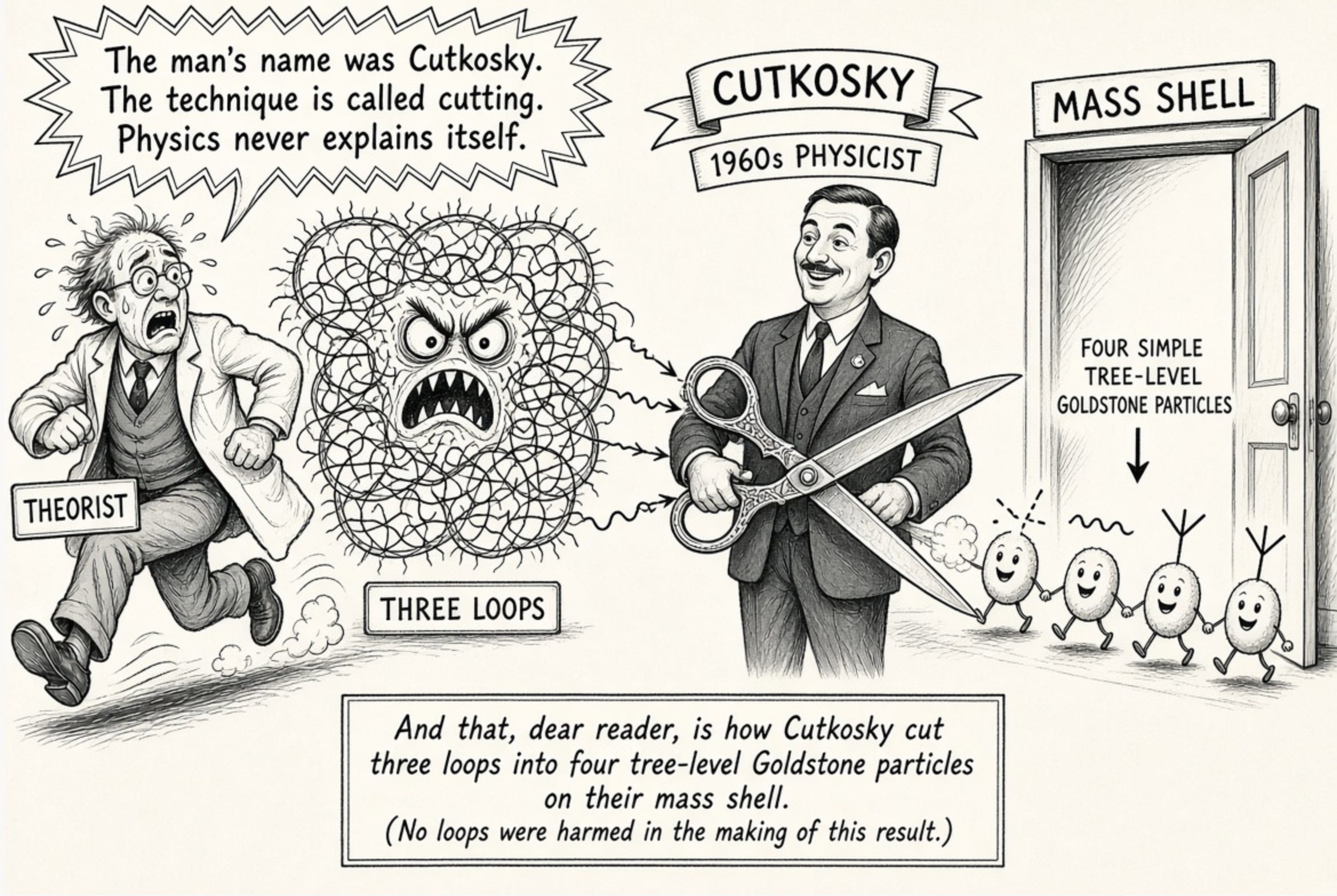
What that buys is enormous. The four-particle piece of a three-loop imaginary part equals a production rate you can compute at tree level. You never do the three-loop integral. You compute the probability that two Goldstones turn into four, using diagrams with no loops in them at all, and unitarity hands you the loop’s imaginary part for free.
This is the whole method of the paper. You obtain the hard object from an easy one, because probability conservation ties them together.
A man down the hall
The counting above settled where the leak opens, back in the 1990s. That part was known.
The amplitude was the harder piece. You need the complete tree-level probability for two Goldstones to become four, which involves fifteen ways the internal labels can pair up, each carrying a direct contact term plus ten distinct ways the process can proceed through an intermediate particle. José Goity computed a massless version analytically in 1993, for pions in a hot hadron gas (the equivalence theorem makes it the same calculation), in a paper that states plainly which class of diagrams it omits. Bijnens and collaborators later worked out complete six-particle amplitudes in general form. That amplitude is prior art.
Duane Dicus and Hong-Jian He did the next piece in 2004: they kept every Goldstone diagram and computed cross sections channel by channel, numerically. A cross section is the effective target area a collision presents: a big one means the process happens often, and it is the quantity an experiment actually measures. They also gave each Goldstone the mass of the W or Z boson it stands in for — putting it on that boson’s mass shell, in the language above — so their final states were real particles with real masses, at the cost of leaving the strictly massless theory behind.
I knew Duane Dicus at Texas. The 1993 paper thanks him by name in its acknowledgements, alongside Sudarshan, for useful discussions. The man whose 2004 cross sections I spent this spring comparing against mine had talked some part of this problem through with me thirty-three years earlier, when I was a graduate student down the hall. Both of my independent methods pick out the same four channels he identified as the largest of their kind among the ten, which is as far as his published numbers allow a comparison. The field is smaller than it looks from outside, and it has a longer memory than the people in it.
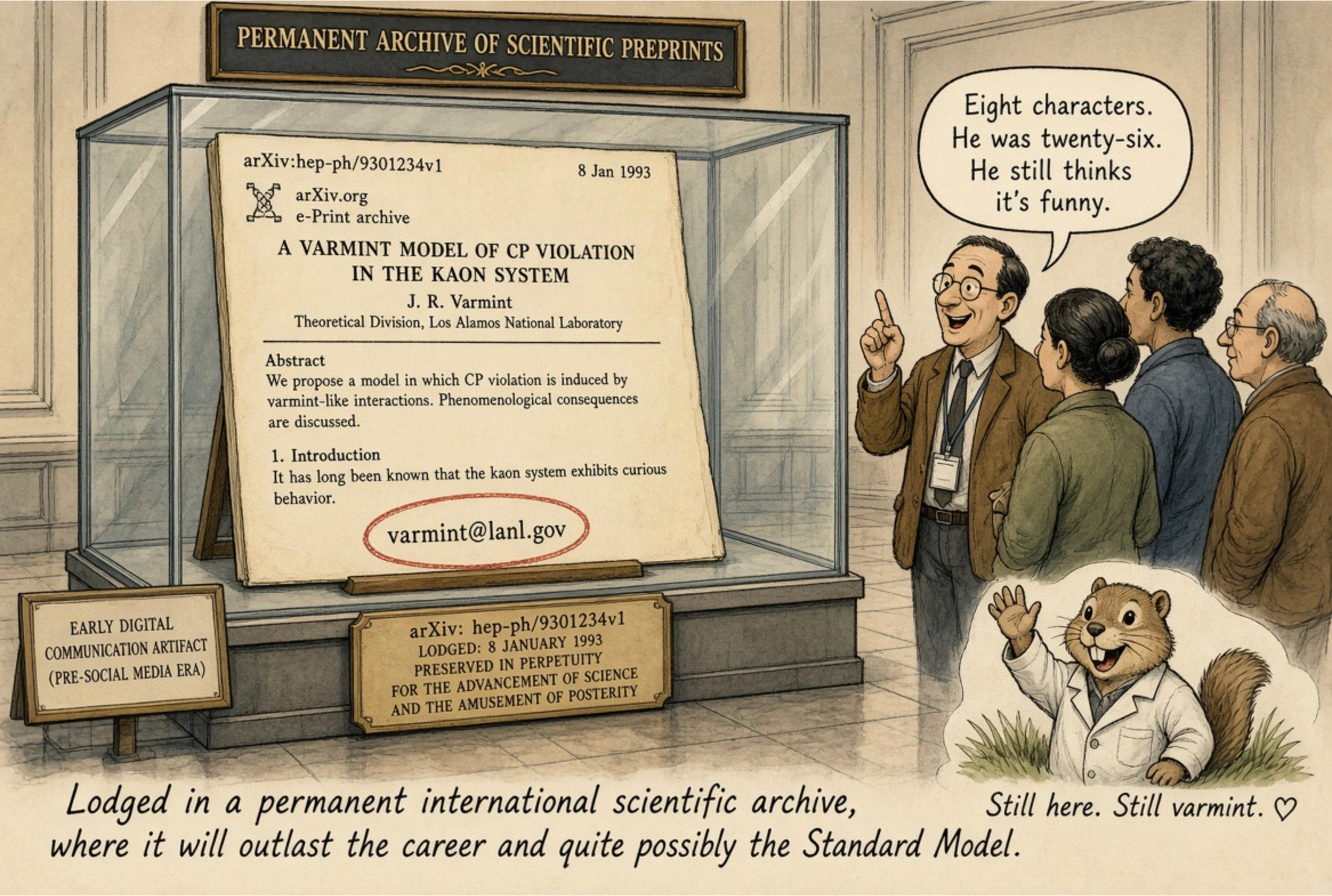
The preprint of the 1993 paper is still on the arXiv, under the longer title it had before Howard Georgi, handling it for the journal, renamed it (yes, that Howard Georgi), and it lists our email addresses at the bottom of the first page. Silas was sbeane. I was varmint. I would like to report that this was a wry comment on the condition of high-energy theory after the SSC vote, or an erudite nod to the coyote of the American Southwest. It was neither. It was 1993, the system administrator allowed eight characters, and I was twenty-six and thought it was funny. It is now lodged in a permanent international scientific archive, where it will outlast me, my non-existent physics career, and quite possibly the Standard Model. I regret nothing. I still think it’s funny.
What the new paper does with the amplitude is the contribution: insert it into the optical theorem, sum over final species, and project the result onto definite spin and isospin (isospin being the label for how the two colliding Goldstones are combined, which gets its own paragraph below). That lands the answer inside the equation the field’s toolkit actually uses, in the units the toolkit reports.
Where it should have blown up
This next part is where a physicist decides whether to believe the result.
Massless particles exchange massless carriers, and an exchanged carrier contributes a factor of one over the momentum transfer. When the deflection angle goes to zero, so does the momentum transfer, and that factor blows up. Sorting the amplitude into partial waves means integrating it over the scattering angle, so the blow-up gets integrated over. Write x for the cosine of the scattering angle, s for the squared collision energy, and t for the momentum transfer:
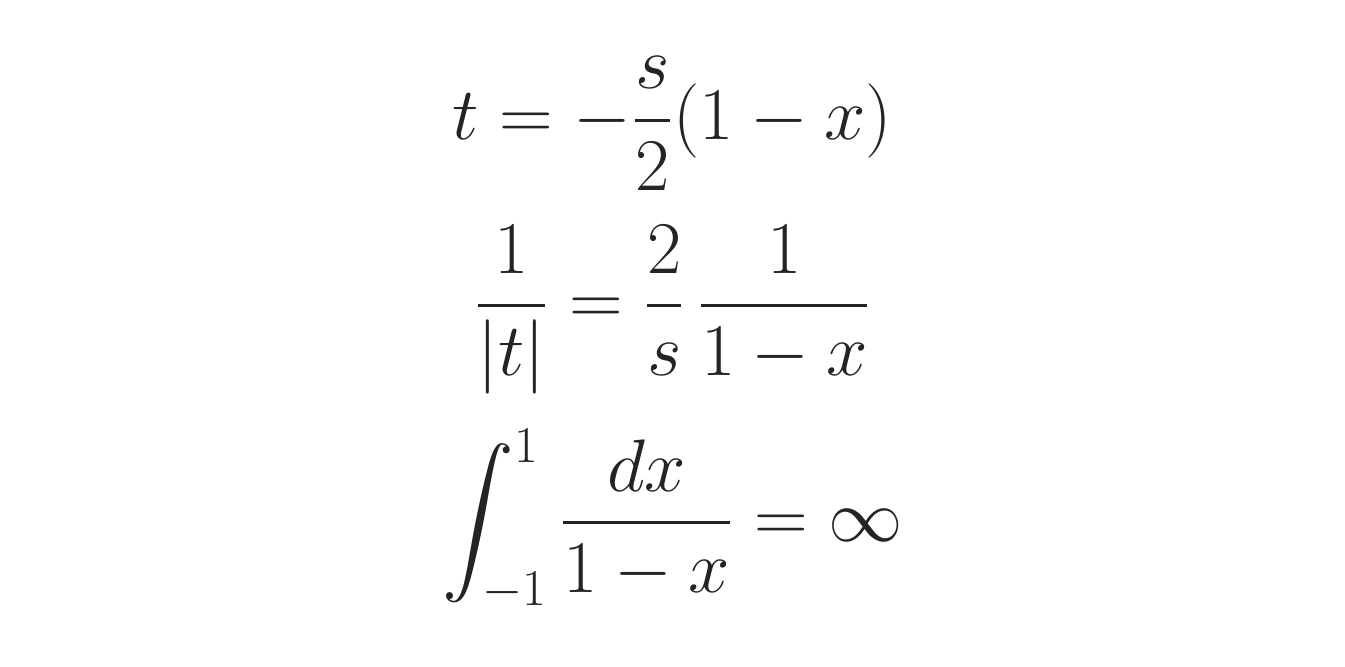
The first relation says the momentum transfer vanishes at x = 1. The second says the exchange factor grows without bound there. The third says that integrating it over the angle, which is what projecting onto a partial wave does, gives infinity: the projection integral diverges logarithmically at x = 1, the exactly forward direction.
This divergence is the same one that leaves naive Coulomb scattering with no total cross section. Coulomb scattering is the textbook problem of one charged particle deflected by another through nothing but their electrical repulsion — an alpha particle swerving past a gold nucleus, which is the experiment that found the nucleus in the first place. The electric force reaches forever, so a charged particle passing at any distance whatever is deflected a little, and adding up “a little” over all distances out to infinity gives infinity. Rutherford’s famous formula for that deflection blows up in the forward direction, and the total cross section it implies diverges. Every student meets this, and every student is told the resolution: in a real material the charges shield one another, the force stops reaching forever, and the integral is cut off. The word is screening.
But! There is no screening here. Nothing gives the Goldstones a range. So the calculation had every right to die.
The theory disarms itself
It survives, and the mechanism is the most satisfying thing in the paper.
Two pieces of diagram vocabulary, since the argument turns on them. A vertex is a point where lines meet — the place in the picture where particles actually interact, and the place where the theory’s interaction strength enters the arithmetic. A propagator is what an internal line contributes: the factor describing a disturbance travelling from one vertex to the next. Its denominator measures how far that internal line sits from the mass shell, so the denominator approaches zero exactly when the internal line approaches being a real particle. That is the source of the trouble above. A vanishing denominator is a diverging factor.
Every interaction vertex in this theory carries two derivatives. That is forced, and the reason goes back to the wine bottle. A Goldstone boson is the ripple of a broken symmetry, which means that shifting the field by a constant amount everywhere must change nothing at all — sliding the marble around the trough is free. A constant shift is a ripple of zero frequency, so the amplitude has to vanish when the momentum vanishes. Every vertex is proportional to momentum, twice over. The statement is called the Adler zero, after Stephen Adler, who found it in the context of pion physics in 1965.
Now look at what that does to the dangerous graphs. The quantity that threatens to blow up is a ratio: a vertex sitting on top of a propagator’s denominator, with the denominator heading for zero. Writing 𝒱A for the vertex and DA for that denominator, the dangerous object is 𝒱A/DA.
Both are built from the same momenta, and the Adler zero forces the vertex to shrink as those momenta shrink. That gives the bound the paper proves:

The DA on the right of the first inequality is doing deliberate work. Bounding the vertex by the very denominator that was about to diverge means the two cancel in the ratio, leaving 1/v2, a fixed finite number with no momentum in it at all. The numerator dies at least as fast as the denominator does, so every endpoint that threatened to produce an infinity produces a bounded number instead.
This sort of cancellation is what every theoretical physicist lives for. You set a calculation going, you watch it head straight for a cliff, and then the structure of the theory reaches out and catches it — and it catches it for a reason, because the symmetry you started from was never going to permit that disaster in the first place. You do not get many of these in a career. You remember the ones you get.
The symmetry that creates these particles also disarms the singularity they would otherwise generate. The theory protects its own integrals.
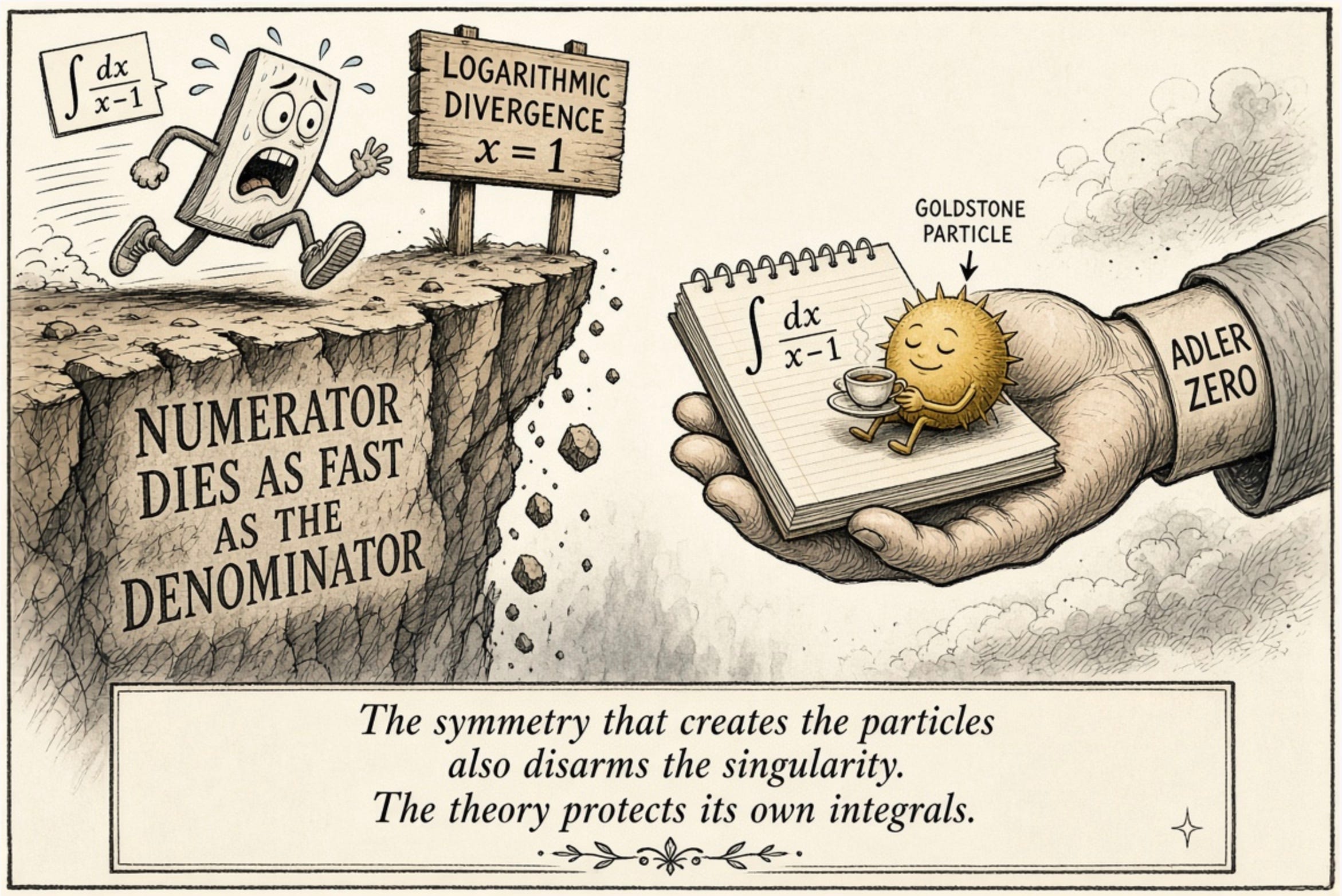
The paper makes this quantitative, bounding the entire six-particle amplitude by 141 s/v4. A bounded integrand over a finite volume converges absolutely. No regulator, no subtraction, no analytic continuation.
Those three are the standard rescues for an integral that misbehaves, and each one is a place where a mistake can live. A regulator deforms the integral into something finite — imposing a maximum momentum, say, or computing in a number of spacetime dimensions slightly different from four — after which you owe a demonstration that the answer does not depend on the deformation. A subtraction removes the divergent piece and absorbs it into the theory’s parameters, a procedure called renormalization, after which you owe a demonstration that what you removed was exactly what needed removing. An analytic continuation evaluates the integral in some region where it does converge and extends the result to the region you actually wanted, after which you owe a demonstration that the extension is unique. All three are legitimate and all three are in daily use. All three are also arguments, and arguments can be wrong.
Renormalization carries a bad reputation it stopped earning about fifty years ago. Loop integrals, taken at face value, come out infinite. The original response was to absorb those infinities into the theory’s unmeasured starting parameters so that the quantities you actually observe came out finite — a procedure Feynman, who helped invent it, cheerfully described as dippy. It gave answers correct to ten decimal places, which made the situation worse.
The meaning arrived later, largely through Kenneth Wilson. The infinities came from pretending that a theory built to describe physics at one distance scale stays valid down to infinitely small distances. It does not. A theory’s parameters are whatever they measure to be at the energy where you measure them, and renormalization is the rule for how those numbers change as the energy changes. That change is physical. The strength of the QCD coupling growing as energy falls, which is why low-energy QCD resists the expansion described above, is that rule in action. Absorbing infinities turned out to be a side effect of a statement about how the world looks different at different resolutions.
An integral that converges on its own asks for none of them. The number is the number. The referee asked me to make this argument explicit, which was the right request, and the paper is better for it.
A sign that could not have come out the other way
The leak divides among spin channels: some of it flows into the state where the outgoing system carries one unit of angular momentum, some into three units, and so on. Call the contribution of each spin CJ. The paper shows that each one is the squared length of a vector in the space of possible outcomes:

Squared lengths are never negative.
Two things follow immediately. The sign of every channel is fixed before a single number is computed. And the total is a sum of nonnegative pieces, so stopping the sum anywhere gives a rigorous lower bound instead of an estimate: the unresolved tail above the highest spin computed can only add to it.
A second symmetry removes half the spins outright. Bose symmetry is the requirement that a system of identical bosons be described identically when you swap two of them — Goldstones are bosons, and swapping two of them has to leave every physical statement untouched. Swapping the two incoming Goldstones amounts to viewing the collision from the opposite side, which reverses the sign of the scattering angle’s cosine. Under that reversal the spin-J channel picks up a factor of (−1)J: even spins come back unchanged, odd spins come back with a minus sign. The isospin arrangement of the incoming pair carries a sign of its own under the same swap.
Isospin here labels how the two colliding Goldstones are combined. There are three Goldstones, and a pair of them can be assembled into one isoscalar combination (I = 0), three isovector combinations (I = 1), or five isotensor ones (I = 2) — the same arithmetic by which two spinning objects combine into a total spin of 0, 1, or 2. The symmetry that keeps these three families from mixing is called custodial: it treats the three Goldstones as interchangeable, and it earns the name by standing guard over the observed relationship between the W and Z masses, which stops holding if it is removed. Each family therefore scatters as an independent problem with its own answer, which is why the paper reports three separate rate coefficients.
Their swap signs are + 1, − 1 and + 1 respectively. The two signs multiply, and the product has to be + 1. So I and J must add to an even number.
In the isovector channel, where I = 1, that forces J to be odd. The even waves are absent exactly, for free, before anyone computes anything — which is why the spin sums in this paper run over odd values only.
This is what mathematical elegance buys in practice: a sign guaranteed before any number is computed, and a truncation that bounds the answer instead of estimating it.
The number
Here is the result the paper exists to deliver. The paper writes t11 for the isovector p-wave, the channel with I = 1 and J = 1 — this t is the partial-wave amplitude, a different object from the momentum transfer t of the divergence section above. The exact-elasticity condition used by every single-channel unitarization scheme says that a certain quantity equals one. It does not equal one. It equals one plus something:
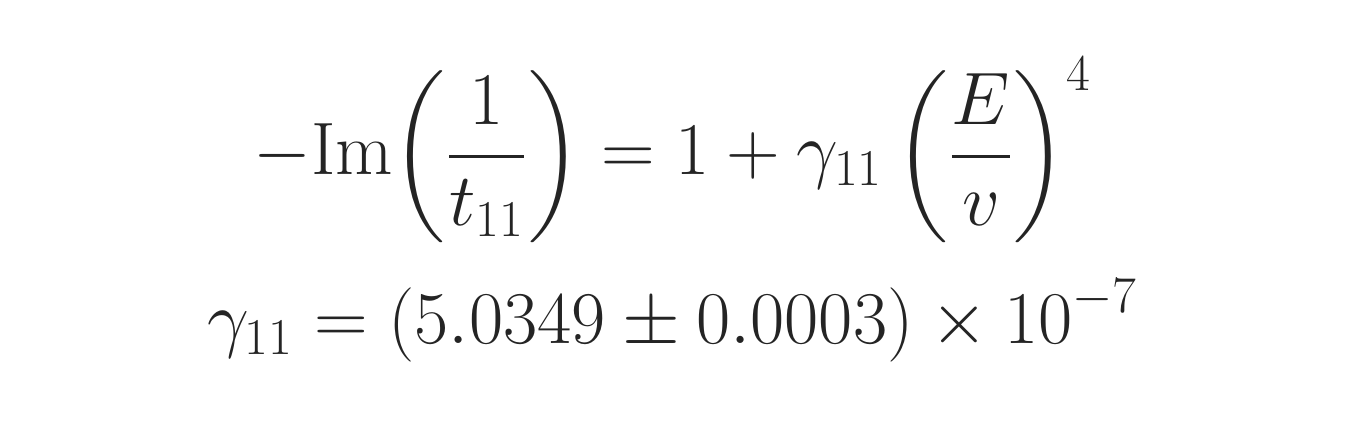
In that expression E is the collision energy, the same quantity set to 2 TeV below, and v is still the 246 GeV from the opening pages. Two energy powers are now in play, and they need reconciling. The four-particle cut, the leak itself from the cutting section, grows as the eighth power of energy, as the order counting demanded. It appears here as a fourth-power correction because this relation divides that leak by the squared leading elastic wave, and that square already carries four powers of its own. Eight powers divided by four powers leaves four.
So the leak grows as the fourth power of the collision energy. At E = 2 TeV, with v at its measured value of 246.22 GeV, it reaches 2.19 × 10⁻³: a departure of about two parts in a thousand from the assumption everyone has been making.
That fourth power is itself a leading-order statement, and it carries the same warning as the runaway growth earlier. The expansion parameter in this theory is E/(4πv), which at 2 TeV equals 0.65. That is large enough to matter. Higher-order terms could be substantial, and nobody has computed their coefficients or their actual size, which is why the paper assigns no truncation uncertainty to the 2 TeV figure. Two parts in a thousand is the leading-order size of the effect, good to a factor. Reading it as a precision electroweak prediction would be the same species of error the 1993 paper was written to expose: mistaking a feature of your approximation for a fact about the world.
Two parts in a thousand also needs a ruler in both directions. Against current experimental capability it is invisible. The 2025 ATLAS and CMS projections for the High-Luminosity LHC put the expected precision on the doubly longitudinal same-sign WW scattering cross section at 17.5 percent, with the two experiments combined. The two are different objects — an uncertainty on a rate, and a defect in a unitarity relation — so the ratio between them sets a scale without forecasting a sensitivity. The scale is the point. The nearest measurable relative of this quantity will be known to about a sixth of its own size, and the effect computed here is two parts in a thousand. Against the calculation it is enormous: the integration noise on the coefficient — the residual wobble left over from approximating a continuous integral with a finite number of sampled points, which I come back to in a moment — is four orders of magnitude smaller than the coefficient itself. The number is sharply determined by the theory while remaining undetectable by anything now in existence.
Within the isovector channel — the I = 1 family, which carries the quantum numbers of the rho meson and is the wave the whole 1993 argument was about — 88.17 percent of the leak flows into the single lowest allowed spin, and 96.88 percent into the lowest two. The escaping particles come out in a strongly preferred configuration.
The ± 0.0003 riding on that coefficient is a smaller claim than an error bar usually makes. It is the integration noise mentioned above. Run the calculation again over a different set of sampled points and the answer shifts a little; the spread across those runs is the figure quoted. It measures how well I did the arithmetic. Two other quantities it might be mistaken for are different animals — a confidence interval about nature, and an estimate of how far the leading-order approximation sits from the truth. That second one is the truncation error discussed above.
To make sure the paper was right, I did the whole numerical integration twice, by two completely separate methods. They agree on every shared quantity. Both must add up the contribution from every way the four outgoing particles can divide the available energy and fly apart — that set of possibilities is what physicists call phase space, and constructing it is most of the work. One method walks through that space along a mathematically designed sequence built to spread its points as evenly as possible and leave no gaps. The other scatters events across it at random, the way a collider simulation would. Turning either into a number needs a quadrature rule, which is the recipe for approximating a continuous integral by a finite sum of sampled points, and the two use different rules.
I wrote the code separately, constructed the phase space separately, built the custodial contractions separately. That last one is the index arithmetic that takes the raw amplitude, with its labels for which Goldstone is which, and projects it onto the isoscalar, isovector and isotensor families of the custodial symmetry. Agreement to a part in a thousand or better, inside the quoted errors, is then a fact about the integral. There is no shared numerical machinery for a coding error to hide inside. Both paths do share the underlying amplitude and its conventions, so a conceptual mistake there would show up in both. An exact algebraic identity relating the physical charge channels to the isospin channels holds entry by entry, which pins the overall normalization without fitting anything.
Does it predict anything?
A reader who took the opening seriously should now be uneasy. The 1993 paper said that axiomatic principles carry no predictive power, and that anyone extracting physics from elastic unitarity was extracting what they had already put in. Here I am, thirty-three years later, extracting a number from elastic unitarity. Have I spent three decades becoming the thing I argued against?
No, and the reason matters more than the number does.
The coefficient comes out of the Lagrangian.
That object is the whole game. A Lagrangian is the complete specification of a physical theory. Write one down and everything else follows by turning a crank: which particles exist, how they interact, every amplitude, every rate, every number a detector will ever report. Knowing the Lagrangian of the world is the entire point of particle physics, and the Standard Model is a Lagrangian — one that fits on a coffee mug, which people find either charming or alarming depending on the decade. The one at work here is the portion of the Standard Model’s Lagrangian that describes these Goldstones once the physical Higgs boson is set aside: the two-derivative interaction forced by the broken symmetry back at the wine bottle.
From that Lagrangian, the coefficient follows: the six-particle amplitude at tree level, integrated over four-body phase space. That calculation contains dynamics. It could have produced any number at all, and the theory alone fixes its value.
Unitarity does one job here, and it is the job an axiom is entitled to do: bookkeeping. It converts a production rate that I computed from the dynamics into a statement about the elastic wave. Cutkosky’s rule is the exchange mechanism. The physics content enters at the vertex, and comes out at the answer.
This is precisely the standard the 1993 paper demanded. Its complaint about the Padé method — the ratio of polynomials described earlier — was that predictive power appeared to emerge from imposing an axiom, when it actually came from quietly dropping a class of graphs. The correct procedure is to make predictive power come from somewhere you can name. Here it comes from a Lagrangian and eight thousand lines of Python, both of which are on the record — the code is archived at Zenodo and the referee read it.
So the coefficient predicts nothing about the spectrum, meaning the list of particles the theory contains. Whether the vector resonance of the opening pages exists stays exactly as open as it was in 1993.
What the coefficient does is constrain, which is what unitarity is for: at this order, in the same massless custodial theory and normalization, any more complete construction must reproduce this number, and one that produces a different value has an error in it.
The continuity runs deeper than the argument. In the 1993 paper the leading vector amplitude carries a coefficient α1 = 1/(96πv2). In the new paper the same amplitude carries K0 = 1/(96π). It is the same 96π, in the same channel, doing the same work, thirty-three years apart. What changed is that the equation it sits in now has a second term.
When will anyone see this?
Not soon, and possibly never in this exact channel.
Where the experiments stand, as of September 2026. ATLAS and CMS are the two general-purpose detectors on the LHC ring, built and run by separate collaborations of a few thousand physicists each, so that anything important gets found twice by people who were not talking to each other. In April 2025 ATLAS reported first evidence, at 3.3 standard deviations, for vector boson scattering involving longitudinally polarized same-sign W bosons — the events where both are longitudinally polarized make up only about a tenth of the sample, which is what makes the measurement hard. In August 2026 the collaboration went further, announcing the first observation of two simultaneously longitudinally polarized Z bosons at 6.5 standard deviations, and 4.0-sigma evidence for longitudinally polarized Z bosons in electroweak WZ production with two jets, one of the channels where boson scattering shows up. No evidence yet for longitudinally polarized W bosons in that channel.
So ATLAS and CMS are seeing the longitudinal modes. Their existence and rough rate are becoming established facts.
Where the upcoming High-Luminosity LHC will get us — the machine went into its long shutdown for that upgrade at the end of June 2026, and CERN plans to start Run 4 in June 2030 — the doubly longitudinal component makes up only six to seven percent of the total same-sign WW scattering cross section, so isolating it stays limited by statistics even after the machine has delivered its full planned quantity of collisions. The 2018 projections had CMS reaching 2.7 standard deviations and the two experiments together barely clearing three. The 2025 update does better: ATLAS and CMS combined expect to cross the five-sigma observation threshold somewhere between two-thirds of the way through the program and its end, with the doubly longitudinal cross section known to 17.5 percent.
Seventeen and a half percent. That is the ruler from the previous section, now with a date on it: after the entire high-luminosity program, the nearest measurable relative of this coefficient will be known to about a sixth of its own size.
What would do it: a multi-TeV lepton machine. The physics case for a 10 TeV muon collider rests substantially on making the first precision experimental tests of the unitarization of massive gauge boson scattering. That machine does not exist. CERN still describes it as a feasibility study, and on present planning assumptions it would be a mid-century machine at the earliest. I do not expect to be around when it turns on. That troubles me less than it might, because the number is already doing its work.
So the audience for this coefficient is the people who build the calculations that experiments will eventually be compared against. Every unitarization scheme in current use sets the leak to zero. Any successor scheme — three-loop, coupled-channel, dispersive — that claims to describe this same theory more completely, at this order, must reproduce this coefficient. It is a fixed target, a consistency condition the next generation of calculations has to satisfy, and anyone with the archived code can check it today.
Physics advances this way more often than the popular account suggests. Someone nails down a number that constrains other people’s theory long before any instrument can resolve it, and the constraint does its work quietly for decades.
What an assumption costs
Physics Letters B is a Letters journal, which means short papers held to a high bar, and it is where ATLAS and CMS published the discovery of the Higgs boson in 2012. The referee on this paper read the archived code independently and asked for a specific gap to be closed. That is what a good report looks like.
A journal of that kind takes a paper like this one because it converts an approximation used by an entire subfield, in every one of its standard tools, into a quantified statement that anyone can check and that any successor calculation must match. The size of the number is beside the point.
Silas is a professor at the University of Washington now, in the Nuclear Theory Group, and a founding member of the collaboration that first brought lattice QCD to bear on nuclear interactions. He has spent recent years on entanglement and geometric quantum mechanics, and in February 2023 he gave a talk on unitarity, causality, and entanglement in a geometric theory of scattering. Neither of us ever quite put the subject down.
Which brings me back to 1993. Beane and I spent that paper arguing about how much the elastic unitarity condition could be made to say, and our answer was: less than people wanted. What neither side of that argument could say was how good the approximation was. Everyone knew elastic unitarity was an idealization. Nobody could put a size on the error, so “small enough to ignore” stayed a shared expectation that no one had ever computed. Thirty-three years on, I computed the leading correction, and it turned out to be small. That does not certify every construction built on exact elasticity; it gives each one a benchmark. The approximation no longer rests on a shared expectation that the missing channel probably does not matter. It rests on a calculation.
What still surprises me is that one person could compute it in a few months, alone, at an age when physicists are supposed to be finished. Model that: either frontier theory has become dramatically cheaper to do, or one appropriations vote stranded thirty-three years of output. Probably both, and the second is the more expensive. As I always say, Congress critters are infinitely wise.
That is a different essay, and I might write it. Or might not.
My book, The Science of Free Will, asks an equally uncomfortable question about an equally cherished story: amzn.to/4aMQJD1
New to the India series? Start with The Paradox of India, and the full series lives at samirvarma.substack.com/t/india.
The rest of the physics writing on this Substack lives at samirvarma.substack.com/t/physics.
On Britain’s institutional decline, which I first noticed in 1979: Albion.
If markets are more your thing than partial waves: samirvarma.substack.com/t/trading.
The paper this essay is about: “Leading four-Goldstone inelasticity in custodial partial waves,” Physics Letters B, doi:10.1016/j.physletb.2026.140915. The code and numbers are deposited separately at doi:10.5281/zenodo.21762619.
The 1993 paper: S. R. Beane and S. Varma, “Strongly interacting W’s and Z’s and the elastic unitarity constraint,” Physics Letters B 313 (1993) 165, doi:10.1016/0370-2693(93)91207-4. Preprint, under its original title: arXiv:hep-ph/9304233.