
The fourth in a series auditing the stories quantitative finance tells itself. Previously, the Emperor had no Alpha, no Identification, and no Benchmark. Today he has no factors, or none that divide out cleanly, and the factor zoo’s own star exhibit will make the case for us.
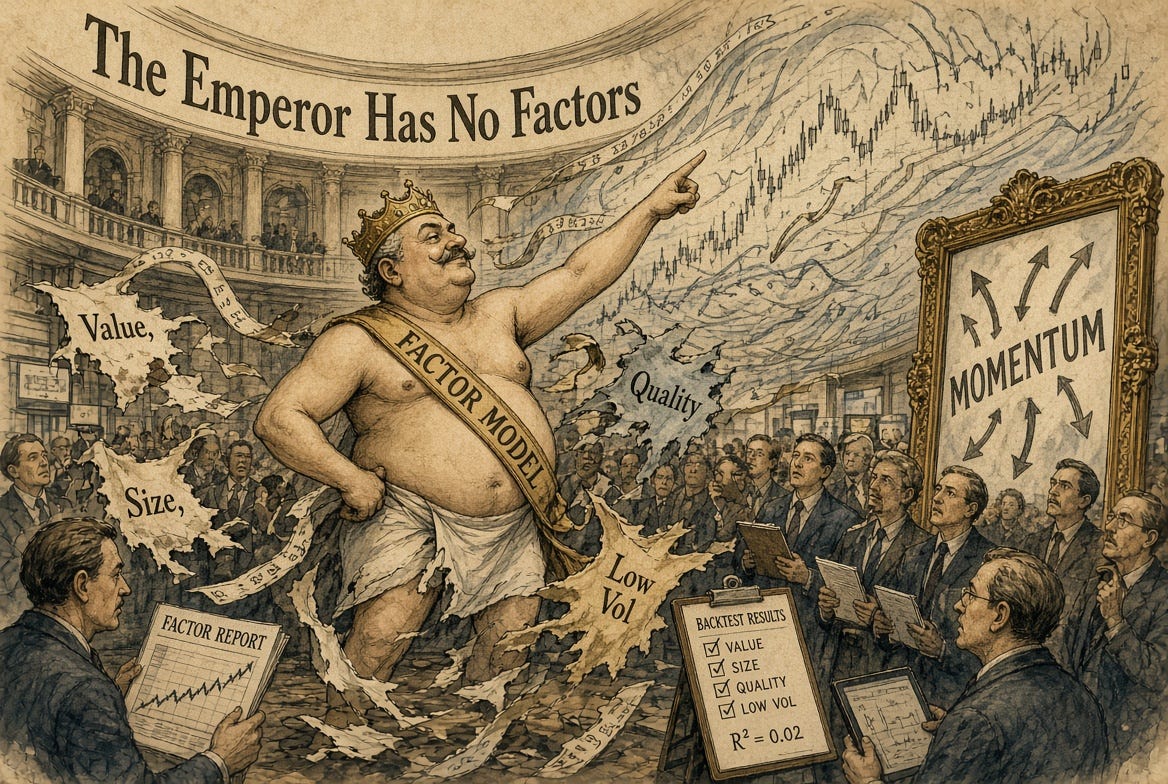
Let me start with the pitch, because you have heard it, and if you manage money for a living you have probably given it.
The market looks like chaos. Ten thousand stocks lurching around on earnings and rumor and the mood of a man in New Jersey who just read something on his phone. Hopeless to model head-on. But, the pitch continues, underneath the chaos there is structure. Here is where the trouble starts. A small number of hidden dials that drive returns. Value. Size. Momentum. Quality. Low volatility. Learn the dials, tilt toward the good ones, and you have reduced an intractable mess to a handful of numbers you can put in a spreadsheet, wrap in an ETF, and teach in a semester. The factor model: the great triumph of quantitative finance, the thing every business school on Earth transmits to every incoming analyst as settled fact.
I want to convince you it is a category error, and I want to do it the honest way. The hundreds of junk factors that don’t survive scrutiny come first, and they matter. But the case closes on the one that does. Because the best-replicated result in all of factor investing, a premium that refuses to die, turns out on inspection not to be a factor of its own. Stay with me. The survivor is the tell.
A doctrine that is a hero in one story and a villain in the next
Regular readers met Intel’s manufacturing doctrine in August 2026, in Are You Smarter Than a Chimpanzee?, where it was the hero. Let me reintroduce it briefly, because here it plays the villain. Or rather, it plays the cautionary tale the villain should have read.
A modern chip fab is a system genuinely too complex to model: thousands of coupled variables, a map from inputs to yield that no equation writes down in closed form. You cannot compute whether a configuration will work; you build it and run it and look. Intel learned this the expensive way in the 1980s, when engineers would move a working process to a new fab, “improve” a few things they were sure didn’t matter, and watch the yield collapse for reasons no one could diagnose. So Intel did the wisest anti-intuitive thing I know in engineering: it banned unvalidated improvement. The doctrine, Copy EXACTLY! (their capital letters), mandates replicating a proven fab down to the color of the paint; a change is tried at one site and spreads only after it has proven itself there. In a system you cannot model, you cannot tell the load-bearing variable from the ceremonial one, and the cost of guessing wrong is a dead factory. You copy the whole known-good answer and let reality be the editor.
That is the correct response to what Stephen Wolfram named computational irreducibility: for some systems there is no shortcut from configuration to outcome, no formula that lets you skip ahead. The only way to find out what the system does is to run it and watch. You cannot compress the computation; you can only perform it. Wolfram is careful to add that such systems still contain pockets of reducibility, patches where a short description works, and the fatal move is mistaking a pocket for the whole. Intel’s engineers, staring at ruined wafers, learned to respect the irreducibility and stopped pretending the fab reduced to the dozen variables they understood.
The factor model is Intel in 1985: the engineer certain he knows which variables are ceremonial, confidently reducing a system at least as tangled as a fab (its components read the model and change their behavior) to the handful of dials he can name. With one difference that is the whole essay: the engineer got fast, brutal feedback and repented. The quant did not. And the market has been trying to tell him so, in a signal he mistook for a paycheck.
The zoo, briefly, for the record
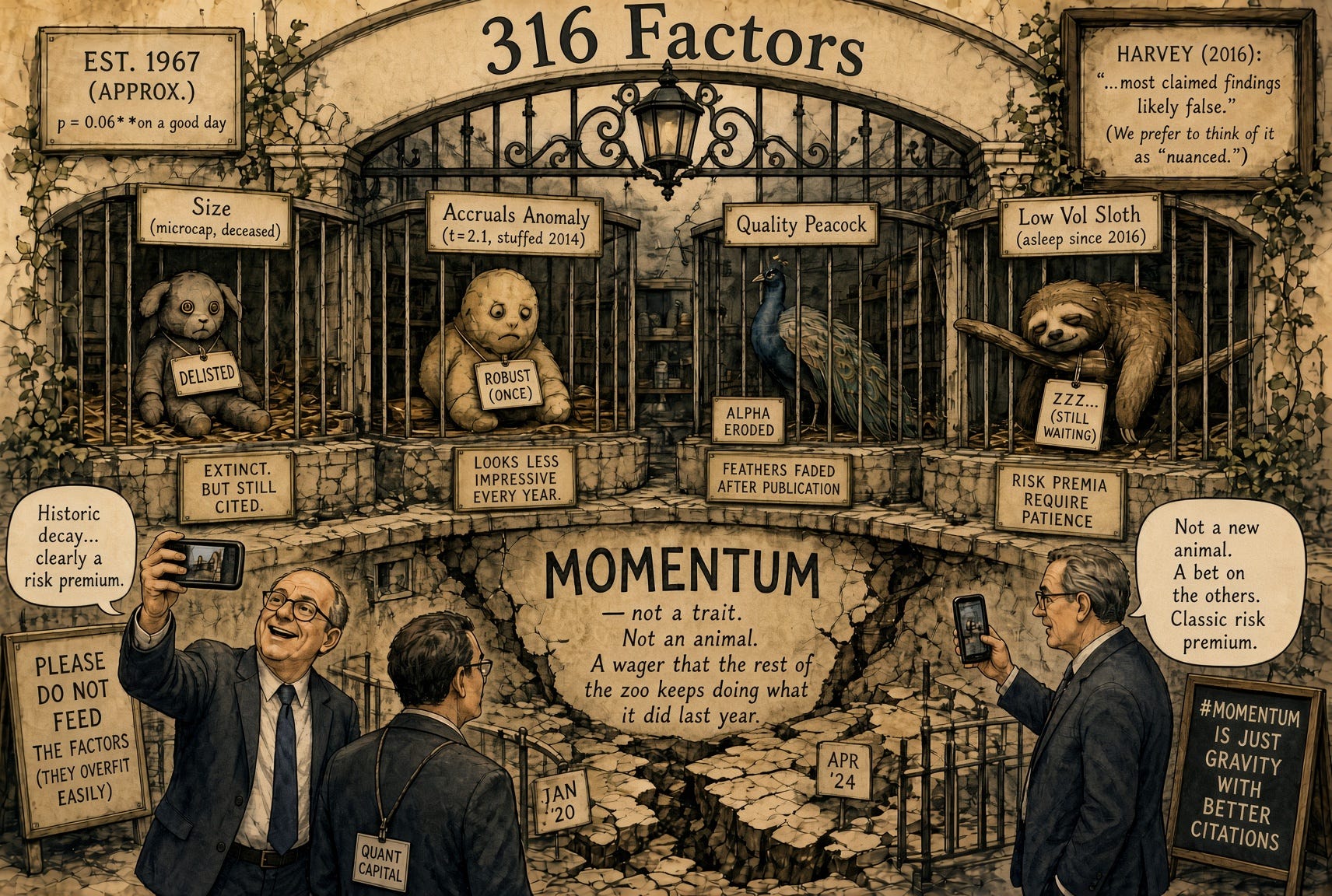
I said I’d win this with the survivor, so I’ll be quick about the junk. It has to be on the record, though, because it establishes that “clears the usual bar” means nothing here.
In 2016 Campbell Harvey, a past president of the American Finance Association, cataloged with Yan Liu and Heqing Zhu the factors proposed to predict returns, in the top journals and a selection of working papers. Between 1967 and 2014: 316 of them, the great majority clearing the customary t-statistic of 2.0. Harvey’s point was arithmetic: test hundreds of variables against the same data and some clear a t-stat of 2.0 by chance (that is what a one-in-twenty threshold means), so if you run enough, you harvest flukes by the fistful. Correct for the volume of testing and the real hurdle should be nearer 3.0, under which most published factors evaporate. His summary sentence, in a top journal, about his own field: most claimed research findings in financial economics are likely false. And the later replication work was harsher: Hou, Xue, and Zhang put 452 published anomalies through a sterner wringer (proper value-weighting, microcaps controlled, a multiple-testing hurdle) and watched most of them fail, the majority losing significance and a large fraction failing outright at the stricter bar.
Fine. The zoo is mostly overfitting, a monument to running t-tests until something twitches. But overfitting is a boring sin; everyone p-hacks. If that were the whole story, the lesson would be “use a bigger t-stat” and the factor model would limp on, chastened.
Before we let it limp, though, I have to say something as a recovering particle physicist, because Harvey’s number stopped me the first time I read it. His stringent, corrected, this-is-the-tough-new-standard hurdle is a t-statistic of 3. In the field I trained in, 3σ clears the bar we call evidence, the sort of bump that makes people look up from their coffee. But evidence is not discovery. Three sigma is where the room gets interested and suspicious in equal measure and someone says “take more data,” because three- and four-sigma signals evaporate often enough to keep physicists professionally twitchy; the graveyard of vanished bumps is enormous. The threshold to say you have actually found something is five sigma. Not two, not three: five. And the gap is cosmic. Physics counts one tail, so take these as one-sided: a two-sigma result is the kind of thing chance hands you a couple of times in a hundred tries; five sigma is a one-in-three-and-a-half-million fluke. Finance’s customary bar is that first one. Harvey’s tough, corrected, new-and-improved bar of three sigma is, by his own two-sided count, 0.27 percent, about one in 370, and one in 740 counted the physicist’s way: real evidence, genuinely better, and still not in the same postal code as what a physicist must clear before he may use the word discovery. And this is what turns a difference in taste into an indictment. We demand that five sigma even though we usually know the theory (the Standard Model tells us roughly where to look and what the bump should look like) and even though we blind the analysis: we scramble the data with a key, or box and hide the signal region, and we freeze every cut and every procedure before anyone is allowed to see the answer, precisely so the analyst cannot tune the test toward the result he is hoping for. Theory to guide the search, blinding to keep him honest, and still he needs that one-in-a-few-million before he may say he found something.
Now count what finance has. The theory on offer says premia are rewards for risk, names the market and a few state variables, and stays silent on the hundreds of factors the zoo actually contains: that is the reason there is no Standard Model of returns. Blinding is not part of the workflow: the researcher stares at the same data, tries specification after specification, and publishes the one that clears the bar. And the bar he is asked to clear, after Harvey’s correction, is thousands of times looser than the one a physicist submits to while enjoying every advantage the quant lacks. The field flying blind, with a theory that stops at the first few risks and its eyes wide open, helps itself to a standard of proof the field with a map and a blindfold considers embarrassingly weak. Everything is backwards. The less you understand your system and the more freely you rummage through it, the higher your burden of proof should climb. Finance runs the dial the other way.
That is the true state of the zoo. It isn’t the whole story either.
Before I swing, one paragraph of scope, because the careful practitioner deserves it. A factor model used as a risk model, a coordinate system for describing what a portfolio just did, decomposing its return into recognizable buckets after the fact, is genuinely useful, and I use it. I have no quarrel with coordinates; they are Wolfram’s reducible pocket. And a careful asset-pricing theorist is right that expected returns can vary through time and factor returns can have memory without breaking a single no-arbitrage equation; autocorrelation by itself refutes nothing. My quarrel is narrower and, I think, deeper than the usual fee complaint. It is with the belief that noticing a few coordinates has reduced the market: that the thing has a short, stable, complete description you can then trade forward, the way Intel briefly believed the fab reduced to the dozen dials it understood. That is the category error, and it is an error about reality before it is an error about marketing. You can sell coordinates as an engine, which is a swindle; or you can simply believe coordinates are an engine, which is a delusion. This essay is about the delusion. The swindle is downstream.
And the tell that the dials on offer are not the stable stack they were sold as is sitting inside the factor zoo’s best-replicated success.
The one that works, and what it actually is
Ask a factor skeptic and a factor evangelist to name the premium that has survived out-of-sample, across decades, across dozens of markets, across asset classes, the one everybody’s own data agrees on, and you get the same answer: momentum. Winners keep winning, losers keep losing, longer than they have any right to. It is the most replicated anomaly in finance.
Now look at what momentum is, because this is the hinge on which the entire Emperor swings.
The classic factors are characteristics, levels you read off a stock today. Book-to-market is a fact about the balance sheet. Size is a fact about the market cap. Low volatility is measured from return history, but it is still a level, a reading of how much a stock moves, with no opinion about which way. The theory is that the characteristic proxies some persistent risk or bias, and the premium is your pay for bearing it. Whatever you think of that story, it is at least a story about a trait.
Momentum is change, not a trait: the first derivative, a property of the stock’s recent motion. A momentum premium is the statement that last year’s return carries information about next year’s, that the past change predicts the next change. Now hold that against the pitch. The pitch sells a tilt: read the dial, lean toward the good setting, hold. Momentum says the reward for leaning depends on what happened last year. Nothing in the mathematics of asset pricing forbids that; a perfectly well-behaved process can have memory. But a premium you can only collect by watching the calendar is a different object from the standing reward the pitch described. It is the leftover motion after your factors have supposedly explained everything, the residual with a name tag. The supposed residual has a pulse.
A defender could shrug at that: one weird factor, call it a behavioral wrinkle. The shrug fails on the detail that makes this essay: momentum shows up three times, at three depths of the apparatus, and the deepest of the three is a strategy run on the dials themselves.
Three momentums, one confession
There is cross-sectional momentum: winners beat losers relative to each other. This is momentum dressed up as a stock characteristic, the version that fits, barely, inside the factor story.
There is time-series momentum (Moskowitz, Ooi, and Pedersen): an asset beats its own past, with no reference to the cross-section at all. An index, a currency, a commodity that went up tends to keep going up, measured against itself. It is a property of a series. The two are different trading rules on the same underlying tendency, and they are correlated, but they frequently come apart: time-series momentum fires in stretches when the cross-sectional version is flat, sags when the cross-sectional version is working, and carries a net directional bet that the dollar-neutral cross-sectional construction deliberately throws away. So “momentum” is already not one number attached to one stock, the way book-to-market is. It is a description of motion, and it reads differently along each axis you measure it on.
And then there is the one that detonates the building. Factor momentum (Ehsani and Linnainmaa, Journal of Finance, 2022): the factors themselves trend. The premia have memory. You can run a momentum strategy on the value factor, on size, on quality, on the very dials that were supposed to be the stable bottom of the whole construction. Momentum eats its own parents. And it is the main event: they find that momentum in the factors subsumes most forms of individual-stock momentum. The anomaly lives in the persistence of the abstractions built to explain the stocks, and only leaks into the stocks from there. “Most forms,” not “all,” and it hardly softens the blow: most of the corpse turning up in the library still makes the butler nervous. Their verdict, in their own words: momentum is not a distinct risk factor; it times other factors. The mechanism, also theirs: the autocorrelations in factor returns transmit into the cross-section through stocks’ factor loadings. Cross-sectional momentum is factor persistence, leaking one level down.
Read those three together and the picture is unmistakable. They are not three separate discoveries. They are one tendency, showing up at three depths of your model, and Ehsani and Linnainmaa show that the deepest level accounts for most of the shallowest. The stocks remember. The series remember. The factors remember. It is memory most of the way down, and cross-sectional, time-series, and factor momentum are the names you give it depending on which layer of your own apparatus you point the instrument at.
Which is the conclusion the pitch cannot survive, and I will be precise about what it is. None of this says factors do not exist; Ehsani and Linnainmaa write inside a factor model themselves. It says that the zoo’s best exhibit is not an exhibit of its own. Momentum was sold as one of the dials, beside value and size and the rest, and it turns out to be a bet placed on the others: a wager that whatever they did last year they will do again. Ehsani and Linnainmaa even hand you the epitaph: a momentum strategy, they write, profits when the factors remain autocorrelated and crashes when those autocorrelations break down. Sit with that. The best-replicated “factor” in all of finance is a bet on the persistence of everything else in the zoo. It pays you while the persistence continues and destroys you when it breaks. It is a wager on the other dials, not a dial of its own: priced, packaged, and sold back to you as a premium.
The best-replicated factor is a wager on the others. The Emperor’s one genuine garment is a mirror.
Why the dials move, and why nobody stops
Two questions remain. Do the dials themselves move, or do they only remember? And why, if the best-replicated factor is a wager on the others, does the industry keep selling the wager as a dial?
The first has a measured answer. In 2016 (busy year) R. David McLean and Jeffrey Pontiff tracked 97 published return predictors and measured what happened after each was published. Returns fell 26% out-of-sample, which they read as an upper bound on how much of the original finding was a fluke, and 58% after publication. The gap between the two, about 32 points, is their lower bound on the effect of publication itself, and their explanation, in their words: investors learn about mispricing from academic publications. You find an edge, you write it up, the market reads it, and the edge shrinks because you announced it. That is a dial moving with a named cause, and it is the one place in this essay where the word non-stationarity is earned: the process changed because someone described it. The act of writing down the reduction changes the system the reduction described. A fab does not read the trade press; silicon has no opinion about your model of silicon. A market is made of people, and people read the paper. Put the two results side by side. The dials shrink when you name them, and the one exhibit that has held up best is a wager on the others, and no dial at all. Neither is what the pitch deck describes.
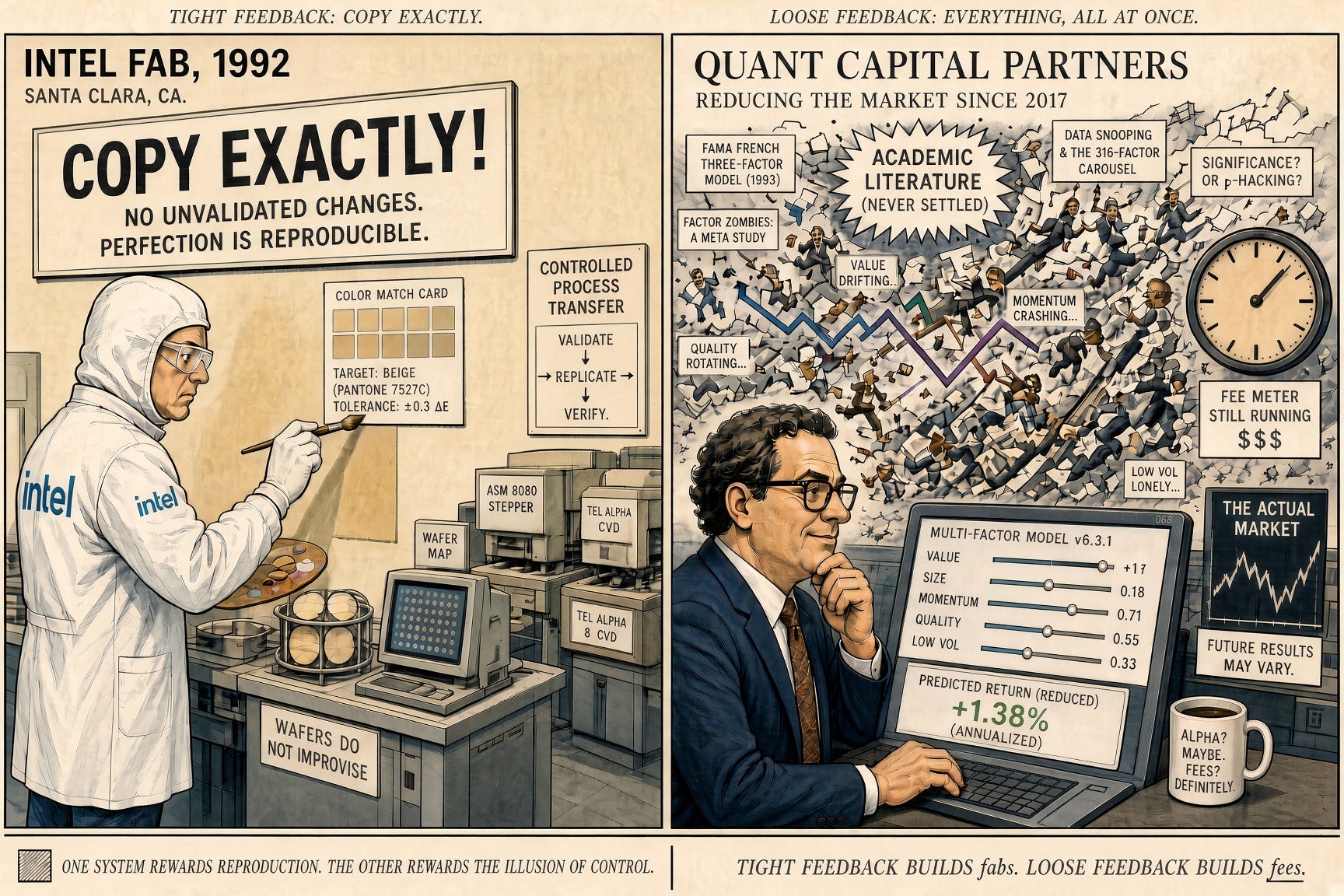
The second question is the one this series keeps arriving at, because I think it is the real one: who pays, and when? Two industries made the identical mistake, mistaking a system too tangled to model for one that reduces to a handful of dials, and one fixed it while the other put it in the curriculum. The difference is the feedback loop. When Intel’s engineer over-reduces the fab, the loop is fast and brutal and lands on him: wrong guess, dead wafers, this quarter, his name on the ramp. A tight loop is a truth-telling machine, and it produced Copy EXACTLY! within a few product cycles. When a quant over-reduces the market, the loop is slow, noisy, and lands on someone else, years later. The sponsor builds the strategy on a backtest that gleams (a backtest is the in-sample fit before the decay has had time to operate), sells it, and the fee meter runs: fifteen basis points in an ETF, a hundred and fifty in a shinier wrapper, always asset-gatherer real. And then, over the following decade, the thing quietly reverts, because the edge was partly a fluke and partly self-erasing. By the time the underperformance is undeniable, the money’s been managed, the fees banked, the sponsor’s moved to the next factor, and the client is holding a product that no longer does what the pitch deck promised. The loss is real but diffuse, smeared across years and clients, never landing hard enough on the person who caused it to force an Intel-style repentance. A tight loop breeds humility. A loose loop breeds a business model.
The strongest objection
I granted the careful practitioner his coordinates up front. He has one more objection, and it is the best one, so it gets the same care I gave the wasp in the chimpanzee essay.
It is this: value and momentum have been more durable than the “it decays when published” story predicts. Asness and others have shown them persisting across a century and dozens of markets, well after everyone knew. True, and it deserves a straight answer. But notice which survivors those are. One is value, which spent much of the last fifteen years in a drawdown deep enough to make “durable” do a great deal of quiet work. The other is momentum, whose survival is the whole point of this essay, because I have just spent it arguing that momentum’s durability is the durability of a bet on persistence. And that durability is self-limiting in exactly the way such a bet must be: momentum survives because it rides the crowd, and it crashes, spectacularly, precisely when the crowd reverses. Momentum investors remember 2009. Durable-until-it-suddenly-isn’t is what a bet on autocorrelation looks like from the inside: you get paid for the persistence right up until the persistence breaks, which is the one thing you can be certain it will eventually do.
So the honest scorecard reads worse for the factor model than “factors are fake.” Most of the zoo is overfitting; the dials that were real shrank when they were published; and the one exhibit that held up best is a wager on the others, whose durability lasts exactly as long as the crowd does. Every door leads to the same room. The category error is in believing that naming a few dials has reduced the market: that the thing has a short, stable, complete description that will keep working after you have written it down and everyone has read it.
It won’t. And the tell is the market’s own best-behaved factor, which turned out to be a bet on the others.
The joke, explained
Which brings me to the physicists in the back, and the parenthesis in the title.
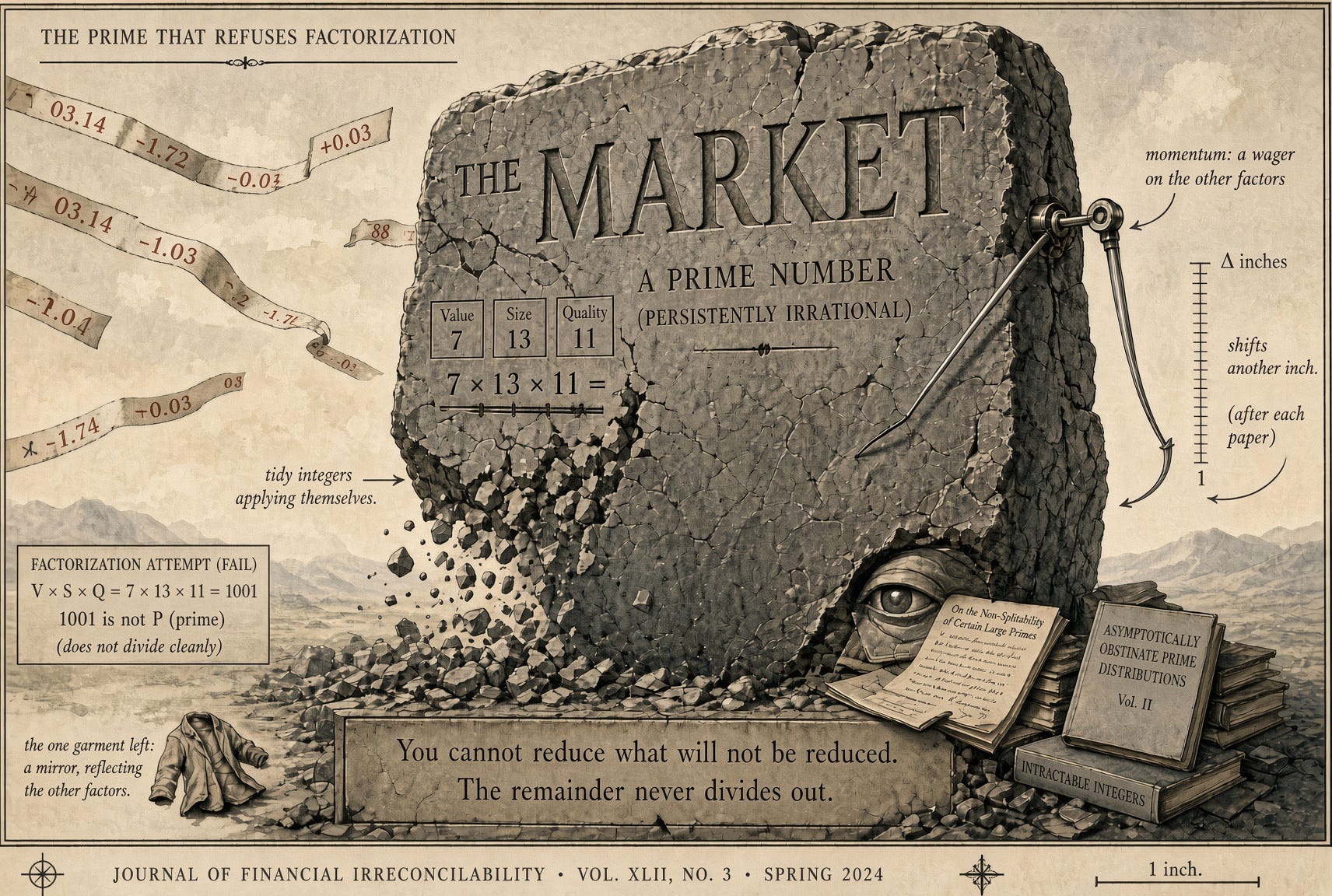
A number that breaks into smaller factors is composite. A number with no factors but itself and one is prime, the irreducible atom of arithmetic. You cannot decompose it, cannot express it as a tidy product of smaller pieces; you take it as it is.
Nobody has proved the market is prime, and I am not going to. What I can show is what every attempt to factor it has looked like. The factors on offer are mostly flukes. The real ones shrink the moment they are published, because this number, unlike any prime, reads what you write about it and moves. And the factorization that holds up best under testing is momentum, which is not a factor of its own; it is a bet on the other factors continuing to behave, which is to say a bet on the factorization holding. It is the remainder that never divides out. After sixty years of that, you are not entitled to call the number prime. You are entitled to notice that it has never once behaved like a composite. The whole enterprise of factor investing is an attempt to write a large, restless number as a product of five small ones, publish the five, watch them shrink on publication, sell them by the basis point anyway, and act wounded when the arithmetic won’t cooperate, when the term that survives the division best turns out to be a wager on the others.
The Emperor has no clothes. He also has no factors, or none anyone has found. And it is the same observation twice: you cannot sell a reduction you have not achieved, and the one thread you can still grab is not a garment. It is the market, mid-stride, walking out of the frame.
This is the fourth essay in the Emperor series. Read the first, The Emperor Has No Alpha; the second, The Emperor Has No Identification; and the third, The Emperor Has No Benchmark.
If you enjoy watching cherished stories audited down to the studs, my book, The Science of Free Will, asks an equally uncomfortable question about an equally cherished story. For more markets work, see Trading; the physics-minded will find its cousins in the Physics series. New here? Start with The Paradox of India and the full India series — and for related country-specific work, there’s Albion, Britain’s institutional decline, first spotted in 1979.
For more on the background behind this work, see my first and second interviews with Titans of Tomorrow, Part 2 of my Algorithmic Advantage Podcast conversation with Simon M., and my Diary of a Trader Podcast conversation with Dan on harnessing AI and chaos theory to find opportunities in market dislocations, and the psychology of risk management.