
Last week, in You Can’t Tax Scrooge McDuck, I made three claims and granted one courtesy. The claims: a fortune is claims on goods, not the goods themselves — you can no more tax Scrooge’s idle hoard into a bridge than you can eat a photograph of lunch. A flat statutory rate on capital hides an effective bite that grows with the horizon, under every architecture: 23.8% on annually taxed gains becomes 37% of a working life’s consumption and two-thirds of a century’s, while the realization system we already have quietly converges, through inflation alone, toward taking that same 23.8% of an asset whose owner never got a dollar richer. And a billionaire who burns his fortune makes everyone else fractionally richer — which tells you exactly what the fortune was, and was not, taking from you. The courtesy: I granted, and still grant, that the concern for the poor behind the wealth-tax proposals is entirely sincere.
This week the economists get their turn: the famous zero, the corrections that bent it, the strongest wealth-tax model in the literature, the one argument I cannot refute, what Sweden learned at the price of an estate — and, at the end, two Berkeley economists whose errors all point in the same direction. The compounding wedge, stated in plain English, is the famous result that economists argue about. So let’s argue about it.
What Chamley and Judd actually proved (and what they didn’t)
In the mid-1980s, Christophe Chamley and Kenneth Judd independently proved a result the rest of public finance would lean on for a generation: in a standard growth model, the optimal tax on capital income, in the long run, is zero. The intuition is exactly the compounding wedge I walked you through last week. A constant capital tax is an ever-growing tax on consumption the further out you look, so taxing capital is a spectacularly inefficient way to raise revenue compared with taxing the thing you’re trying to fund more directly.
For years this got flattened, by people who liked the conclusion, into a bumper sticker: the optimal capital tax is zero, science says so. It deserved puncturing, and the serious opposition punctured it. But watch what actually burst: the science says so, not the zero. Zero might still be the answer — whether it is, or whether the honest answer is merely low, is the question this whole post is chasing. Peter Diamond and Emmanuel Saez (about as credentialed as optimal-tax theorists get) argued in their “Case for a Progressive Tax” that capital income should be taxed, and that the Chamley-Judd zero-tax result is simply not policy-relevant. They are the strongest people on the other side, and it is them you have to answer, not the cartoon version.
So meet them. Notice what they actually deliver: a direction, not a magnitude. “Capital should be taxed positively” — but at what rate? The number, in their framework, hangs on the long-run elasticity of capital with respect to the net-of-tax return, and that elasticity is, in the literature’s own word, elusive — nobody has pinned it down. So the rate is left conveniently unspecified — hold that thought, because we will meet the genre it belongs to before the end. Diamond and Saez, to their credit, show their work and accept the constraints.
Then in 2020 Ludwig Straub and Iván Werning came at the question from pure theory, and “Positive Long-Run Capital Taxation: Chamley-Judd Revisited” did the field the larger service: they showed the zero-tax conclusion doesn’t survive inside Chamley and Judd’s own models. Under some preference specifications the optimal long-run capital tax is positive and significant; under others it converges to zero only after centuries. And they explicitly reject the argument that the ever-growing consumption-tax equivalence (my asymptote, in its formal dress) settles the question against capital taxation by itself. Their result does not repeal the wedge; it establishes that the wedge is one term in a welfare calculation, not the whole calculation. That sharpens the question rather than weakening it. The real fight is quantitative: how large are the countervailing forces in the economy we actually inhabit? That is a fight about magnitudes, which is where this essay has been trying to drag the debate all along.
The benchmark holds one more result, and this one argues for taxing wealth — which is exactly why it belongs here. Inside the model, the existing stock of wealth is the one thing that can be taxed without distortion — the past cannot respond retroactively — so a truly one-time levy on wealth already accumulated is the closest thing public finance has to a free lunch, and Diamond and Saez say so. The catch, which they also say, is the phrase one-time. A government cannot credibly promise the levy won’t recur. The first once-in-a-lifetime wealth tax is politically indistinguishable from the first installment of a series, and the moment savers expect a second helping, the lump-sum magic evaporates and you are back to taxing future saving with all the compounding machinery of last week’s essay. The free lunch exists only if no one believes you will ever eat it again — and no one ever believes that. Ask the citizens of any country that has ever levied a “temporary” income tax.
What the people who cheer all this miss — and it is the hinge of the entire post — is that positive is not the same as high.Diamond and Saez want capital taxed; Straub and Werning proved zero isn’t forced; incomplete-markets models find a positive optimum too. Grant every one of them. None of it repeals the wedge — it locates the exceptions, the places where the clean benchmark is too clean: finite lives, borrowing constraints, earnings uncertainty, the arbitrage problem we’ll get to. And with one exception, which I will meet head-on in a moment, none of those corrections pushes the optimal rate to where we tax labor, let alone to where the wealth-tax enthusiasts want to go. The disagreement among people doing the actual accounting is over how far above zero a low number sits. It is rarely between “low” and “tax it like a paycheck.” The economists are fighting over the first ten yards of the field. The political proposals are standing in the parking lot.
Now the exception, because it exists and it deserves better than a footnote. In 2023, Fatih Guvenen and coauthors published “Use It or Lose It” in the QJE, built on a fact the standard framework assumes away: returns differ persistently across people. Some entrepreneurs compound at twenty percent for decades; some heirs earn the T-bill rate on a fortune they didn’t build. Under a capital income tax, the productive entrepreneur pays more precisely because she produces more. Under a wealth tax, both pay the same on the same fortune, which shifts the burden toward the unproductive holder, nudges idle fortunes toward whoever can use them, and in their calibration produces a positive optimal wealth tax, at rates in the neighborhood of the real-world proposals, with real efficiency gains. Use it or lose it. With persistent return heterogeneity, a wealth tax can be a selection device. It is the strongest sophisticated case for a wealth tax. The theorem stands. Implementation is another matter. The tax authority observes asset values, not entrepreneurial productivity, and valuation discounts, leverage, private-company appraisal games, and plain mobility scramble the intended selection badly — a tax designed to dislodge unproductive owners tends in practice to dislodge the most liquid and transparent ones, which is roughly the opposite of the intent. Sweden, as we’ll see shortly, ran that experiment. And one twist from inside their own model: the reason wealth taxation looks attractive there is that capital-*income* taxation is significantly more distorting — the best pro-wealth-tax paper in the literature agrees that taxing the return is the thing you must not do. The wedge survives even in the model built to escape it.
The newest entrants — a cluster of automation-era optimal-tax preprints, Nakatani’s among them — mostly reinforce the pattern while demonstrating its fragility: depending on the version, the instrument mix, and the substitution elasticities you feed them, the same modeling family produces optimal capital rates anywhere from near zero to the low thirties, alongside a robot tax that keeps coming out at or near zero. I cite none of it as proof of anything. The instability is itself the instructive part: the optimal number is wildly model-sensitive even where the intertemporal wedge is not — which is the entire thesis of this essay.
That’s the thing about a conservation law. You can come at it from any direction you like. It’s still there when you arrive.
So why isn’t it zero?
Because of the single best argument for taxing capital — an argument I want to hand you at full strength, because it is the reason the true number is low rather than literally nothing. I owe the sharpest version of it to Tyler Cowen:
I used to favor a zero tax rate of capital, but I no longer hold that view. There are too many options for reclassifying labor income into capital income and thwarting the purposes of the tax system altogether. Nonetheless, subject to this constraint, I think taxes on capital should be as low as possible.
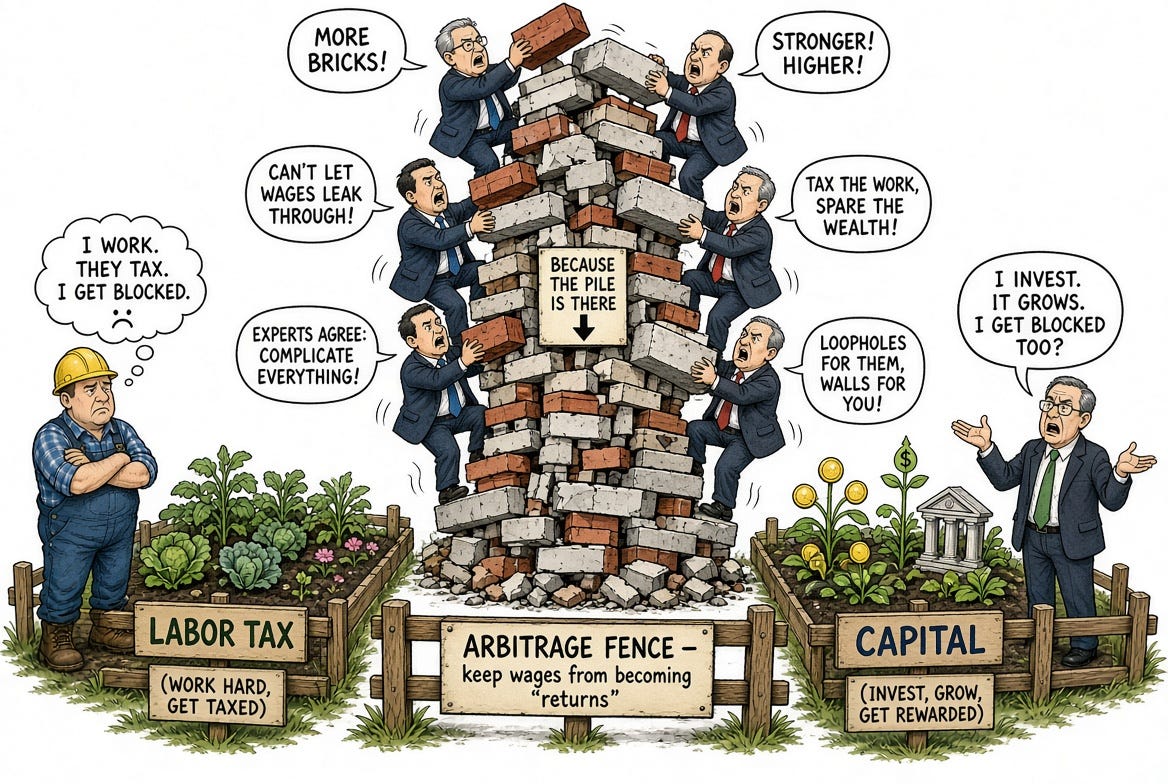
It goes like this. Suppose you set the capital rate to zero while taxing labor at forty percent. You have just handed every high earner who can plausibly incorporate a standing invitation: stop calling your income wages and start calling it a return on your equity. Form the LLC, pay yourself a distribution instead of a salary, and watch your tax rate fall by half. The line between labor income and capital income is not a wall of nature; it is a lawyer’s construction, and a zero capital rate next to a high labor rate puts an enormous bounty on erasing it. The labor tax base would hemorrhage from the top down. So you need a positive tax on capital, not because the optimal-tax mathematics wants one (it wants roughly zero), but as a fence around the labor tax: high enough that relabeling wages as returns isn’t worth the lawyer, the LLC, and the audit risk.
This is a serious argument. It is also, note, an argument I made myself, years ago, as the one caveat to the two-extremes case — that absent some rule or some small tax, workers will incorporate and rebrand their paychecks. Cowen states it better than I did. But the fence argument delivers less than it seems, so let me be exact about what it does deliver. It sets the rate from below — it does not, by itself, set it low. How high the floor sits depends on how cleanly the law can separate wages from returns: tight rules on owner-manager compensation, payroll-tax integration, and organizational form keep the floor low; sloppy rules, next to a forty-percent labor rate, can push it uncomfortably high, because the fence must be tall enough to beat the lawyer. What the argument does establish, unconditionally, is the purpose of the positive rate: it exists to protect the labor tax base, not to soak the pile. A fence, not a confiscation — and the fence’s height is a question of legal drafting, nothing grander.
Now look where that lands. The optimal-tax literature sets the ceiling: it starts from the benchmark’s zero, and the corrections (finite lives, incomplete markets, Straub-Werning) raise the defensible rate by amounts everyone agrees are contested and most agree are modest — so the ceiling sits low. The arbitrage argument sets the floor: the rate cannot sit at zero without the labor tax base leaking out through the LLC door — so the floor sits above zero, at a height that depends on legal drafting. Neither bound is a single number. But look at what both directions agree on, because it’s the thing the proposals deny: the rate is set by specific, nameable mechanisms (the wedge, the fence, the exceptions) and not by the size of the pile. Nothing in either direction says “there sits a great fortune; take a bite because it is there.” The bite-because-it-is-there theory is the one theory with no model behind it. That is the convergence, and it is enough.
The inversion
Now put the pieces together, and watch the wealth tax turn inside out in your hands.
The intuition that animates the tax is that the rich are sitting on a pile withheld from everyone else, and the tax claws some of it back for the common good. Every step of that is wrong. The pile, to the extent it’s a genuine hoard, is already a gift — withheld from no one, because unexercised claims feed everyone else’s claims exactly as a bonfire would. And to the extent it isn’t a hoard, it isn’t a pile at all — it’s deployed capital, the productive machinery whose returns set tomorrow’s wages, and the tax is a compounding wedge driven straight into it.
So this is what the tax actually does, granting its champions every ounce of the sincerity I promised them. It reaches past the harmless, self-donating hoard — which it can’t really touch and wouldn’t help anyone by touching — and it lands on the deployed capital instead. It shrinks the capital stock over time (how much depends on saving elasticities, capital mobility, and where the revenue goes, and the models disagree about the size), and a thinner capital stock pays lower real wages, and lower real wages fall hardest on exactly the people who own no capital and have nothing but their wages: the future poor. The size of the shift is model-dependent; its existence is not, and it is not zero merely because the tax bill bears a billionaire’s name. The policy aimed at the pile misses the pile and hits the future low-wage worker, through the one channel, the wage-setting power of the capital stock, that the champions of the tax never put on the slide.
And now the other end of the pipe, which never makes the slide either. Capital is deferred consumption; that is the premise this whole pair of essays runs on. So look at what the revenue actually buys. Federal R&D, the closest thing the budget has to a line that builds the future, runs around three percent of outlays, and roughly half of that is defense. The overwhelming mass of federal spending is Social Security, Medicare, Medicaid, other transfers, and interest on the debt. Present consumption, nearly all of it. That is no accusation — consumption is the entire point of an economy; the only reason to defer any of it is to do more of it later. I am not calling Social Security waste. I am calling the accounting dishonest. The machine takes deferred consumption in at one end and pays present consumption out at the other, at a compounding loss in between, and the loss lands on whoever will be doing the deferring later. That is not a metaphor. It is a description of the two ends of the pipe, available from the outlay tables. Pretending the trade is free — that you can move consumption from the future to the present and pay nothing in foregone growth — is the shared vice of the whole debate, left and right alike, and the most popular defense of the capital tax, that the money buys something that grows, is an argument about three cents on the dollar.
The exceptions are real, and they get their due. Some transfers really are investment: the work on the marginal value of public funds finds certain child-directed programs with returns high enough to pay for themselves several times over. And most public capital that does grow the future (roads, schools, universities) is built at the state and local level, not by the federal government a wealth tax would fund. And yes, revenue is fungible: the marginal dollar wears no name tag, and a capital tax funding a high-return childhood program is a different bargain from one funding undifferentiated present consumption. But composition is destiny in expectation: when ninety-seven cents of the existing dollar buys present consumption, the sensible prior on the marginal dollar is not “this one’s different.” The federal base is old-age transfers and interest, and those are present consumption however worthy.
There is a joke buried in the ledger, too. The fastest-growing line in the federal budget is net interest — compensation for lending, yes, but follow the composition: it flows to bondholders, which is to say to the holders of capital. The state is already writing checks to the very people the wealth tax is aimed at, and it is writing bigger ones every year.
The billionaire with a match makes everyone fractionally richer. The capital tax makes the future poor poorer, in the name of helping them. The bonfire is a better philanthropist than the tax bill, and it isn’t close.
One real complication remains, and it deserves full strength. Some top-end wealth really is low-velocity: art on a freeport wall, raw land held purely for appreciation, the empty trophy apartment. That looks more like the bin than the factory, and there the harmlessness argument is weaker. But two things. First, it’s a small slice of the relevant base; the overwhelming mass of great fortunes is equity in operating companies, not Picassos in a vault. Second, even on that slice, a wealth tax mostly distorts the composition of what people hold rather than raising clean revenue. And the one genuine exception, the asset whose supply truly can’t flee the tax, is land, which is the entire Georgist insight and has been sitting in plain sight since 1879. If you want to tax something inert and unproductive without the compounding catastrophe, tax land. That is a serious argument. “Mark Elon’s shares to market every April” is not that argument, and the people making the second one rarely have the courage to make the first.
What Sweden learned the hard way
One more objection needs answering, because it is the reflexive one, and a certain kind of American politician reaches for it constantly: but Scandinavia. The Nordic countries are held up as proof that you can soak capital and wealth and thrive. So look at what they actually did, as opposed to what they are imagined to have done.
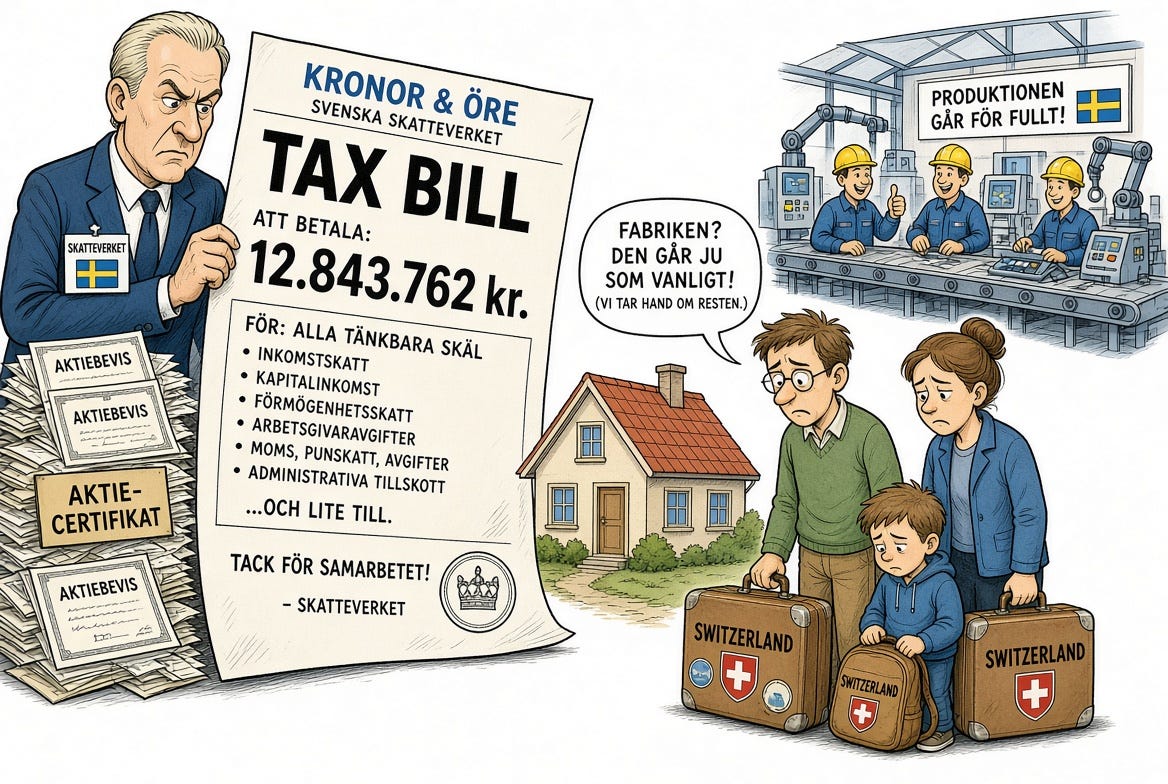
They are not socialist. They are open, capitalist, free-trading economies that happen to run high taxes on income and consumptionto fund generous welfare states — which is a real choice with real trade-offs, but it is not a tax on capital. And on the specific question of taxing accumulated wealth, the region ran both arms of the experiment, which is more useful than either alone. Sweden walked away entirely: it abolished its inheritance and gift tax in 2004, by unanimous vote of the Riksdag (when the Boxing Day tsunami killed hundreds of Swedes days after the vote, the repeal was even backdated so that the victims’ estates would escape it) and abolished its wealth tax three years later, in 2007, reforms begun under a Social Democratic government and finished by the center-right one that followed. Norway abolished inheritance tax in 2014 but kept its net wealth tax, roughly one percent a year at the top, and has spent recent years watching a well-publicized procession of its wealthiest founders decamp for Switzerland, taking their tax bases with them. Denmark alone of the Scandinavian three still levies an inheritance tax; Norway alone still levies a wealth tax, and Norway’s experience with it is the cautionary half of the tale. The supposed socialist heartland ran both arms of the trial: the country that repealed is fine, and the country that kept is the case study in exit.
And they repealed it not on theory but on a corpse. Sweden’s inheritance tax kept doing the precise thing the deployed-capital argument predicts: because great fortunes are equity in operating companies, not coins in a vault, the tax repeatedly forced heirs to strip liquidity out of working businesses, or dump shares, just to pay it. The canonical case is almost too on-the-nose. When Sally Kistner (widow of Erik Kistner, the largest individual shareholder in Astra, the pharmaceutical company that would one day become half of AstraZeneca) died in 1984, her roughly 300-million-krona estate was mostly Astra stock. The top inheritance rate of 65% applied, and because the heirs would have to sell shares to pay it, a capital gains tax of almost 26% stacked on top: a combined bill near 90% before a single share had moved. Then the shares moved. The market understood the heirs would have to dump a large block, anticipated the flood, and the price fell — and the falling price dragged the total tax bill above the entire value of the estate. The estate was declared insolvent. The tax was larger than the thing it taxed. And note what did not break: Astra sailed on — it’s the Astra in AstraZeneca — because the company was never the problem. What broke was the estate, the family’s holding, and the incentive of anyone watching to keep concentrated ownership of a productive Swedish company inside Sweden. “Taxing the pile” never touched the factory. It destroyed the holder, and it taught every other holder the lesson.
And it didn’t just eat that estate; it exported the next one. When Fredrik Lundberg, today one of Sweden’s wealthiest industrialists, emigrated to Switzerland in 1985, he pointed to the Kistner case by name as his reason for leaving. He was not the only one; Ingvar Kamprad of IKEA and the Rausings of Tetra Pak had already gone, taking their companies’ futures with them. The tax didn’t redistribute the pile. It chased the pile out of the country and bankrupted the pile that stayed. The Swedes watched it happen often enough that the left decided it wasn’t worth it.
That is the mechanism above, running live. One ruined estate and a procession of emigrants do not estimate an aggregate counterfactual — case evidence never does — but the aggregate estimate now exists, and it is worth quoting both halves. Jakobsen, Kleven, Kolsrud, Landais, and Muñoz, using Scandinavian administrative data, find that a one-point rise in the top wealth-tax rate shrinks the stock of wealthy taxpayers by about 2%, and that the businesses of the owners who leave are measurably damaged. The exit is real, and it takes firms with it. The authors call the aggregate losses modest: two-hundredths of a percent of employment, a tenth of a percent of value-added, per percentage point of tax. Put a ruler on that adjective before accepting it. A tenth of a percent of value-added is, at American scale, roughly thirty billion dollars, and it recurs every year the tax stands, growing to the extent the missing investment compounds the capital stock downward. Set that against what the tax would actually collect (Summers and Sarin’s twelve to forty cents on the advertised dollar) and the recurring loss is the same order as the realistic revenue. Transplanting Scandinavian elasticities to America is heroic, so hold the number loosely; but hold it, because it is the honest one. The direction is theirs and it is certain. The adjective is theirs too. The compounding is ours.
Why they sweep it away
Which brings us, finally, to the rug.
None of the findings above is fringe. The wedge is freshman arithmetic; Chamley-Judd is in every graduate textbook; the corrections are published in the field’s best journals; and what they jointly establish is not a number but a burden of proof: each capital tax must justify itself through a specific, nameable mechanism, because the one theory none of them supports is take-a-bite-because-the-pile-is-there. Is the optimal rate exactly zero? Almost certainly not. But it is far closer to zero than anyone who loves capital taxation will say out loud, and the one model that reaches proposal-scale rates depends on the tax authority observing what it cannot observe. So why does the political conversation price capital taxation as if the optimum were high and the mechanism question settled, when the literature says neither? Ask the proposers which model backs their rate. Go ahead. I’ll wait.
Crickets.
And when I say the policy comes first, I am not guessing at anyone’s soul. I am reading the residuals. Any hard empirical problem forces dozens of judgment calls — which income concept, whose incidence assumptions, what counts as a transfer — and an honest researcher’s calls scatter: some flatter the thesis, some wound it. Random errors have no favorite direction. So look at the published record of Emmanuel Saez and Gabriel Zucman, the Berkeley economists whose numbers carry the wealth-tax movement. Their top-income series has been reconstructed from the same tax data by Gerald Auten of the Treasury and David Splinter of the Joint Committee on Taxation and comes out far flatter once taxes and transfers are counted. Their book-length headline — billionaires pay lower rates than secretaries — required excluding the refundable credits that do the most work at the bottom of the distribution, and reversing the corporate-incidence convention their own QJE paper had used the year before. Two switches, both moving the headline the same way. Their revenue score for the Warren wealth tax — a proposal they themselves developed, advised, and, in Lawrence Summers’s own words, “played a major role in developing and validating” (author, advocate, and referee in a single chair) came in, per Summers and Sarin, at somewhere between a tenth and four-tenths of the advertised figure once valuation, avoidance, and enforcement were priced in. Each call, taken alone, is defensible, and their fights are live — Piketty, Saez, and Zucman have rebutted Auten and Splinter, and the rebuttal is now itself being defended — so I am not declaring a winner on the measurement. I am pointing at something that requires no winner: the sign. Every disputed judgment call leans toward the conclusion. In my trade that is called a systematic error. Random mistakes cancel; these compound, and always in the same direction. None of this requires bad faith. I granted sincerity at the top of this pair and I am not taking it back, because motivated reasoning does not feel like lying from the inside; it feels like being right. But the direction of a bias term is not a feeling. Twenty judgment calls, twenty heads. Draw your own conclusion about the coin.
Because the result is inconvenient for the stated goal itself, and that is the one thing harder to look at than an unfair tax. An honest redistributionist could say “tax capital heavily, accept the efficiency cost, call it fairness” — and reasonable people could weigh that trade. But the arithmetic doesn’t offer that trade. It says the heavy capital tax makes the future poorer, and the future poor poorest of all. There is no billionaire-versus-everyone-else ledger to balance here; there is only a present-versus-future one, and the tax is on the wrong side of it. So the result goes under the rug, and the rug is woven entirely out of good intentions.
I’ll grant the good intentions. I said I would, and I meant it. But good intentions are not a conservation law. They don’t suspend the arithmetic. A wedge driven into a compounding quantity grows without bound no matter how kind the hand on the hammer, and the future worker whose wages it lowers will not be consoled to learn it was done out of concern for him.
You cannot tax Scrooge McDuck. If his bin is full of idle gold, you cannot take anything from him at all: as Part 1 showed, his consumption was zero before the seizure and zero after, so beyond the psychic sting of a smaller pool to swim in, he is untouched. What changes is that the government now consumes more — and since the goods are the goods, everyone else consumes less. The tax on the idle man is paid, to the last dollar, by everyone who is not the idle man. If you carry one sentence out of this pair of essays, carry that one. If his bin — like every real fortune — is deployed in the world building the things the rest of us use, then taxing it is a slow tax on the future, falling hardest on the people with no bin of their own. Either way you miss the duck. The only question is who you hit instead.
It is almost always someone who couldn’t afford to be hit.
You Can’t Tax Scrooge McDuck is Part 1 of this pair — the duck, the arithmetic, and the bonfire. If you found the terminal-accounting move useful, it’s the same one I ran on the wealth-management industry in The Conservation Law of Tax Alpha — different pile, same conserved quantity, same trick for finding where it went.
This piece is one argument out of a book’s worth I’ve already written up — a whole manuscript of economics done this way, from first principles, following the arithmetic wherever it goes. If you happen to be a literary agent and any of this is your kind of thing, get in touch. I have no appetite for firing proposals into the void; the void, as far as I can tell, is managing perfectly well without them.
My book, The Science of Free Will, asks an equally uncomfortable question about an equally cherished story. For the India series, start with The Paradox of India and the full collection; for Britain’s long institutional decline, first seen in 1979, there’s Albion.