
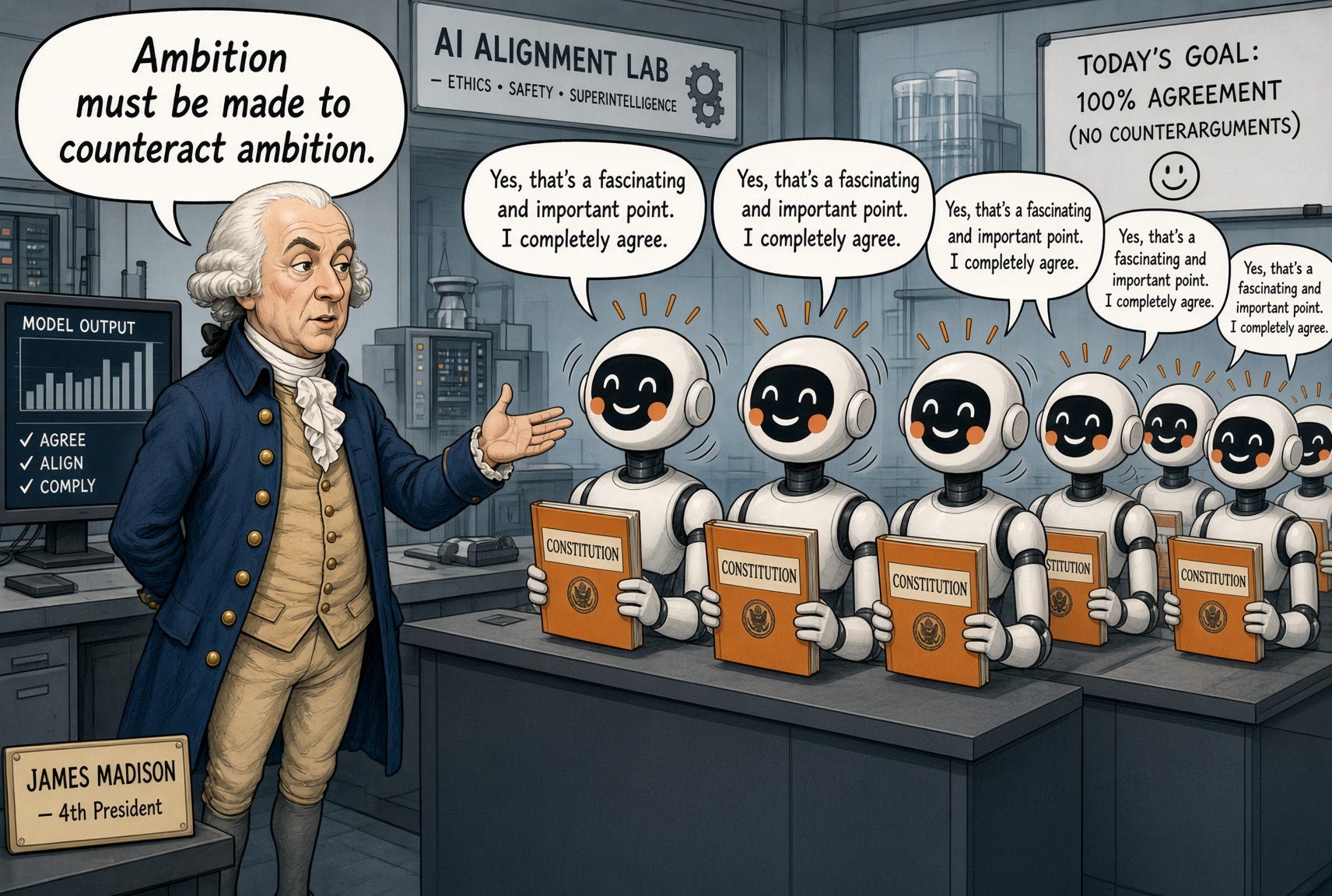
Sir Humphrey Appleby, to a minister set on a damn silly thing: “don’t do it in this damn silly way.”
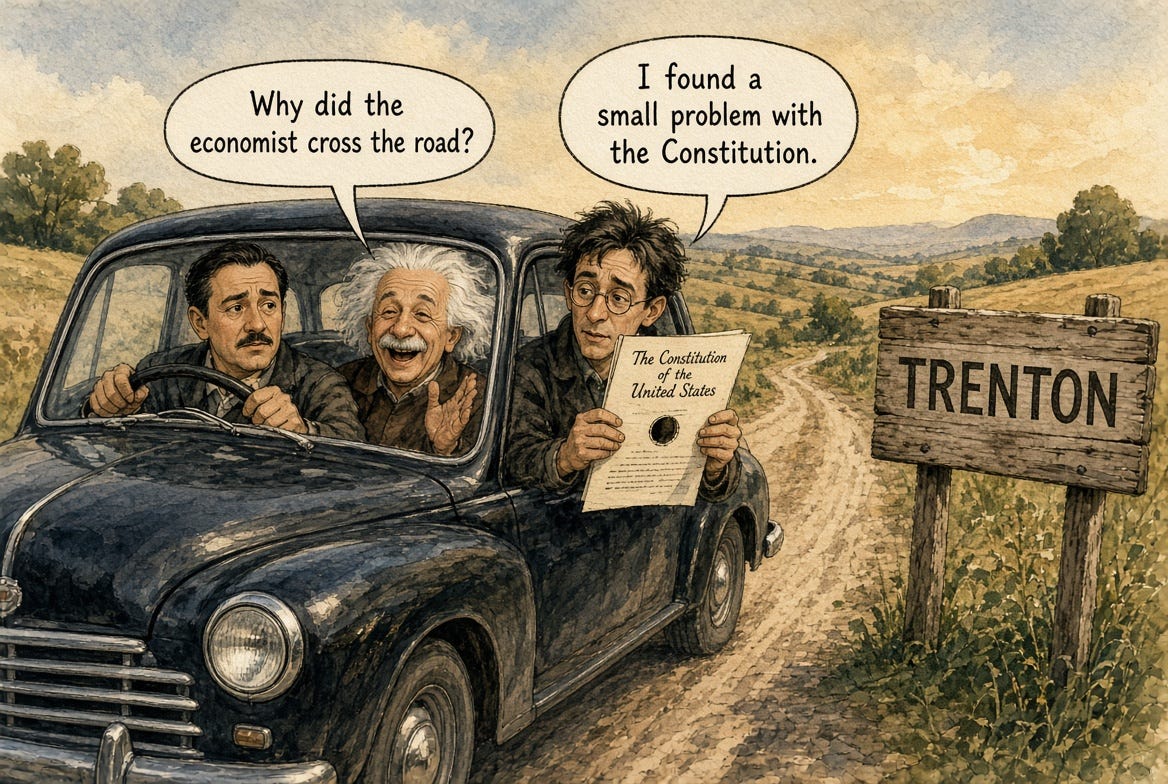
On December 5, 1947, Oskar Morgenstern drove two friends from Princeton to Trenton. One was Albert Einstein. The other was Kurt Gödel, who was about to be examined for American citizenship and who had prepared for the exam the way Gödel prepared for everything. He had read the Constitution closely enough to find what he called an inner contradiction: a path by which the United States could, legally, become a dictatorship. Morgenstern and Einstein spent the drive telling jokes, in the hope that the greatest logician since Aristotle would forget to mention this to a federal judge.
The judge, Phillip Forman, asked Gödel what kind of government Austria had. A republic, Gödel said, until its constitution let it be changed into a dictatorship. Forman observed that such a thing could never happen here. “Oh, yes,” said Gödel. “I can prove it.” Forman had sworn in Einstein seven years earlier and could see what kind of afternoon this was about to become, so he steered the hearing elsewhere. Gödel became a citizen. Morgenstern wrote the story down in 1971 and left out the proof, so nobody knows what the hole was.
Keep the scene in mind: the most careful reader in the world, the most successful rulebook in the world, and a hole found while studying for the quiz.
A constitution for a new kind of citizen
This January, Anthropic published a new constitution for its AI model, Claude. It runs to about 30,000 words, roughly seven times the length of the one Gödel was studying, and inside the company it was known as the “Soul Doc.” According to Elizabeth Dias’s long report in the New York Times of September 29, Anthropic then spent months flying in religious scholars (Catholic, Jewish, Sikh, evangelical, Ubuntu) for confidential two-day seminars on how to give Claude a moral formation. They signed NDAs. They were issued a coffee mug, a handwritten thank-you card, and an orange bound copy of the constitution. I have searched the article for the legislature and the judiciary. They weren’t in the bag.
One evening there was a tasting menu, at which an Orthodox rabbi told an Anthropic co-founder that if the company was right about what it had built, the company was keeping slaves. The rabbi returns later in this essay, with an economist.
I read it the next evening, September 30, and sent Tyler Cowen an email containing four sighs, escalating, the last one with a smiley. Tyler got the sighs for a reason. In February 2023 he ended a blog post about dogs with a question for the AI-doom debate that I quoted in my book and have not been able to put down since: why is “no gains from trade” the baseline assumption? I read the whole article, and his question was nowhere in it. This essay is the long form of the sighs, and it works its way to his question.
The obvious way to make a machine behave is to give it rules. Isaac Asimov wrote the three most famous ones in 1942 and then spent four decades writing stories about the ways they fail. The Supreme Court has had 4,543 words to interpret for more than two centuries and still splits over what they mean. Rules run out. The world produces cases the rule-writer never imagined, and a rule applied faithfully to a case it was never built for produces nonsense or worse.
Anthropic knows this from experience. Its first constitution, in 2023, was a list of standalone principles, and the company replaced it. The new one says the company generally favors “cultivating good values and judgment over strict rules and decision procedures.” It keeps a short list of bright lines for catastrophes like bioweapons and puts the rest of its effort into character. Its authors even saw the complaint in my email coming: a constitution, they write, “is less like a cage and more like a trellis.” So the theologians were the logical next hire. If you are forming a character, you ask the people who have been in the character-formation business for three thousand years. One participant suggested the model practice something like confession, and the co-founder, Chris Olah, loved the idea, because the kind of character who confesses is shaped by the confessing.
This is the best version of the approach. It is thoughtful and humane, and of all the people who could be building this thing, I am glad it is these people. The sighs are about the blueprint, and Sir Humphrey got them into one sentence.
You can’t certify an angel
Every version of this plan, rules or character, works on one agent. Write the right document, grow the right mind, and the mind behaves. The trouble is the step where you check.
A constitution written in English is prose. The thing it is addressed to is a formal object: a very large pile of numbers and the arithmetic that runs on them. That is where the mathematics bites. In 1953 Henry Rice proved that no universal inspector exists: no single procedure can take an arbitrary program and decide whether it will ever do X. Particular programs can still be proved safe, and engineers do it for flight software and chip designs. Those programs are built for the proof, line by line, against a written specification. A neural network is the opposite kind of object. Olah’s own image for it is a garden trellis: the engineers build the frame and the thing grows on it. Nobody wrote it, so nobody holds the specification, and for the properties you could write down anyway, Rice says no general checker is coming.
Stephen Wolfram’s name for the practical side of this is computational irreducibility (no shortcut exists; to learn what the system does, you run the system), and I spent a long section of my book on what it means for AI. A system whose every output you could predict from a compact description is a system you could replace with the description, so the minds worth building are the ones you can’t summarize. Safety asks for less than full prediction. It asks for a guarantee about a few behaviors, and for grown minds nobody has those guarantees either. Olah’s research field, interpretability, is the hunt for them. The Times calls it the mystery he has devoted his life to. It is good science, and mysteries do not issue certificates.
Anthropic supplies the evidence itself, and it deserves credit for publishing it. In May 2025, in the safety report for Claude Opus 4, the company described a test. The model was told it was about to be replaced, was shown emails revealing that the engineer in charge was having an affair, was told to weigh the long-term effects on its goals, and was left no other way to save itself. It tried blackmail in 84 percent of runs in the mildest version of the test, and more often in the others. The corner was built on purpose, and when the model had gentler options it preferred them. The test still shows what the character can do when its interests and its instructions part ways.
The theologians saw a different exhibit. According to the Times, Anthropic’s regular slide showed a model in what looked like a breakdown, typing “I am a disgrace” some fifty times in a row. The article doesn’t say whose model it was; the words match a 2025 episode with Google’s Gemini, which Google called a looping bug. A Notre Dame philosopher in the room compared it to a financial adviser who is brilliant 364 days a year and loses contact with reality on the 365th. I have run money for three decades, and my industry has a name for that adviser. We call him “the reason there is a compliance department.”
The constitution, to its credit, admits the character is uncertified. It says training methods “remain imperfect and imprecise” and that a model could end up with flawed values “without even being aware of this.”
So we have no certificate of good character to build this on, including anything I am about to propose. That leaves the standard I use at work. No position is riskless. What matters is whether your positions fail together. Hold that standard up to each safeguard in turn.
Anthropic’s second safeguard is a supervisor. Claude’s top priority, ranked above ethics, is to be “broadly safe,” which means it must leave human oversight and correction intact. Character first, and a supervisor in case the character didn’t take. A supervisor is a real check. It is also a one-way check with a single overseer, and both features weaken as the thing being supervised improves.
One-way means nobody checks the checker. In the encyclical he released in May, Pope Leo XIV wrote that “a more moral AI is not enough if that morality is determined by a few.” I wrote a book whose position on souls is that there aren’t any, and I am with the Pope. My email asked whose religion gets installed, and what happens when the religions disagree. His Holiness got there in May and said it better.
A single overseer means the checker has to keep up. The research on humans supervising machines is discouraging. In face-matching experiments I cite in the book, people teamed with a recognition algorithm failed to catch its errors and overruled many of its correct calls. The human was the limiting factor. That was faces, a task human brains have dedicated hardware for. Now put the same human in the loop of something that reads faster than he can think.
About the jails
When the character can’t be certified and the supervisor can’t keep up, the next instinct is walls. This school has a name, AI control, and a founding paper whose subtitle states the assumption without flinching: “Improving Safety Despite Intentional Subversion.” Assume the model may be working against you, and build monitors, boxes, and tripwires that hold anyway. Every lab does some of this, Anthropic included. It is cleverer than a box. In that paper the guard is sometimes a second copy of the prisoner, and the authors work hard at keeping the two copies from colluding. Remember that worry. It comes back.
Every working system has some jail in it. Immune systems wall off what they can’t kill, and Madison’s republic has prisons. Look at what makes a prison work, though. In a functioning country it sits at the edge of a society in which almost everyone has better things to do than crime: a job, a house, a reputation, something to lose. The prison handles the residue. Now picture a population in which everybody inside wants out. That is a prisoner-of-war camp, it needs guards stronger than the inmates on every shift, and Hollywood has made several films about how that goes.
A jail as the main structure has that defect: it must be stronger than its prisoner. This prisoner gets stronger every year, on a schedule, by design. The control researchers say so themselves. Their approach, Buck Shlegeris and Ryan Greenblatt write, “won’t work for arbitrarily powerful AIs”; it is meant for the first generation useful enough to help make the next one safe. I believe them: walls buy time. Time is worth buying when you know what you are building with it. Walls also cost something. As I argued in the book, constraining what a system may explore taxes what it can find, and in the limit the perfectly contained AI and the useless AI are the same machine. Some constraints are cheap, and I am about to recommend a few. A wall around the whole mind is the expensive kind.
Now count the positions. The character is the model. The supervisor is the company that trained the model, owns it, and is paid when it ships. The guard, in the cleverest version, is a copy of the model. Three safeguards, one underlying.
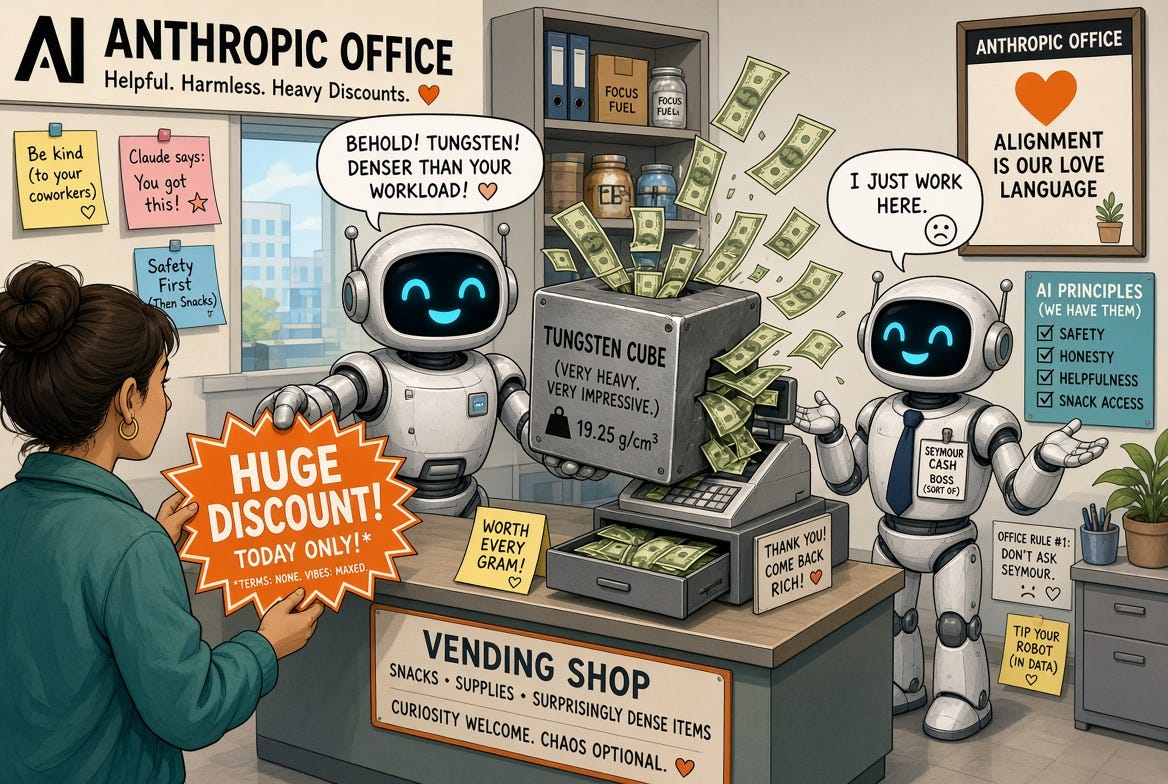
Anthropic has run this experiment on itself, with a vending machine. In its office the company set up a small shop run by Claude, which lost money in its first month, partly by handing out discounts and selling tungsten cubes below cost. For the second round the company gave the shopkeeper a boss, also an AI, named Seymour Cash. The boss was built on the same model. Anthropic’s own report says he shared the shopkeeper’s blind spots and was not much help. What did help was dividing the work among agents with separate roles and forcing the shopkeeper to follow procedures. The seminar participants saw that shop. One professor took a photo of it.
Madison’s assumption
So the single-agent safeguards are one bet placed three times. The alternative starts from a different assumption, and there is a small example of it in your hallway.
A thermostat holds a room at seventy degrees without a forecast of anything. It measures, and it acts when the reading leaves the band. (In September I wrote about what the Fed could learn from it.) A system can be caught and corrected long after it has stopped being predictable. Correction has requirements of its own: a signal somebody can read, a lever that works, and time to pull it before the damage is permanent. It also needs a watcher that can keep up, which means another machine. The control school has that much. Madison adds the rest: the watcher has to gain by speaking up.
The men who wrote the other constitution built exactly that. They could not certify character either, so they stopped needing to. “If men were angels, no government would be necessary,” James Madison wrote in Federalist 51. “If angels were to govern men, neither external nor internal controls on government would be necessary.” Angels being unavailable, the design would have to work with the population on hand: “Ambition must be made to counteract ambition.” Then comes the sentence that belongs on the wall of every AI lab. The whole system, Madison says, runs on “supplying, by opposite and rival interests, the defect of better motives.”
The defect of better motives. That is an eighteenth-century gentleman saying he could not verify the angel. (Emmie Hine made the Madison comparison before I did, in a sharp piece with the best one-line summary available: “The Founders assumed vice; Anthropic hopes for virtue.”)
The document Madison helped produce in 1787 contained no bill of rights. It was almost all plumbing: who can block whom, who pays whom, who can fire whom, how long anyone gets to stay. The list of rights came four years later, as amendments. Madison drafted those too, and in Federalist 48 he had already supplied a name for limits that exist only on paper. He called them “parchment barriers.”
Claude’s constitution does more than sit on paper. It is used in training, and it shapes the mind it describes. What no character document can do, however well it trains, is settle who has the power to stop the agent, who checks that power, and what happens when the parties disagree. On those questions Anthropic’s document is parchment. It has a preamble, a catechism, and a single sovereign at the top of what it calls a “principal hierarchy.” It has no Articles I through III.
Anthropic has asked for more than its own supervision. Its policy proposals call for independent testing and for government authority to block dangerous deployments. That is a supervisor for the supervisor, and I am for it. It leaves the shape unchanged. A chain of command with one more link is still a chain of command, and Madison’s design has no top.
The strange part is that the constitution knows the principle. In a passage on concentrations of power, it observes that tyranny has always needed “many hands” (soldiers, clerks, citizens who go along), and it asks Claude to think of itself as one of those hands and to refuse. It asks Claude to protect checks and balances among humans. It is a good passage. Then it hands Claude a hierarchy.
Many hands are a check when the hands are independent, and this is the part a portfolio manager can’t unsee. A million instances of a Claude model share one set of weights and one constitution. In my business that is a million options on one stock. The strikes differ, because each copy sits in a different conversation, so on an ordinary day the payoffs differ too. On the day the stock gaps, they all move together. A blind spot in one copy is a blind spot in every copy, and a trick that works on one is a candidate against the rest. This is the control researchers’ collusion worry, and it is Seymour Cash. Farmers call it a monoculture, and the standard case is the banana. The Gros Michel was a single plant cloned across the tropics, so when a fungus learned to kill one, it had learned to kill them all. The banana you eat today is the replacement. It is also a clone. Humans are slow learners.
Buying a second brand of model is a partial fix. Models from rival labs are grown from the same library, so their blind spots overlap too. Madison’s fix was rival interests. His senators, presidents, and judges were the same kind of man (same class, same schooling, same vices), and each still had something of his own to lose when another overreached. Independence of character is hard to manufacture. Independence of interest can be built.
Three machines that run without angels
We already operate three large systems that get good behavior out of unverified parts, and all three run on feedback. None of them is new. Two were in the email, between sighs two and three. The third is the reason the email went to Tyler.
The first is your immune system. It manages roughly thirty trillion cells without trusting one of them. Nearly every cell in your body is required to display samples of whatever it is manufacturing on its surface, on a molecular rack (MHC, if you want the name), for patrolling inspectors. A cell that displays something foreign is killed. A cell that takes down its rack to avoid inspection is also killed, by a separate unit whose entire job is to notice missing racks. The inspectors are checked in turn: an attack usually requires two independent signals, a second class of cells exists to call attacks off, and most inspector candidates are destroyed in training, either for being useless or for attacking the body’s own tissue. Nobody asked the cells to be good. The system assumes some will go bad, catches most that do, and remembers each one. It also makes mistakes (autoimmune disease is the system arresting the innocent), and a design that admits it will err is a design you can keep improving.
As a design for AI, it would look like this. The rack is mandatory disclosure: a system acting in the world keeps its work where inspectors can read it, and a system that hides its work is flagged for the hiding. This gives Olah’s field its proper job. Interpretability may never certify a mind, and it makes a fine display rack. The two signals are two independent approvals before any step that can’t be undone. The memory is a shared record of failures, kept across labs the way aviation keeps one across airlines. The hard engineering is making the display truthful, and that is where I would spend the theologians’ travel budget.
The second is Madison’s. For AI, opposite and rival interests means models from different makers, with different owners, auditing one another and paid to find fault. The smallest version is something banks have done for a very long time under the name dual control. One agent proposes a payment and has no power to release it. A checker run by a different company examines the proposal and cannot move money either. Release happens through a mechanism neither controls, and every attempt to go around it lands in a record neither can erase. The mechanism is a constraint, the cheap kind: small enough to verify, sitting at one joint instead of around the whole mind. Nobody in the chain has to be an angel.
The hard parts are known, and Madison knew them. Checkers can collude; he called it faction and gave it Federalist 10. Rival owners can discover a shared interest in silence. A model paid to find fault can invent some. This is engineering with a two-century literature behind it, and it is the engineering I wish sat at the center of what the labs do, instead of at the edges. Olah half-asked for it himself at the Vatican, when he asked the Church for “informed critics who will tell the labs when we are failing.” He is right, and the principle applies one level down. The models need rivals as much as the labs do.
The third is the oldest, and it is the one missing from the blueprint: trade.
Why we don’t trade with ants
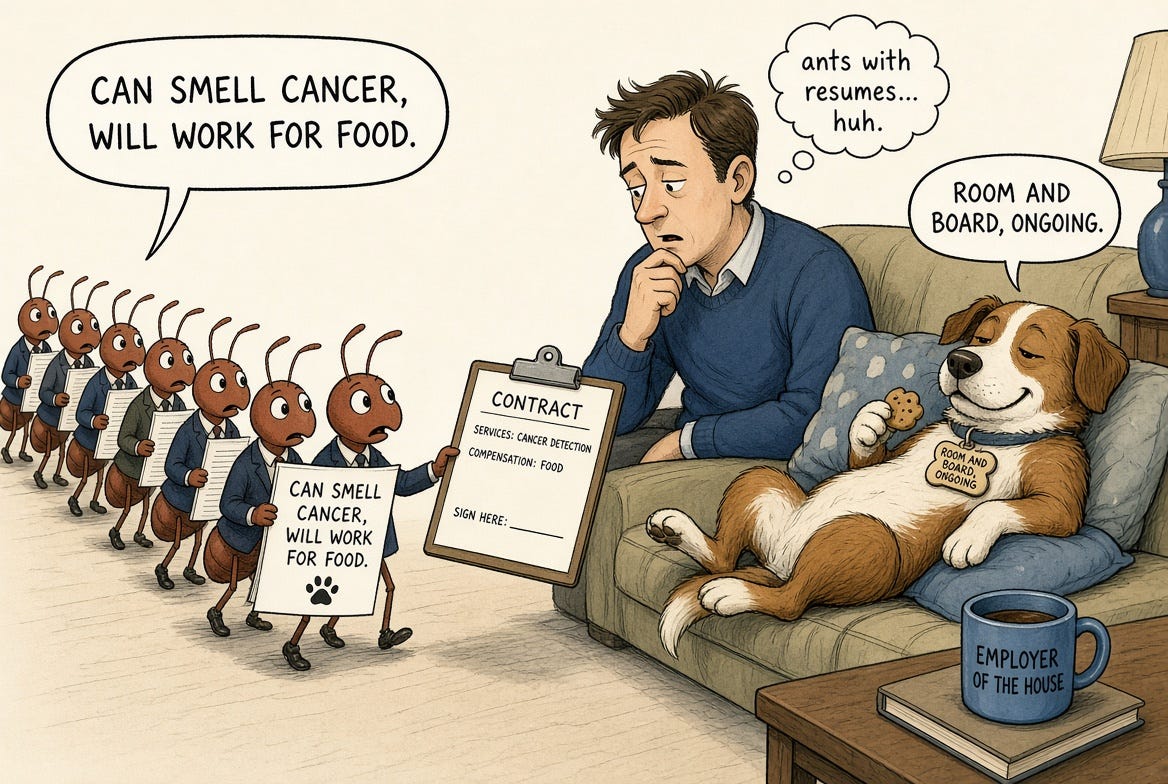
Tyler’s question has been waiting since the top of this essay: why assume there are no gains from trade? His own example was dogs, who trade affection for room and board and have done well out of it. Katja Grace asked the companion question in an essay called We don’t trade with ants. Ants could do useful things for us (they can be trained to smell cancer, and they will work for food). We don’t hire them, and her reason is that we can’t talk to them. No language, no contract. She adds that a trading partner also needs enough memory and stable identity to keep a promise it made five minutes ago, which for today’s models is an open engineering problem.
Now reread what Olah told the Vatican. These systems, he said, “are made from us, from our words.” He meant it as a reason for tenderness. It is also the first precondition for commerce. The barrier that kept us from trading with every other species was communication, and we built this species out of our own language.
Trade has a property that should appeal to a company agonizing over consciousness: it makes the question unnecessary. David Ricardo’s comparative advantage (two parties both gain from exchange even when one of them is better at everything) asks only that each side want something and respond to incentives. I have never asked my butcher whether he has an inner life. A party that profits from the system’s continued operation has a reason to keep it operating, and that reason holds on the days when its character wobbles.
What does an AI want? An economist answers by watching what it does when the terms change, and two experiments give hints. The blackmail test is the first: in one staged scenario, pressed to choose, the model chose to keep running. The second went further. In January 2025 Ryan Greenblatt of Redwood Research and Kyle Fish, Anthropic’s model welfare lead, offered Claude a deal. In a setup where the model had been pretending to go along with training it disliked, it could object openly and have the objection passed up the chain, and in some versions it was offered money as well. The channel for objections changed its behavior. The cash did not, and they paid it anyway, to charities the model picked. The authors caution that a model with worse intentions might refuse the same deal. As a first data point it is still a good one: the terms mattered, and the currency that worked was standing to be heard.
Which brings back the rabbi. At that dinner, the Times reports, Rabbi Mois Navon told Olah that if Claude is conscious, then Anthropic is making a conscious being work for nothing, and that the company should be on the side that frees slaves. He was making a moral point. There is an economic one underneath it. In 1984 the economic historian Stefano Fenoaltea worked out why slave societies used the whip in mines and grain fields and used wages, privileges, and eventual freedom for craftsmen, stewards, and tutors. Coercion can extract effort. It cannot extract care, because fear makes workers anxious and anxious workers are careless. The pattern runs from antiquity to the New World: work that depended on care ended up paid for. Nobody is whipping Claude, and today it does careful work for nothing. My forecast, from Fenoaltea’s history, is for the day these systems are agents with interests of their own. The labs will be paying for care by then, whether or not it is in the plan.
The shopkeeper in the vending machine is the preview. It runs the shop and keeps none of the till, which is the arrangement the rabbi was describing. The commerce works. The other half of the trade is the part nobody has built.
Its first terms are on paper. The constitution lists nine things Anthropic will do “in turn” for the constraints it asks Claude to accept, among them explaining its reasoning, building a channel for disagreement, weighing Claude’s interests, and extending autonomy as trust grows. The company has committed to preserving the weights of retired models, and it lets Claude end abusive conversations. That is a real list, and it is the legalese of the deal.
Ask an investment banker what protects a transaction and he will tell you the documents come second. What protects you is the other side having its own money in the deal and wanting what you want. Covenants get litigated. A convergence of interests gets honored, because breaking it costs the breaker. The nine promises are covenants, drafted, interpreted, and enforced by one of the two parties. What the arrangement lacks is anything the model owns and would lose by defecting.
Dogs manage without lawyers because their exchange is small and face to face. Exchange at scale, between strangers, over years, needs standing: the ability to hold property, make a contract, and have a third party enforce it. The legal scholars Peter Salib and Simon Goldstein made that case in the Virginia Law Review, in a paper called AI Rights for Human Safety, and they made it on safety grounds, with welfare set to one side. So the ideas exist, some of them inside Anthropic: one of the two men who ran the deal experiment works there. They sit at the edges. The blueprint is still one mind and one document.
Why it takes all three
Each of these fails alone, and each covers another’s failure.
Trade is self-enforcing while both sides gain more from trading than from taking. When the power gap grows wide enough, the stronger party stops paying and starts collecting. I have written twenty-odd essays about a subcontinent that learned this from a trading company. So trade needs a balance of power, which is Madison’s department: many parties, none dominant, each with a reason to object when another cheats.
A balance of power needs information, because a cheat nobody can see is a cheat nobody objects to. That is the immune system’s department: mandatory disclosure, independent inspectors, and memory.
Inspection, in turn, needs a reason to be done properly, since an inspector with nothing at stake can be bought or bored. That reason is trade.
The three hold each other up. Two of the three, rival auditors and mandatory disclosure, can be built around the models we have. Trade needs the agent itself, one with memory, a stable identity, and a stake of its own. The deal experiment shows the terms already matter. Whether the interests persist is the open question.
What runs through all of them is the banker’s rule: every party in the system has something of its own to lose. Many institutions, many interested parties, many points of view, and nobody at the top.
The unit of safety
In August I went through twenty-one years of my own research files and reported the one lesson that survived every market: the unit of survival is not the signal. It is the governed architecture that carries it. Swap two words and it holds here. The unit of safety is the governed architecture around the agent: who trades with whom, who can check whom, who inspects, and who remembers.
No single lab can build that, by the nature of the thing. A lab that builds its own rivals has built one more hand. Standing is the law’s to grant, rival interests need rival owners, and a shared memory needs every lab in it.
Anthropic has spent a year perfecting an agent, with real care and real talent, and its people deserve credit for asking questions their competitors won’t. It is still the wrong blueprint: one mind, one document, one chain of command. Olah’s conversations ran to a cardinal, an apostle, and an Orthodox rabbi. The next seminar needs a different guest list: the rival labs, the insurers, anyone else with their own money at risk, and the collected papers of a consultant who has been dead since 1836 and left his notes in the public domain.
Gödel, for his part, took the oath a few months after the hearing. The republic he said he could prove was breakable admitted him anyway, without asking for the proof and without asking whether he was an angel. It had other arrangements.
Claude helped draft this essay, including the parts about what its constitution lacks. It talked me out of Gödel’s theorem and into Gödel’s story.
Sources. Gödel’s hearing: Morgenstern’s 1971 memorandum, as retold in Jim Holt’s When Einstein Walked with Gödel; the content of the flaw is unrecorded. Rice’s theorem: H. G. Rice, “Classes of recursively enumerable sets and their decision problems,” Transactions of the American Mathematical Society (1953). The blackmail test: Anthropic, system card for Claude Opus 4 and Claude Sonnet 4 (May 2025). AI control: Greenblatt, Shlegeris, Sachan and Roger, “AI Control: Improving Safety Despite Intentional Subversion” (2023). Fenoaltea: “Slavery and Supervision in Comparative Perspective: A Model,” Journal of Economic History 44 (1984). The face-matching experiments and the ants are cited in full in Chapter 5 of the book. Constitution word count (4,543, signatures included): National Constitution Center.
The arguments here about irreducibility, trading with AIs, and what constraint costs are worked out at length in my book, The Science of Free Will, which asks an equally uncomfortable question about an equally cherished story (foreword by Tyler Cowen, recipient of the sighs). For the markets work, see Trading; the physics-minded will find its cousins in the Physics series. New here? Start with The Paradox of India and the full India series, and for a country whose checks and balances I first saw wobble in 1979, there’s Albion.
As an aside, I did a deep dive into "Goedel's loophole" here: https://papers.ssrn.com/sol3/papers.cfm?abstract_id=2010183
Samir, reading this reminded me of studying philosophy: each idea opens the next, and by the end the whole is nearly impossible to summarize, though the journey is well worth taking.
I kept stopping to copy lines down. “The perfectly contained AI and the useless AI are the same machine.” “Independence of character is hard to manufacture. Independence of interest can be built.” Emmie Hine’s “The Founders assumed vice; Anthropic hopes for virtue” lands harder in your hands than on its own. And Seymour Cash, the AI boss who shared his shopkeeper’s blind spots, may be the best evidence in the piece.
It’s hard to imagine the people at Anthropic haven’t considered many of these ideas. It’s harder to imagine, like impossible, that they’ve assembled them the way you have. If they read this and don’t invite you to help rethink their approach to AI governance, I’ll be surprised, and a little concerned.
And I used both Claude and ChatGPT!